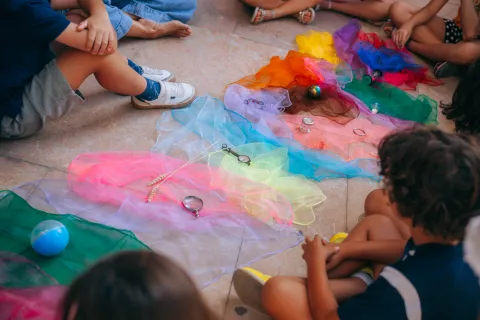
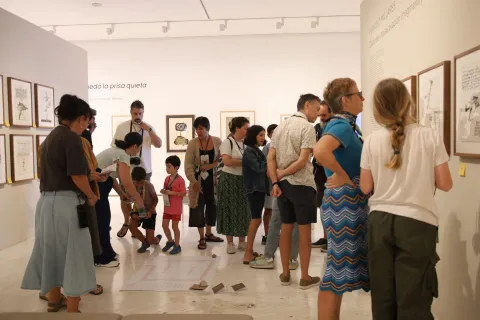
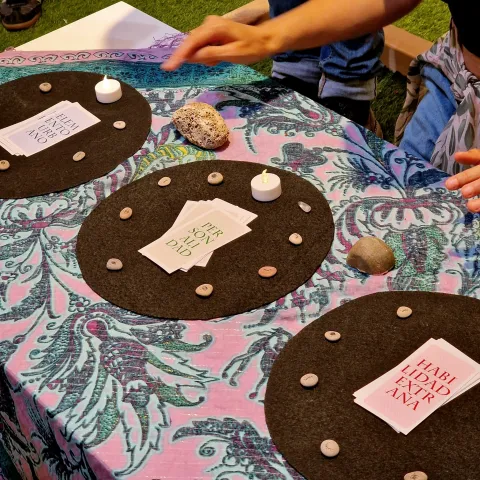
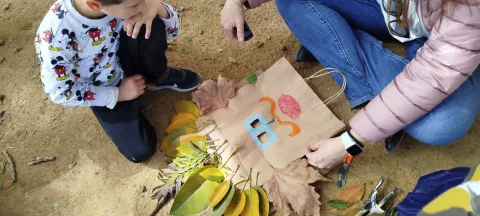
We were coming from the previous session, MutaPlantas, very pleased with the feeling of having discovered the concept of "myths of the future", "Fed up already with past mythologies, we propose a future mythology, to dream with…" we said in the previous report. And that pushed us to continue in this session with that idea, because talking about desirable futures is a proactive attitude towards change, and if the fabulation of the mythical origin of things helps us understand the present, imagining retroactively the path towards the future from a myth created within 500 years, which looks at the past (our present) and mythically fabulates its present (our future)… it can be a very powerful tool of speculative fiction!
–But how do we do it? –we asked ourselves.
The "hall of mirrors" and kinetic art
This session was going to be special, because it coincided with the DIM – International Museum Day. And to hold a session focused on the interior of the museum, we decided at the time that it would be on its 3rd floor, where the kinetic sculptures of Eusebio Sempere rest. "The hall of mirrors", we said. We had already talked about the oval that floats in the museum's vestibule in the Arborescent session, fabulating its changing reflections and its geometry of rods repeated in space. So on this occasion we decided that the attendees would create myths that look towards the future using the qualities of kinetic art as a creative activator. Kinetic art or kineticism is an artistic movement that integrates physical-spatial movement as a compositional element: the real physical movement of the work, the movement of the eye over the piece and the physical movement of the spectator cause the works to transform, change their appearance and their relationship with space. They also use light as a plastic element, transform it and use it to create spatial effects and transform the surrounding space, and the phenomenon of optical perception creating visual rhythms, the superposition of ambiguous geometric forms and dynamic luminous perception. Furthermore, Eusebio Sempere has a very special relationship with the museum: his donation of a contemporary art collection was the trigger for converting the old Casa de la Asegurada into the current Museum of Contemporary Art of Alicante. Sempere almost made the museum appear with the works he brought with him, he placed them in a place and around them a Museum grew (with architectural reforms and later expansions). That image of the power of a work of art not only to transform the surrounding space, but to create it! was wonderful, so we began there!
The MACA presents the largest Kara Walker exhibition held to date in Spain. The exhibition, which can be visited until September 7, is curated by Rosa Castells, and offers a journey through her trajectory over the last four decades. Kara Walker is one of the most prominent artists of her generation and one of the most interesting figures in the international art scene, with a complex body of work that analyzes, in sometimes chaotic scenes, issues of race, identity, power and desire used always as systems of oppression and subjugation, across centuries and continents.The exhibition brings together the numerous works by Kara Walker present in the Michael Jenkins and Javier Romero collection at the MACA. It consists of 44 pieces that cover part of her trajectory and constitute one of the most complete sets of the artist's work existing in European institutions. Here are displayed drawings, prints, sculptures, artist books and one of her most recent videos, a total of 31 works donated in ownership to the MACA in 2021 and 13 pieces deposited in 2024 for this exhibition that have traveled from New York. Her work addresses themes of violence, identity, race and sexuality in the context of the still-present psychological wound caused by the tragic legacy of slavery, presenting a critical vision of the historical past and examining racial and gender stereotypes in our current society.Known for her work of paper-cut silhouettes, inspired by the historical tradition of Victorian shadow portraits, shadow theater or magic lanterns, Walker uses, in works of great formal beauty, the language of satire and archetypes to reveal the contradictions of the concept a nation has of itself, while casting a very lucid subversive gaze on the historical-artistic allusions that influence her works.Through drawing, printmaking, sculpture, video and installation, the artist explores the representation of the notion of race in modern and contemporary art, as well as the need to establish new narratives that challenge the way we look at and understand history. The images in Walker's work, drawn from both historical realism and the fantastical space of the imagined, seduce through their emotional rawness, the intellectual force they contain and their extraordinary visual beauty.
The Mitolatorio began its journey in April 2020. During the pandemic, it functioned as a digital collaborative map of contemporary myths. It was a way to stay connected with the outside world, redefining public space from our homes.One of the pillars of the Mitolatorio has always been urban redefinition, because reviewing our emotions about public space empowers us within it, because paying special attention to it makes us more aware of its peculiarities, and it helps us value all elements of the public and urban landscape by placing on the samelevel the architectural (a building with an emblematic façade), the vegetal (the tree in the plaza where we played) and the human (the neighbor who always sat on the same park bench), among others. We believe that this perspective can becomeradical in an unexpected way if it is carried out from the perspective of a work from the Museum previously seen, smelled, and creatively discussed.The mediation of the works and places will be based on carrying out creative actions with them as objects, to promote critical and expanded observation of the work and subjective, bodily and also critical exploration ofurban space. To the significant power of the work-place binomial we thus add two contributions: that of the practices of mediated plastic creation from the workshops and laboratories of María Maraña, and that of the techniques of proprioceptive exploration and identity fabulation from the interactive practices of Sergi Hernández.
The Michael Jenkins and Javier Romero Collection is an extensive international exhibition that documents the broad range of formal and conceptual research investigations that characterize modern and contemporary artistic practice. The extreme vari...