Exiled Thought. Ana Teresa Ortega

Submitted by brandcode_deweloper on
Contemporary Art Collection of the Valencian Generalitat

Ana Teresa Ortega is the 2020 National Photography Prize winner. The jury has recognized one of the artists who has most contributed to making photography a form of contemporary art. Her work is guided by an investigative will regarding the limits and possibilities of photography as a hybrid language, which dialogues with three-dimensionality and is in constant reflection.

Her work freed photography from the documentary function that dominated the medium until the seventies. Her early works experimented with visual rhetoric using the medium and montage techniques, especially with her photosculptures from the 1990s. In the early decades of the 2000s, Ortega understands photography as a tool for constructing collective memory and history, and her images invoke another time in which forgotten past and history that never was can appear.

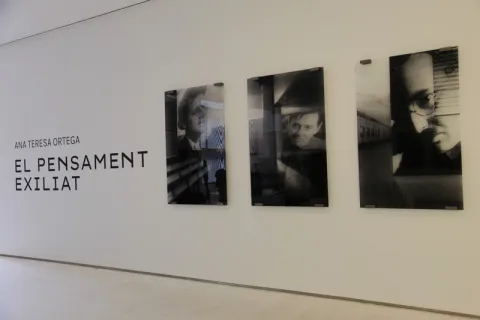
This is what happens in Thinkers (2002), where reflection on the intellectual heritage of the twentieth century and its transmission become image. Through a play between installation and photomontage, projections of writers' faces are photographed on empty architectural spaces. The images show these portraits, extracted from encyclopedias, on facades, interior walls, hallways or in doorways and stairwells: the enlarged face of Walter Benjamin is cut off at the corner of a factory; the gaze of Ángel Valente is framed between cement pillars; Joyce seems to sigh, pensive, long like a venetian blind.

The series consists of 24 images of projected portraits, from Zambrano's Z to Arendt's A, and forms an inverted alphabet of the century's intellectual legacy, with one peculiarity: all the portraits belong to exiled thinkers. Writers reluctant to the social, political and cultural environment of their time, who saw in writing the place and refuge to express their discontent with the world. Their committed writings reflect freedom, intelligence and hope, and their different conceptions of the world remain alive in our memory today.

The photographs were taken in suburban spaces, because they speak of thought in the margins, a metaphor for the physical or psychological confinement that all of them suffered. It is about thinking exile. Not about bringing back those who left—perhaps they were never present—but about invoking them as lost. And doing so through photographs of projected photographs of a third photograph that is the encyclopedic portrait, with a reflection on the trace: photographs, as imprints of light, are the trace and form the trail of that which is exiled in memory: an exile of light. To look at the gaze of Valente, Joyce and Benjamin and think about their trace. As if the past were not dead. As if it were not even past.

This work belongs to the Art Contemporani Collection of the Generalitat Valenciana. Since 2017, the Ministry of Education, Culture and Sport has maintained a line of acquisition of artworks with the dual purpose of stimulating the contemporary art market, while also gathering a collection of works representative of the artistic present in our Community. Different generations and sensibilities that approach the artistic creation process, offering new perspectives on your closest world.

EXPO-0052
Imagen
IMG_8790.jpg
Rosa María Castells
Col·lecció Art Contemporani de la Generalitat Valenciana

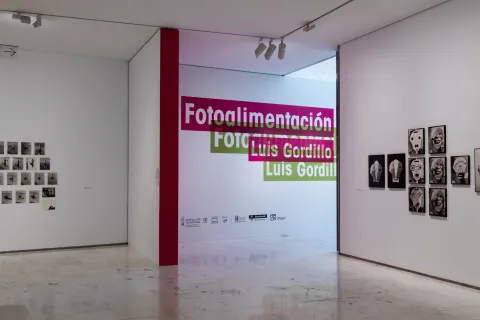
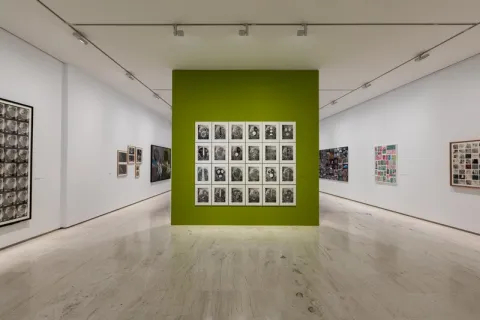
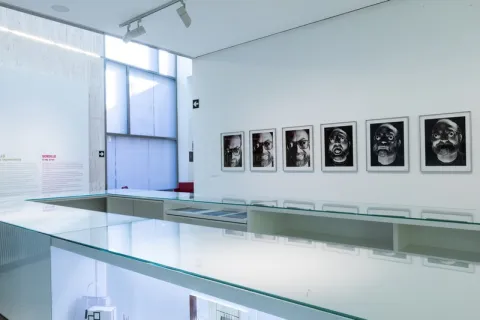
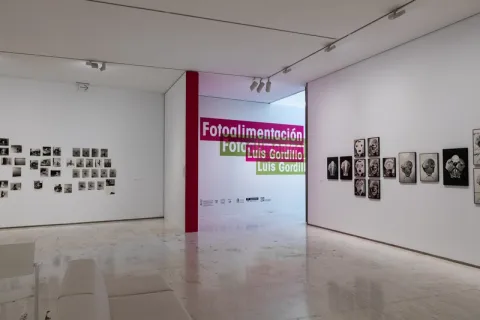
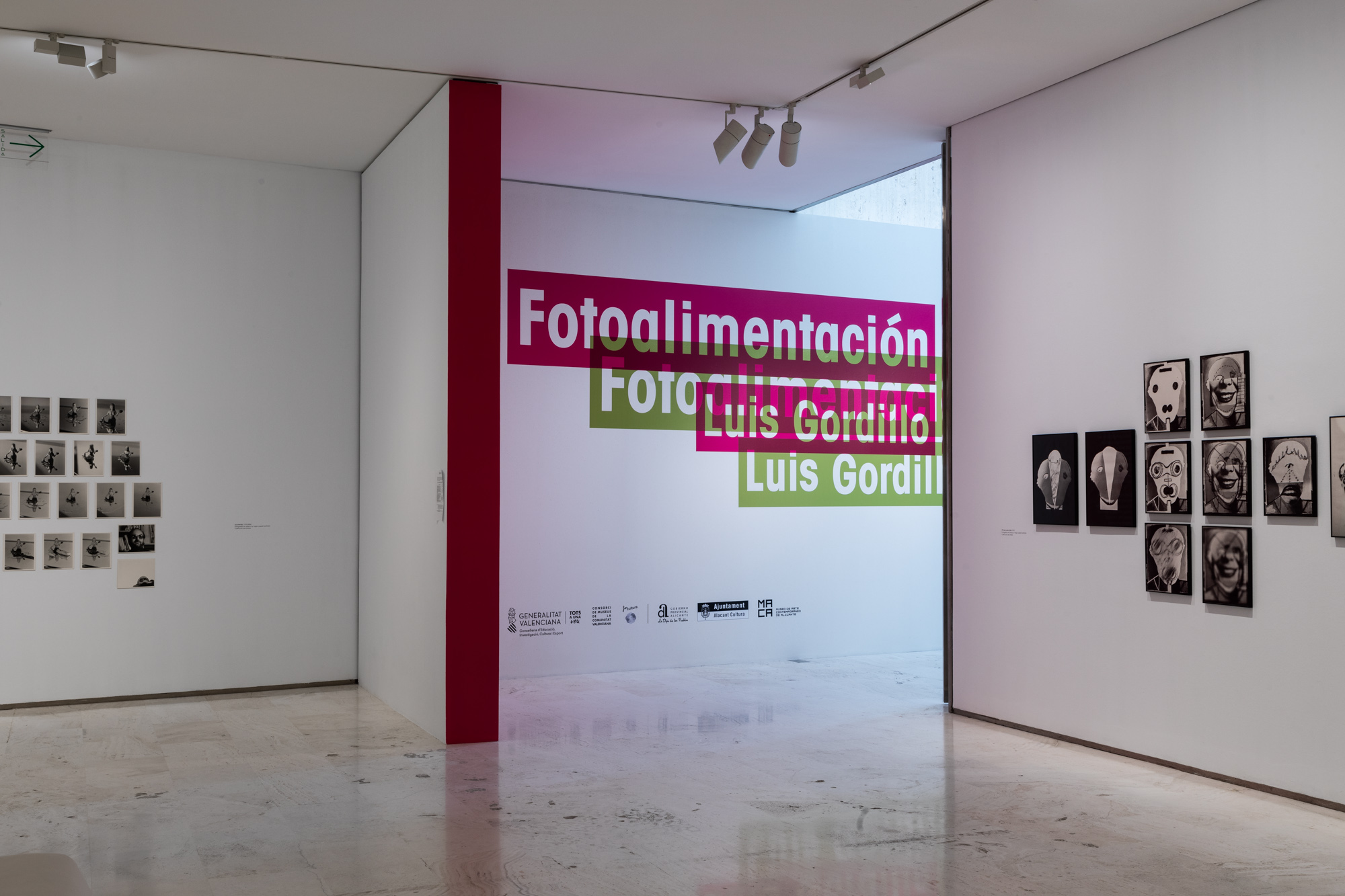
Photo-feeding. Luis Gordillo

Submitted by brandcode_deweloper on

The artist has been using photography since the early 1970s with the aim of finding other options to the dominant color in his painting: to open an investigation that neutralizes his violent use of complementary colors.

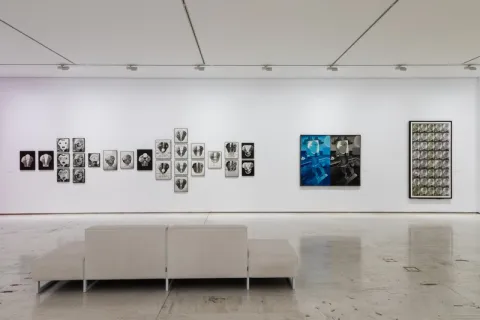
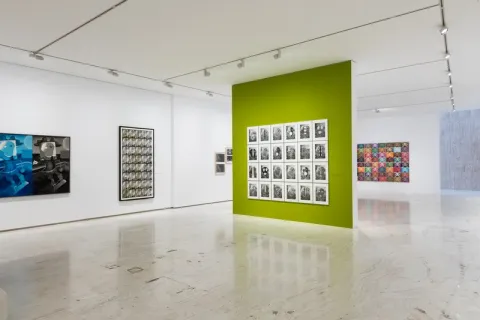
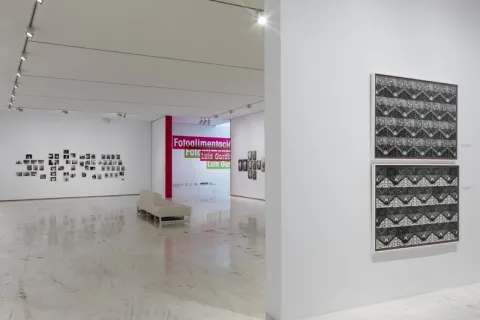
This experimental photographic practice allows him to investigate the construction, reconstruction and destruction of the image. Transformation techniques such as photography, but also printing, photocopying and collage recycling themselves and working in a spiral. Through these techniques Gordillo adopts modes of optical and constructivist art such as serialization, repetition, variants and differences between the almost identical that allow him to unfold, simultaneize and obsessively copy the same image.

Working with the negative and positive of the image, superimposed or sometimes slightly displaced, and also decomposed into the four colors of four-color printing, Gordillo converts the resulting images into "schizoid," a singular style steeped in ironic melancholy partly influenced by his long psychoanalytic practice.

Gordillo, in his collector's zeal, accumulates both banal objects from popular culture and images from the press, making a broad radiography of reality; from all of this psychedelic images emerge, sometimes close to pop.

The photographic processes carried out basically in the 1970s illuminate a way of understanding the creative process of Luis Gordillo, sometimes stranded between chance and automatism, but always disturbing where some of the artist's obsessions emerge: the encounter with absurd objects, the incoherent and endless accumulation of items he has been collecting for years. Decontextualized things and laden with plastic significance that he uses as visual material that result in psychedelic images sometimes close to pop, laden with a preset and manic humor. And this so libertarian way of making photography leads us to propose this series of works transcribed from psychoanalysis to make up the exhibition of Luis Gordillo.

EXPO-0042
Imagen
042A8352.jpg
/sites/default/files/inline-images/resources/exposiciones/EXPO-0042/Diptico-Expo-Gordillo-castellano-OK_7.pdf
De mayo a septiembre de 2019 en el Centre del Carme Cultura Contemporània de Valencia

Joan Miró and Joan Baixas. Mori el Merma in Alicante

Submitted by brandcode_deweloper on

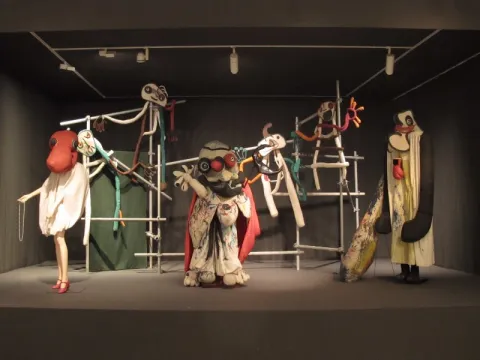
Mori el Merma was a theatrical spectacle by the Teatre de la Claca company directed by Joan Baixas and Teresa Calafell with sets, masks and large puppets designed and painted by Joan Miró. For several months, Miró collaborated in the design of the characters constructed in fabric and foam rubber by the group and in March 1977, in La Claca's own workshop and as one more member of the group, he proceeded to paint and decorate them. The adventure was recorded by the attentive camera of Francesc Catalá Roca. After months of rehearsals, the work premiered in 1978, first at the Teatro Principal in Palma de Mallorca and later at the Gran Teatro del Liceo in Barcelona. The success was resounding and clamorous. This chaotic and anarchist "troupe" was the image of a new country that had finally ended the dictatorship. In the first two years, from 1978 to 1980, Mori el Merma was performed throughout Europe: at the Centre Pompidou in Paris, at the Riverside Studios in London, at the Fondation Maeght in Saint Paul de Vence or at the Sala Olympia in Madrid.

The importance of Mori el Merma in Joan Miró's production is capital: it is not just another of his forays into the theatrical scene, an artistic aspect for which he felt genuine passion. It is the representation of the character of Ubú conceived by Alfred Jarry, paradigm of all the dictators of the twentieth century, the vulgar and bloodthirsty tyrant who embodies corruption and despotism and whom Miró associated with General Franco. The character of Ubú, which Miró develops plastically through a series of drawings and three portfolios of lithographs, takes the stage with the work of Mori el Merma thus collecting his political ideology, transversally bathed in surrealism.

The history of the Mori el Merma puppets in Alicante is complicated but fascinating. When in 1980, La Claca dismantled the work to undertake a new stage, Miró agreed to the sale of the initial sets: part of which were deposited in the Miró Foundation in Barcelona and another part, thanks to the efforts of Alicante artist Eusebio Sempere, were acquired by the Diputación of Alicante with the purpose of completing the Twentieth Century Art Collection. Meanwhile, the sets were exhibited in 1980 at the Museo de la Asegurada, not without friction between the artist and the City Council as recorded in the press. After fourteen months of exhibition they were dismantled and stored in wicker baskets that were removed by the Diputación in 1988 where they have been preserved ever since. They were never exhibited again.

EXPO-0022
Imagen
Sin-t%C3%ADtulo-11.jpg
/sites/default/files/inline-images/resources/exposiciones/EXPO-0022/folleto-mori-el-merma-baja_8.pdf
Rosa María Castells
Del 11 de junio al 13 de septiembre de 2015