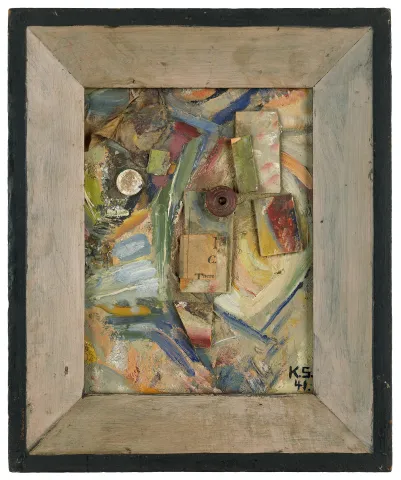
Context avant-garde 2. Kurt Schwitters
The MACA presents the second exhibition within the "Contexto vanguardias" program with two works by Kurt Schwitters. This program aims to maintain a permanent dialogue between the works in the IVAM collection belonging to the avant-gardes of the first decades of the twentieth century and the works of the Twentieth Century Art Collection, so that complementary readings are established, transversal perspectives, support and context for some pieces that, in communication with others, strengthen their language and message and complete the vision of a fundamental era of modernity that travels paths between tradition and the new. Doing it at the MACA, in Alicante, alongside the same works from the Twentieth Century Art Collection will allow visitors to enjoy works never before seen in the city and are references in art history that are part of the excellent collections of the institution you direct.
This second exhibition consists of a set of two works by Kurt Schwitters, one of the most radical artists in the twentieth-century artistic panorama, being the continuation of the previous "Contexto Vanguardias" and which will coexist in the first room of the museum alongside his contemporaries Julio González, Pablo Gargallo and Juan Gris.
The Artist
German artist Kurt Schwitters (Hanover, 1887 – Ambleside, United Kingdom, 1948) was one of the main and most influential protagonists of the Dada movement. In 1919 he constructed his first collages and assemblages with waste materials, which he would call Merz, turning them into a symbol of a world in ruins. He created multidisciplinary art, free from traditional artistic conventions, and Merz would give its name to his poems, his magazine, his theater and his collages or sculptural constructions.
He abandoned his architectural studies in his native city to move to Dresden, where he visited the Kunstakademie with the purpose of becoming a painter. After some beginnings linked to impressionism and somewhat later to expressionism, in 1918 he exhibited his first works in the cubist-futurist style at the Der Sturm gallery in Berlin. A year later he constructed his first collages and assemblages with waste materials, which he would call Merz, a name derived from the fortuitous mutilation of the word Kommerz, which he had used in one of his collages. Merz would become synonymous with the new multidisciplinary art he would create from then on, free from traditional artistic conventions and which would give its name to his poems, his magazine, his theater and his sculptural-architectural constructions (Merzbau). He himself would define this artistic process as a consequence of the historical moment in which he had lived: "The Great War has ended, in a way the world is in ruins, so I gather its fragments and build a new reality".
His work was banned by the Nazi authorities upon their rise to power in 1933 and included in the lists of "degenerate art". Upon learning that he was being sought by the Gestapo, he went into exile in Norway in January 1937, leaving his wife Helma in Germany. After the Nazi invasion of the Nordic country, he fled by ship to Edinburgh. In the United Kingdom he was considered a foreign enemy and went through several internment camps, finally ending up in the Hutchison Camp on the Isle of Man. Once released, he went through London and, after the war ended, moved to the Lake District in northern England. In October 1946 he broke a leg after a fall from which he would never recover. He died in Kendal on January 8, 1948; two days later he was informed by letter that he had been granted British citizenship.