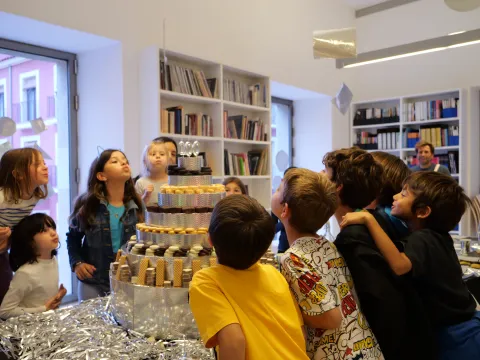
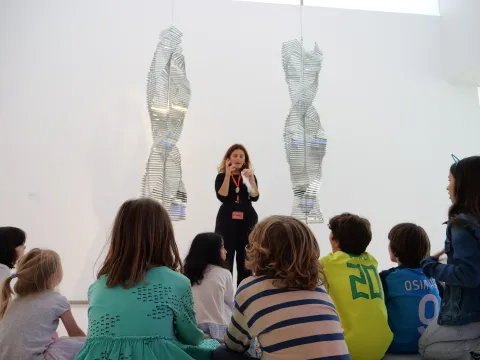
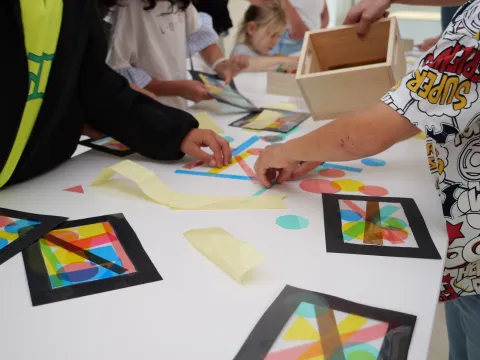
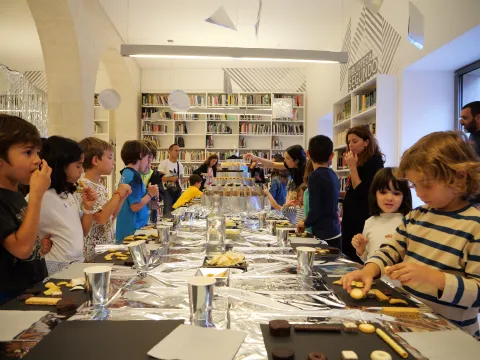
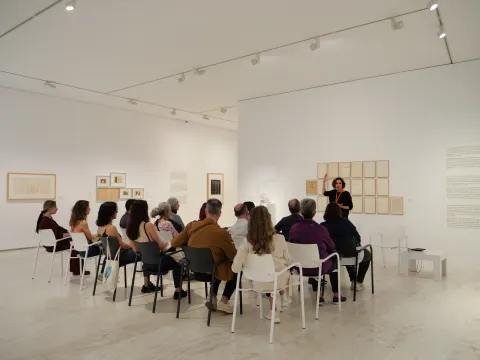
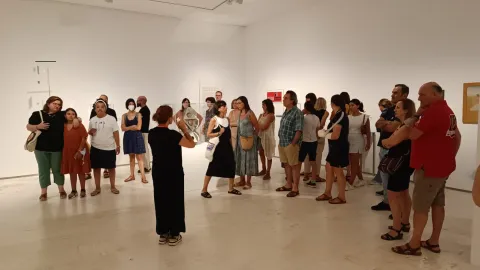
Visit-workshop with vermouth around the artists of the collections, in this case around the figure of Elena Asins. We will learn not only about her work but also her life, with the intention of awakening a new perspective that recognizes women's work in overcoming the roles and models imposed throughout art history, which has been dominated by the male sex.
For general audiences. Coordinated by: MACA Mediation Department.
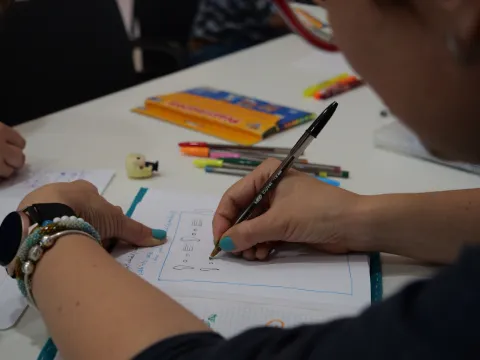
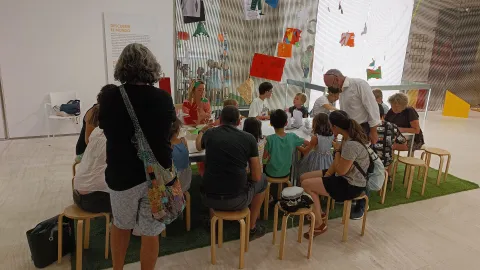
On this occasion playing with the concept of the sound of the spheres. Graphic music workshops function as practical activities on graphic scores, linking sound and drawing in a participatory and creative way.
Aimed at people interested in visual art and/or sound art and music. From 8 years of age accompanied by an adult.
Attendees must bring drawing materials: pencils or pens and notebooks.
Family workshop. Directed by: Carlos Izquierdo, composer and musician.
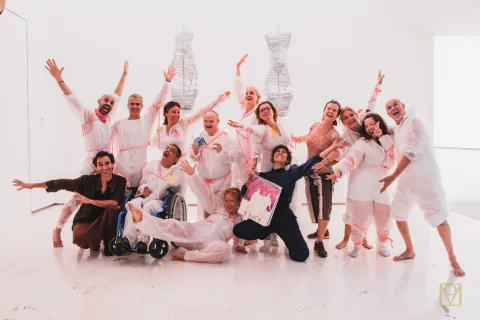
Test of the participatory project of inclusive dance and performing arts developed by Ruedapies in collaboration with the Art for change Project of the La Caixa Foundation.
In this activity of participatory, interdisciplinary and inclusive creation, people with functional diversity will be the creative agents, and not mere reproducers of a given culture, thus promoting a social, empowering and lasting transformation over time.
Organization and coordination: Ruedapies: Marisa Brugarolas, Alicia Esteve and Luis Martínez.
Lumina Ensemble is the project of four saxophonists
passionate about their instrument and contemporary music, who belong
to two generations and who join efforts to achieve
high-level musical performances.
Lumina refers to the light that continuously permeates
our land. Light that determines our open and
tolerant character, and that proposes the union of people who converge in a
common project. Light as an analogy of our way of understanding musical performance in its infinite forms, with proposals
committed to contemporary music. Essential therefore to achieve
this goal, is the collaboration with composers and the premiere of works
written or transcribed for this group.
This concert serves as the presentation of Lumina to the
public, although it should be noted that its members
have an important artistic and professional background that has led them
to perform in numerous concert halls, festivals and concert
series.
Lumina Ensemble is a flexible group that is based on the
saxophonists Pablo de la Fuente, Javier Carrillos, Isaac Verdú and
José A. Suay. In this event it also includes Óscar
Martí (percussion) and Mercedes Lozano (organ). Samuel Cedillo Tetela, Tlalpujahua Michoacán, Mexico (1981)
Of Mazahua origin. Peasant and craftsman in his childhood. Undergraduate studies
in composition with Germán Romero, obtaining
the Honorable Mention from the Conservatorio de las Rosas in Morelia (Mexico) in 2007. From his formative influences after Romero, Cedillo considers mainly Emmanuel Nunes and Pierluigi Billone. Since 2002 his music has been programmed in various venues and concerts within Mexico and in various cities in other countries such as Darmstadt, York, Chicago, Vienna, Innsbruck, Brussels, Paris, Gothenburg, Athens, Salamanca Spain, Tallinn, Córdoba and Buenos Aires.
He has received commissions from Platypus Ensemble, Austria; Tres Américas Ensemble, ICE Ensemble, New York; Smash Ensemble, Spain; Puentes-Sigma Proyect Festival, Mexico-Spain; Royaumont Foundation-Namascae Lemanic Modern Ensemble, France and Tallinn New Musical Ensemble, Estonia.
He was part of the Composition and Ear Training Departments of the Conservatorio de las Rosas in Morelia between 2003 and 2008; advisor and professor of the Regional Music Education Program of SECUM in Michoacán between 2005 and 2010. He has published various recordings with his personal works and a new monographic album is in the process of publication.
Since 2008 he has been a guide for the Creation Workshop, a space that is beginning to
form a new and solid generation of composers at the
national level. In 2018 he enters the National System of Art Creators of Mexico. Currently Cedillo's work is considered by critics as one of the most radical and outstanding of his generation throughout Latin America
Lumina Ensemble is the project of four saxophonists
passionate about their instrument and contemporary music, who belong
to two generations and who join efforts to achieve
high-level musical performances.
Lumina refers to the light that continuously permeates
our land. Light that determines our open and
tolerant character, and that proposes the union of people who converge in a
common project. Light as an analogy of our way of understanding musical interpretation in its infinite forms, with proposals
committed to contemporary music. Essential therefore to achieve
this goal, is the collaboration with composers and the premiere of works
written or transcribed for this group.
This concert serves to present Lumina to the
public, although it should be noted that its members
have an important artistic and professional background that has led them
to perform in numerous concert halls, festivals and concert series.
Lumina Ensemble is a flexible group that is based on the
saxophonists Pablo de la Fuente, Javier Carrillos, Isaac Verdú and
José A. Suay. In this current meeting, it also includes Óscar
Martí (percussion) and Mercedes Lozano (organ). Zulema de la Cruz. Superior degree in Piano and Composition from the Royal Superior Conservatory of Music in Madrid, Master of Arts in Composition and Computer Music from Stanford University (California, USA) with John Chowning. Advanced Studies Diploma from SEK Universidad de Segovia. Doctor in Culture and Communication from the University of Madrid in 2015 with the Thesis "Research and Electroacoustic and Computer Composition Laboratory of the RCSMM.
Lumina Ensemble is the project of four saxophonists
passionate about their instrument and contemporary music, who belong
to two generations and who join efforts to achieve
high-level musical performances.
Lumina refers to the light that continuously permeates
our land. Light that determines our open and
tolerant character, and that proposes the union of people who converge in a
common project. Light as an analogy of our way of understanding musical interpretation in its infinite forms, with proposals
committed to contemporary music. Essential therefore to achieve
this goal, is the collaboration with composers and the premiere of works
written or transcribed for this group.
This concert serves to present Lumina to the
public, although it should be noted that its members
have an important artistic and professional background that has led them
to perform in numerous concert halls, festivals and concert series.
Lumina Ensemble is a flexible group that is based on the
saxophonists Pablo de la Fuente, Javier Carrillos, Isaac Verdú and
José A. Suay. In this current meeting, it also includes Óscar
Martí (percussion) and Mercedes Lozano (organ).
In her interpretive work, she is a member of the Foundation and the
Sax Ensemble group since 1993, as responsible for
electroacoustic media.
With this group she achieved the National Music Prize in
performance in 1997. Award winner in numerous composition competitions, advisor and jury member of multiple institutions. Her works, commissioned by various entities, have been performed in Europe, USA, Canada, South America, Japan, China and Australia. Her catalog includes all types of formations from solo instruments, chamber, electroacoustic, multimedia, concerts with soloists,
symphonic, symphonic choral, vocal and scenic music.
She has collaborated since 2015 with UNIR (International University
of La Rioja) as a member of the evaluation committees for
Master projects (TFM) and in the Direction and Coordination of the
Master's in Musical Composition with New Technologies, and with
UPV (Polytechnic University of Valencia) as a collaborator of its Soundcool research group, directing and being a member of the evaluation of doctoral theses in the Doctorate in Music.
Since 1988 she has developed her teaching and research work as
Professor of Electroacoustic Composition in the Research and Electroacoustic and Computer Composition Laboratory (LICEO) of the Royal Superior Conservatory of Music in Madrid, carrying out its design, maintenance and cataloging of its productions.
Alicante proposes year after year the White Night, with an attractive cultural offer. The initiative is jointly programmed by the city's museums and art centers. The proposal that emerges from several meetings between technicians from different museums is to celebrate the first edition of the White Night in Alicante, on July 15, 2015, with an attractive offer of activities. The purpose is to enjoy contemporary artistic creation through different activities and free cultural events, thus promoting citizen participation. In Spain, this initiative is developed in cities such as Madrid, Burgos, Málaga, Albacete and Barcelona, to which others have been added such as La Laguna, Badajoz, Teguise, Alcalá de Henares, Zaragoza, Nerja, Seville, Almería, Cáceres, Oviedo or Granada.
With this purpose, Alicante proposes year after year the White Night, with an attractive cultural offer. The initiative is jointly programmed by the city's museums and art centers: MARQ Archaeological Museum, MACA Museum of Contemporary Art of Alicante, MUBAG Museum of Fine Arts Gravina, MUA Museum of the University of Alicante, Las Cigarreras, Volvo Ocean Race Museum, Museum of Waters of Alicante, Exhibition Hall of the Fish Market, Institute of Culture Juan Gil Albert, and MUSA, Alicante City Museum. The project aims to bring together all types of public and private cultural initiatives, promote the participation of people from Alicante, individually or collectively, and suggests rediscovering the city with the opening of different spaces that are not usually accessible to the public at night.