Antonio Serrano Bru.

Submitted by brandcode_deweloper on
The architect's desk 1

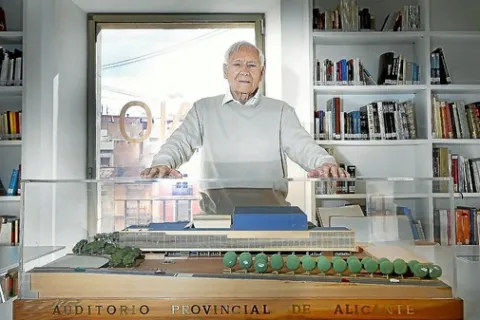
Few architects in the province of Alicante during the second half of the twentieth century have had such professional and critical success with their work. An extraordinary capacity for design was coupled from the very beginning with the possibility of executing major commissions with a strong urban impact that, thanks to the promotion of the most cultured layers of the industrial bourgeoisie of Elche, public institutions and the Church, contributed to the definition of the modern city of Elche.

He served as president of the Board of Trustees of the Misteri d'Elx (1988-1998), professor at the new School of Architecture of Alicante and member of the College of Architects. His activity as an architect was long and intense, facilitated by the premature death in a traffic accident in 1968 of his father, architect Antonio Serrano Peral. He knew how to use his youth and creative capacity to run a studio that, with numerous commissions and works left unfinished by his father, counted on the collaboration of excellent draftsmen and construction managers, had a well-organized professional archive and a substantial architecture library. The incorporation into it of his brother Andrés and his nephew Antonio (and, later, architects Fernando Valderrama and Beatriz Serrano), during decades of great construction activity in Elche, intensified its possibilities, developing an architecture rooted in the Madrid School, but related, somewhat eclectically, to the contemporary work developed in Europe. AWARD FOR PROFESSIONAL TRAJECTORY 2023

An architect focused on his city

Few architects in the province of Alicante during the second half of the twentieth century have had such professional and critical success with their work. An extraordinary capacity for design was coupled from the very beginning with the possibility of executing major commissions with a strong urban impact that, thanks to the promotion of the most cultured layers of the industrial bourgeoisie of Elche, public institutions and the Church, contributed to the definition of the modern city of Elche.

He served as president of the Board of Trustees of the Misteri d'Elx (1988-1998), professor at the new School of Architecture of Alicante and member of the College of Architects. His activity as an architect was long and intense, facilitated by the premature death in a traffic accident in 1968 of his father, architect Antonio Serrano Peral. He knew how to use his youth and creative capacity to run a studio that, with numerous commissions and works left unfinished by his father, counted on the collaboration of excellent draftsmen and construction managers, had a well-organized professional archive and a substantial architecture library. The incorporation into it of his brother Andrés and his nephew Antonio (and, later, architects Fernando Valderrama and Beatriz Serrano), during decades of great construction activity in Elche, intensified its possibilities, developing an architecture rooted in the Madrid School, but related, somewhat eclectically, to the contemporary work developed in Europe.

Quality public architectures

In Elche he created: the El Palmeral Public School (1969), based on isolated pavilions, with a graceful exposed metal structure and visible white concrete blocks, in one of the famous palm groves; the Cuartel Viejo residential-commercial complex (1971-1976), centered by a public plaza, with its dynamic Italianate volumes and its corner tower, finished in striking white, blue and maroon colors, which changed the toponymy, now known as Pisos Azules; two commercial and residential buildings in the Glorieta (1973), with delicate pink marble facades entrusted to an exposed metal structure that recalls Milanese neoliberty and Wright's prairie houses; various schools built as school architect and member of the Construction Board, including the Candalix, the result of rehabilitating an old shoe factory (1985), the Miguel de Cervantes (1979), awarded by the College of Architects, the CAM daycare center (Palas Atenea Award 1984), and others, formalized with various models that he intelligently repeats; the Pla de Sant Josep market (1974), a brutalist piece, unique in the province, unfortunately demolished.

Also very notable are his restorations such as the Town Hall (1970-1980), the Basilica of Santa María (1980-1997), the Hermitage of San Sebastián, the Altamira Palace for the Archaeological Museum (1980-2009), the Arab baths and the Nursing Home for the Elderly.

ACTI-0542
Imagen
1cfadaa9-221a-478b-860f-6865ee1fe326_16-9-discover-aspect-ratio_default_0.jpg
7:00 PM
90 minutes
Library

Juan Antonio García Solera

Submitted by brandcode_deweloper on
The architect's desk 1

Juan Antonio García Solera, born in Alicante in 1924, and classmate of Javier Carvajal, began practicing as an architect in his native city in 1953, shortly after completing his Architecture studies at the School of Madrid. Without a doubt due to the chronology mentioned, but above all due to the significance of his architecture in the city, García Solera is the representative in Alicante of that second generation of architects pointed out by Carlos Flores. In 1967, with the project for a Convention Palace, he began a series of projects that aimed to provide Alicante with an infrastructure for holding international congresses that would complement the city's tourist offerings. The project, developed on a hexagonal grid that revisits geometries and modules tested by Corrales and Molezún in the Spanish pavilion of the 1958 Brussels Universal Exposition nine years earlier, was submitted to the National Architecture Competition promoted by the General Directorate of Fine Arts, being one of the 12 projects selected for the exhibition.

ACTI-0541
Imagen
15655436322778.jpg
7:00 PM
90 minutes
Library

Complete the city / Housing projects. Mónica Alberola

Submitted by brandcode_deweloper on
The architecture table 12

Completing the City / Housing Projects with Mónica Alberola. Thursday, October 30 at 7:30 PM. Free admission.

Associate Professor in the Department of Projects at ETSAM of the Polytechnic University of Madrid. Since 1996, together with Consuelo Martorell, she founded the alberolamartorell studio, and in 2018 with the incorporation into the team of architects María Casariego Córdoba and Guiomar Martín Domínguez and architect Enrique de Teresa Trilla.

The studio has focused its activity on heritage recovery works and new construction projects in which competitions have been the main driver of our professional activity, highlighting awards in project competitions and built works, among which stand out: 1st Prize Reclassification of the Ex Macello area in Arona, Italy. VPO Prize IX BEAU Building of 22 social housing units for young people in El Rastro, Madrid. 2011. 1st Prize Housing in the PAU of los Ahijones, Madrid. IVIMA. 2007. 1st Prize Housing Building Pza. General Vara del Rey, Madrid. EMVS (2005) and recently the 1st Prize of the competition for the Auditorium and National School of Public Health of the Carlos III Health Institute in Madrid.

Coordinated by: Santiago Varela

In collaboration with: College of Architects of Alicante

ACTI-0540
Imagen
Mónica Alberola
Desactivado
7:00 PM
90 minutes
Library

Slow Art Day 2024

Submitted by brandcode_deweloper on

The Museum participates once again, as host in the celebration of Slow Art Day. We invite you to come on Saturday at 6 p.m., guided by our mediator, you will observe individually five selected works, and then share your impressions in a group discussion about the viewing experience.

All of this will happen simultaneously in hundreds of museums around the world.

The selected works are:

Kiki de Montparnasse by Pablo Gargallo

Jefe Contable and Riu-Rau by COLEC-002

Rebasando el límite by Juan Genovés

Descubrimientos Militares 1671. Diario de una excavación imaginaria y barroca by Manuel Millares.

ACTI-0539
Imagen
98.jpg
All day

White Night 2015

Submitted by brandcode_deweloper on

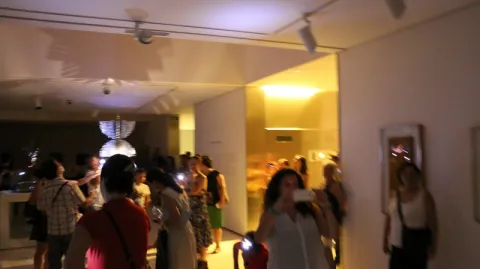
The city of Alicante will celebrate, for the first time, the White Night on July 24th, a proposal that stems from collaboration between Alicante's museums and art centers. The technicians from the city's museums have held various meetings and are already working on an attractive offer of activities for that date.

The White Night is a cultural initiative that was created in Paris in 2002 and has been joined by other European capitals and major cities such as Rome, Bucharest, Riga, Amsterdam, and Brussels. The purpose is to enjoy contemporary artistic creation through different activities and free cultural events, thereby promoting citizen participation.

Alicante proposes its first White Night with an attractive cultural offer that will be announced at a Press Conference in the coming days. The initiative is jointly organized by MARQ Archaeological Museum, MACA Museum of Contemporary Art of Alicante, MUBAG Gravina Museum of Fine Arts, MUA Museum of the University of Alicante, Las Cigarreras, Volvo Ocean Race Museum, and Museum of Waters of Alicante, which will remain open until 1:00 a.m. on July 24th. The project aims to bring together all types of public and private cultural initiatives, promote the participation of Alicante residents, individually or collectively, and suggests rediscovering the city with the opening of different spaces that are not usually accessible to the public at night.

In Spain, this initiative is already being developed in cities such as Madrid, Burgos, Málaga, Albacete, and Barcelona, with other cities such as La Laguna, Badajoz, Teguise, Alcalá de Henares, Zaragoza, Nerja, Seville, Almería, Cáceres, Oviedo, and Granada joining in.

All information at https://www.facebook.com/nochenblancoalicante


Participants: This is an invitation to join the first edition of The White Night, a cultural celebration that should bring together the participating public around art and artistic creation including all types of cultural expression: cinema, theater, exhibitions, shows, workshops, actions, performances, music, gastronomy, and anything else that can be programmed.

ACTI-0538
Imagen
noche-blanco-alicante.jpg

Only this time

Submitted by brandcode_deweloper on
Museum Day 2014

The MACA will allow photographs to be taken from April 14 to May 14, 2015. For reasons beyond the organization's control, and according to indications from the Obra Social Caja Mediterráneo, the works belonging to the Caja Mediterráneo Collection cannot be photographed. When taking photographs, the museum's rules must be respected and care should be taken not to disturb its operation. Participation can be individual or collective. Photographs of an obscene, violent, dangerous, racist nature, against public order, likely to harm the sensitivity of minors or violate the dignity of persons are not admitted.

There is no age limit to participate, but the competition will be divided into two categories according to the age of participants; two junior (up to 16 years old) and two senior (up to 99) which will be chosen by a specialized jury and followers on Facebook and Twitter respectively.

Additionally, this year we have included an option for all those Instagram users. All participants who wish to do so must upload their photos with the hashtag #Soloporestavez4 and share it on the museum's profile (macaalicante).

ACTI-0537
Imagen
75.jpg

Concert of Graphic Music

Submitted by brandcode_deweloper on
White Night 2024

Directed by composer Carlos Izquierdo. Graphic scores from the museum's workshop cycle are performed. Improvisation, play and creativity in a participatory concert featuring Fátima Boix on clarinet, Eve Matin on harp and Óscar Martí on percussion.

ACTI-0536
Imagen
WhatsApp-Image-2024-07-12-at-23.19.17.jpeg
10:30 PM
40 minutes
Ground Floor

Kites at the MACA

Submitted by brandcode_deweloper on
White Night 2024

Participatory Podcast "Kites at the MACA"! We present a new podcast created by the group of young artists from the Scenic Campus "No More Boring Artists III: COLEC-002", directed by the team of educators from Cía Ambulantes Lab. The program will be dedicated to the renowned Alicante artist COLEC-002. Additionally, it will address topics related to contemporary art, museums, and the artist herself, all from the perspective of young people between 12 and 26 years old. We invite you to join us in this unique experience, where you can be an active part of an evening dedicated to art and creativity.

ACTI-0535
Imagen
WhatsApp-Image-2024-07-12-at-21.31.56.jpeg
21:00 hours
40 minutes
3rd floor

This is not a cube. Immersive and collaborative experience

Submitted by brandcode_deweloper on
White Night 2024

This workshop is an immersive and collaborative experience, in which participants will be able to rethink and transform the concept of the white cube, using paper and markers to create a large collective work.

ACTI-0534
Imagen
WhatsApp-Image-2024-07-12-at-20.59.35.jpeg
8:30 PM
90 minutes
Ground Floor

"The video essay and the interview as aesthetic practice. Utopias and Dystopias of Modernity, non-places and the placeless". White Night 2024

Submitted by brandcode_deweloper on

In charge of Ingrid Wildi. Subsequently, the book "Aesthetics of the Fragile. Catastrophe and Imagination" coordinated by Teresa Marín García, director of the research group Artistic and Media Interference Laboratory (IAM-Lab), will be presented. The event will conclude with a conversation between both of them about the essay as an aesthetic practice. The event will be presented by cultural manager and independent curator Begoña Deltell.

ACTI-0533
Imagen
WhatsApp-Image-2024-07-12-at-21.16.46.jpeg
8:00 PM
60 minutes
Auditorium