MACA wants to join two important celebrations that have March as their temporal axis.
On one hand, the third edition of Photoalicante, a collaborative and participatory project. An event that, from such a notable and contemporary discipline as photography, proposes to be the first meeting in which the most outstanding institutions (public and private) that participate in the cultural and artistic life of the city of Alicante collaborate. For three years now, MACA has collaborated in this Photography Festival held in Alicante not only with an exhibition project but also with the organization of conferences, courses and round tables.
On the other hand, the Biennial Festival Miradas de Mujeres 2016, a reformulation of the Festival Miradas de Mujer that took place in 2012, 2013 and 2014. MAV, the Association Women in the Visual Arts has decided to celebrate it every two years, alternating it with the MAV Forum, a space for reflection and debate that converged in Barcelona and Madrid in 2015. For this reason, participation is invited in this open call for artistic proposals in various formats, such as exhibitions, actions, ephemeral constructions, video projections, workshops, etc., which will become part of the Program of the Biennial Miradas de Mujeres that will be held during 2016. For two editions now, MACA has participated in this feminist festival, thus emphasizing the visibility not only of art made by women but also of art thought, studied, researched or curated by women.
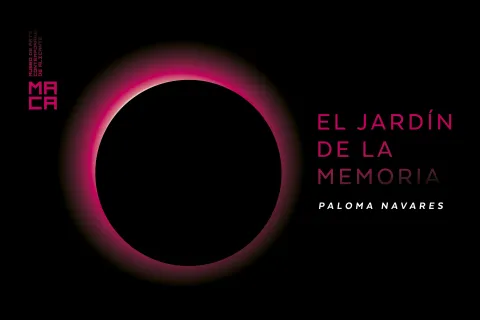
To participate in both events, MACA proposes a small exhibition around the work of artist Paloma Navares held at MACA. Paloma Navares, from Burgos and based in Madrid, (who spends long periods in Campello) is the creator of her own plastic language characterized by the use of new technologies, the use of space, light and the integration of various techniques. Her first audiovisual works are linked to performance and dance. From her beginnings in 1979 to the present day, she has held more than a hundred exhibitions throughout the world, being present at Fairs and Biennials. Her work is found in museums, institutions and public and private collections. Along with her artistic activity, she develops work in training, promotion and direction of artistic events of an international character. More information in the full note
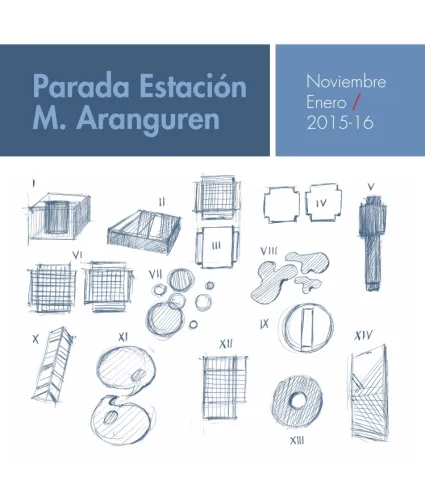
"Parada Estación" is an installation by María Aranguren that pays tribute to Eusebio Sempere and is part of the set of activities that the Alicante City Council and the MACA have programmed on the occasion of the 30th anniversary of the artist's death.
"Parada Estación" marks a route, through fourteen small polycarbonate pieces on the street, that leads the pedestrian from Plaza de la Santa Faz to the MACA. Fourteen "Stations" in places chosen by the artist between the first two stations of the Via Crucis of the Santa Faz: the fountain, the Palace, Portaferrisa, the Maldonado curve, the Heliodoro Guillén alley...
In the search for or discovery of these enclaves, aesthetic and conceptual relationships are established that encourage a different perspective on the walls and facades of this singular neighborhood and guide visitors toward the MACA entrance, where a large tribute piece, inspired by Sempere's work, closes the route. More information in the full note
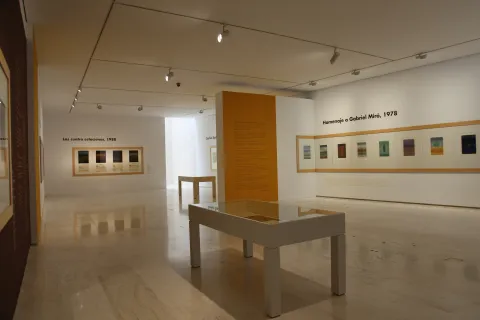
The MACA, within the scheduled activities of the Sempere Year on the occasion of the 30th anniversary of the death of Eusebio Sempere, wishes to pay tribute to the Alicante artist through an exhibition composed entirely of works from the MACA collections that demonstrate the importance of music and literature in Semperian work while highlighting the meticulous silkscreen work carried out by Abel Martín. The Four Seasons of 1965 is the first portfolio of artistic silkscreens printed in Spain. It was 50 years ago and the presentation at the Juana Mordó Gallery became an unprecedented success in terms of public, critical, and sales. It was the beginning of one of the most important sets of graphic work created in 20th century Spain, that of artist Eusebio Sempere, exceptional both in its quality and quantity. Approximately two hundred works including silkscreens, lithographs and engravings, elaborated by hand in which the highest levels of perfection are achieved, always meticulous and sometimes precious. 9 portfolios of original silkscreens by Eusebio Sempere are presented, all printed by Abel Martín as if it were a team effort, which trace the vital trajectory of both artists and demonstrate the joint artistic collaboration, the union and spiritual communication. Sempere would be the mind behind the forms and colors that Abel Martín, an excellent printer, then transferred onto paper through the superposition of silk screens, one for each of the colors used. Sometimes more than 40. The Four Seasons of 1965, Nayar Album of 1967, Alarma Book, Transparency of Time or The Alhambra of 1977, Homage to Gabriel Miró of 1978, The Light of the Psalms of 1980, Spiritual Canticle of 1982 or the posthumous portfolio of The Four Seasons of 1988 that Abel Martín would complete alone, combine the magic of numbers that do not exist with the precise literature for each line. All portfolios are accompanied by literary texts, experimental, avant-garde, classical or mystical. Pedro Laín Entralgo, Julio Campal, José Miguel Ullán, Edmond Jabès, the Arab poets of Granada, Gabriel Miró, biblical psalms or Saint John of the Cross presented in turn by Rafael Alberti, Gerardo Diego, Vicente Aleixandre, Juan Cantó or Vicente Aguilera Cerni, words set in the forms and colors that inspire souls with the desire to stay there and take a seat. The Four Seasons, 1965 It consists of 4 original silkscreens printed by Abel Martín and the author himself, each accompanied by a poem by Pedro Laín Entralgo. It was published by the Juana Mordó Gallery in Madrid, with a limited edition of 50 signed and numbered copies. The design and printing of the typography as well as the portfolio presentation were carried out in the workshops of Artes Gráficas Luis Pérez, in Madrid. Nayar Album, 1967 It consists of 4 original silkscreens by Eusebio Sempere printed by Abel Martín and 4 poems by Uruguayan poet Julio Campal. It was published by the Juana Mordó Gallery in Madrid, with an edition of 50 signed and numbered copies. The typography and portfolio presentation were carried out by Artes Gráficas Luis Pérez of Madrid. Alarma Book, 1976 It is a book composed of 8 original silkscreens by Eusebio Sempere that illustrate visual poems by José-Miguel Ullán, all printed by Abel Martín. The typography and presentation were carried out by Industrias Gráficas Caro of Madrid. The book with cardboard binding covered with fabric with cream-colored stripes is published by Ediciones Rayuela with an edition of 160 copies. Transparency of Time, 1977 It consists of 5 original silkscreens by Eusebio Sempere printed by Abel Martín and four prose poems by Egyptian poet Edmond Jabès in Spanish translation by José-Miguel Ullán. It was published by the Carmen Durango Gallery in Valladolid with an edition of 95 copies signed and numbered by the artist. The typography was composed by Fotomecánica Castellana and printed at Gráficas Andrés Martín in Valladolid. The presentation in a wooden case was carried out by Artes Gráficas Luis Pérez of Madrid. The Alhambra, 1977 It consists of 9 original silkscreens by Eusebio Sempere printed by Abel Martín and 13 pages of text that include a Porch by poet Rafael Alberti and 9 fragments of Arabo-Andalusian casidas written by Ibn 'Atiyya, Ibn Bayyā', Ibn Sāra, Abū Bakr B. Hišām, Ibn Zamrak, Ibn Razin, Ibn al- Zaqqāq (with two), and Ibn Šuhayd, in Spanish translation by Arabists Emilio García Gómez and Emilio de Santiago Simón. The edition consists of 110 copies and was published by the Rodríguez-Acosta Foundation of Granada and Juan March Foundation of Madrid, with the collaboration of the Alhambra Foundation of Granada. Nine geometric designs printed in one color on vegetable paper are inserted, created by Sempere at the Computing Center of the University of Madrid, in 1972. The typography was composed and printed in Barcelona by Casamajó and the portfolio presentation was designed and carried out by Jaume and Jordi Blassi of Barcelona. Homage to Gabriel Miró, 1978 Published by the Italia Gallery in Alicante, the sixth portfolio of graphic work by Sempere consists of 8 original silkscreens printed by Abel Martín, an introductory poem written by Gerardo Diego and eight text fragments by Gabriel Miró, selected by Elena Escolano and taken from The Cherries of the Cemetery (1910), Big Child (1922), Within the Enclosure (1916), Corpus and Other Stories (1951), Our Father Saint Daniel (1921), The Sleeping Smoke (1919, two fragments) and The Novel of My Friend (1908). The edition consists of a print run of 110 signed and numbered copies. The texts were printed by Gráficas Sucesores de Such Serra and the portfolio was made by Encuadernaciones Moscú, also in Alicante. The Light of the Psalms, 1980 It includes 7 original silkscreens by Sempere that Abel Martín printed on parchment paper, a commentary by Juan Cantó Rubio and 7 biblical fragments printed in Hebrew and in Spanish, taken from Psalms 17, 18, 28, 49, 77, 111 and 134. It was published by the artist himself and an edition of 97 signed and numbered copies was made. The printing of the texts and presentation was handled by Artes Gráficas Luis Pérez of Madrid, with the entire portfolio made on handmade papers with watermark in the workshop of Segundo Santos of Cuenca. Spiritual Canticle (Homage to Saint John of the Cross), 1982 It is composed of 7 original silkscreens by Sempere printed by Abel Martín, with a presentation by Vicente Aleixandre (reproduction of a letter from the poet addressed to Sempere and dated in Madrid, June 2, 1982) and 7 fragments taken from the Spiritual Songs of Saint John of the Cross, specifically from Songs 4, 11, 14, 15, 21, 32 and 35. Published by the artist with an edition of 99 signed and numbered copies. The portfolio was composed in the workshops of Artes Gráficas Luis Pérez, Madrid. The Four Seasons, 1988 The portfolio was started during Eusebio Sempere's lifetime and the editing work was interrupted as a result of his death. It was published three years later, in 1988. It consists of 4 silkscreens printed in the workshops of Serigrafía Ibero-Suiza in Valencia supervised by Abel Martín. The print run was 125 copies marked with Roman numerals with the artist's signature printed in silkscreen, and 125 copies in Arabic numerals. It includes a presentation text by Vicente Aguilera Cerni and, accompanying each of the silkscreens, a musical score based on the seasonal motif that inspired them.
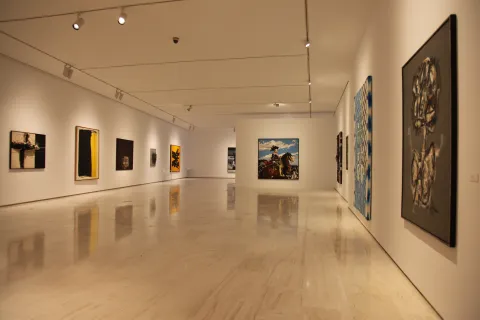
The exhibition titled The Revelation of Painting brings together a total of 15 works by artists that are part of the Fundación Caja Mediterráneo Collection.
Organized by: MACA, Museum of Contemporary Art of Alicante
Produced by: City Council of Alicante and Provincial Council of Alicante
Curated by: Rosa María Castells
Press Conference On behalf of the City Council of Alicante, Daniel Simón, Councilor of Culture, attends the event. On behalf of the Fundación Caja Mediterráneo, Matías Pérez Such, President of the Foundation.
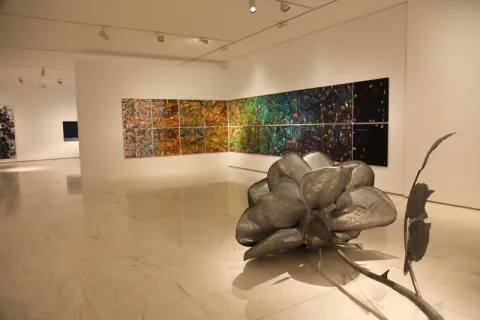
The Exhibition The Revelation of Painting... brings together a selection of works by different artists who share a passion for painting. Is it possible to speak of painting in the 21st century? To speak painting or about painting? Painting itself seems to stop at the border of a surface configured by two variables: chemistry and gesture. The reactions of chemical elements such as color pigments, binding substances and additives, volatile or solid, synthetic or natural, are scientific proof that painting exists. The way this colored compound of pasty or liquid consistency is applied is what shapes the gesture and captures time, always fragmented. But it will be the gaze (of the painter and the viewer) that grants "meaning" to the result. Painting, that "accidental surface," perhaps of dramatic intensity, is revealed in this exhibition as present in some paintings as it is absent in others. A window through which to penetrate an immaterial world or a textured wall where one can appreciate the folds of matter. Forgetting the object of representation and the spell of text or texture. The imperceptible brush and a certain sensation of watery transparency. Artists who through painting established a way of looking at the world that has shaped our contemporaneity. It is not possible to speak of Spanish painting without Joan Hernández Pijuan or Jordi Teixidor nor Carlos León, Alfonso Albacete, José María Sicilia or Prudencio Irazábal. Just when we thought painting had died forever, José Manuel Ciria, Antonio Mesones, Sergio Barrera, Juan Olivares, Nico Munuera and Oliver Johnson arrived to prove us wrong. The Foam of Days, the title of Boris Vian's novel and of the sculpture by Susy Gómez reminds us of that imaginary place where we never were. The Fundación Caja Mediterráneo Collection is composed of 213 works of art. Painting, sculpture, photography, video, installations, digital techniques… that span the work of 126 essential artists in the contemporary Spanish art scene, from the democratic transition to the present day. The Collection is deposited at MACA for a period of five years, thanks to the agreement signed by the City Council of Alicante and the Social Work of Caja Mediterráneo. More information in the complete note.
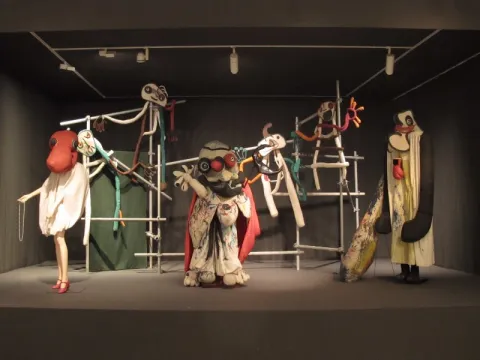
The exhibition titled Joan Miró and Joan Baixas. Mori el Merma in Alicante, organized by the MACA and the Consortium of Museums of the Generalitat, would not have been possible without the loan of works from the Provincial Council of Alicante, Fundació Miró, Barcelona; Fundació Pilar i Joan Miró, Palma; Es Baluard, Palma; Catalan Roca Archive, COAC, College of Architects of Catalonia and Municipal Archive of Alicante. History of a Representation Mori el Merma was a theatrical spectacle by the Teatre de la Claca company directed by Joan Baixas and Teresa Calafell with sets, masks and large puppets or dolls designed and painted by Joan Miró. For several months, Miró collaborated in the design of the characters constructed in fabric and foam rubber by the group and in March 1977, in La Claca's own workshop and as another member of the group, he proceeded to paint and decorate them. After months of rehearsals, the work premiered first in Palma de Mallorca, at the Teatro Principal and later, at the Gran Teatro del Liceo in Barcelona on June 7, 1978. In the first two years, from 1978 to 1980, it was performed within the Festival d'Automme at the Pompidou Center in Paris, at the Riverside Studios in London, at the Fondation Maeght in Saint Paul de Vence or at the Sala Olympia in Madrid. The importance of Mori el Merma in Joan Miró's production is capital: it is not just another of his incursions into the theatrical scene, an artistic aspect for which he felt genuine passion. It is the representation of the character of Ubu that Miró associates with General Franco. Joan Miró conceived of the dictator as the embodiment of darkness, the iron hand of Spain's darkest period, the sinister force that sowed salt in the territories where freedom was to grow. The character of Ubu that Miró develops plastically through a series of drawings and three portfolios of lithographs, takes the stage with the work of Mori el Merma which encompasses his political ideology transversally bathed in surrealism. The history of the puppets of Mori el Merma in Alicante is complicated but fascinating. When in 1980, La Claca dismantled the work to undertake a new stage, Miró agreed to the sale of the initial sets, part of which were deposited in the Miró Foundation in Barcelona and another part, thanks to the efforts of the Alicante artist Eusebio Sempere, were acquired by the Provincial Council of Alicante with the purpose of completing the 20th Century Art Collection. Meanwhile, the sets were exhibited in 1980 at the Museo de la Asegurada, not without friction between the artist and the City Council as reported by the press. After fourteen months of exhibition they were dismantled and stored in wicker baskets that were removed in 1988 by the Provincial Council, where they were preserved from then on. They were never exhibited again. This exhibition that we present has been made possible thanks to the collaboration of all the institutions involved, the willingness to highlight this fascinating story about the puppets, masks and sets by Joan Miró and the Teatro La Claca group, and to recover for everyone, one more of the efforts made by Eusebio Sempere for the benefit of his fellow citizens. The puppets, masks and scenic material have been restored by the Valencian Institute for Conservation and Restoration of the Generalitat. Joan Miró, Ubu and the Theater Painter of poets as Joan Brossa defined him, Miró maintained a close relationship with literature, especially with the poetic creation of his time, with the poets and writers linked to the avant-garde who attracted him through their desire for experimentation and their rebellious and nonconformist character. From this perspective, one must understand his affinity with the Surrealists with whom he identified very early, upon his arrival in Paris in the 1920s. Surrealism opened the doors to an imaginary world that he made his own and gave him a certain sense of rebellion that he would never abandon. In that search for transgression, Miró felt genuine fascination for the work of Alfred Jarry and his famous theatrical work Ubu roi. The character of Ubu, recreated a thousand times by twentieth-century artists, is the personification of the tyranny of power, vulgar and bloody, that embodies corruption and despotism. "Now everyone sees clearly that what Alfred Jarry imagined was actually Franco and his followers. This is the reason why Ubu fascinated me during the Franco years and it is the reason why I have drawn it so many times." And so it was, the subject interested him and he worked on it again and again. The plastic result: drawings, sculptures and three books with lithographs published in 1966, 1971 and 1975 (Ubu roi, Ubu aux Baléares and L'Enfance d'Ubu) that were direct stimulus for the argument and scenic elements of the theatrical work Mori el Merma, a spectacle that in 1978 closed the cycle of Ubu in Joan Miró's work. Miró's passion for the stage is a subject demonstrated in exhibitions and studies but not as well known to the general public. For the theatrical world he designed costumes, characters, posters and dance spectacles. He was fascinated by the theme of representation and believed in the great theater of the world where everything came to life. "Theater is made and nothing remains, that is fascinating. The work of art can disappear, that doesn't matter but it must have left its seeds in the earth." In 1975, Joan Miró proposed to the Teatre La Claca group a collaboration beyond painting a couple of puppets or large-headed figures; he wanted to participate in the design and staging of a theatrical work, Mori el Merma (the title would come later) in what ultimately became the last great project of his life. Miró wanted to get involved attracted by theatrical language in a complete spectacle and felt from the beginning a passionate interest in this collaborative work. Fundamentally for three reasons. First because the plastic intervention that was requested of him was about his own work and he approached it as a challenge of plastic experimentation. On the theatrical level, Miró participated in the idea of a poetic theater, not necessarily linked to words and with strong popular roots manifested in festivals and carnivals. And finally, as a fundamental reason, Miró collaborated thus, at such a delicate moment as 1976-1977, in the struggle against intolerance and abuses of power, to exorcise fears, to finish off the aggressors and their followers who had made prisoners of the ideas and expression of an entire people and to expel rage and bitterness. Miró managed, thanks to the collaboration and enthusiasm of the young people of La Claca, to stage a plastic and political obsession. At his age, already near ninety years old, the artist remained curious and in search of new discoveries; constant proof of his youth. It was his last great project, with full awareness and with the greatest of satisfactions. The Exhibition 1.- Joan Miró / Alfred Jarry Joan Miró always had a very special interest in the work of Alfred Jarry. He felt genuine fascination for the writings and personality of the French artist and for his famous theatrical work Ubu roi to which he would dedicate three bibliophile books and the scenography of the work that concerns us, Mori el Merma. The text of Ubu roi considered the vanguard of the Dada movement has been successfully performed throughout the twentieth century by numerous theatrical directors who have often adapted it to the present day. Miró knew Jarry's text in the early 1920s since he bought a copy of the book published in 1921 and read and reread it, annotating in the margins and drawing on the blank pages inspired by the character of Ubu and in clippings that he interspersed between the pages of the copy preserved in the Miró Foundation in Barcelona. His interest in the text manifests itself for the first time in 1937 when he participates in the creation of the program for Ubu enchaîné presented at the Comédie des Champs Elysées with sets by Max Ernst. Miró participated along with Breton, Eluard, Magritte, Picasso, Man Ray, Tanguy and others in the publication of a notebook of drawings and poetic texts dedicated to Jarry and the world of Ubu. Miró presents a grotesque Portrait of Mère Ubu, a deformed tuber in which lyrical elements coexist with scatological and crude motifs. Over the years, the fascination with Jarry's character acquired an extraordinary dimension through the trilogy of books dedicated to Ubu and published by Tériade. 2.- Artist Editions. Inspired by Alfred Jarry's grotesque farce, Joan Miró designs three bibliophile books published by Tériade in Paris in 1966, 1971 and 1975 that illustrate the artist's obsession with the character of Ubu. The first with original text by Alfred Jarry is Ubu roi. The second and third are entirely the fruit of Miró's invention, both the situations and the drawings and the text. We could almost speak of two theatrical works by Miró in the line of absurdist theater that he also illustrates graphically and they are Ubu aux Baléares and L'Enfance d'Ubu. Miró places Jarry's protagonist in the Balearic Islands and with an ingenious counterpoint of images and popular Majorcan and Catalan phrases of humorous and somewhat crude tone, collected by the artist to compose the text, it seems he wants to opt for irony and joking rather than drama. UBU ROI Alfred Jarry, Ubu roi, Original Lithographs by Joan Miró Paris Tériade Editor, 1966. Printer: Imprimerie Nationale, Paris, for the text and typography. Mourlot, Paris, for the lithographs. Publisher: Tériade Editeur, Paris. Ubu roi contains 13 lithographs (a frontispiece and twelve interior plates drawn in violent interlaced arabesques that tend to fill the entire space) colored with very varied inks, of strange broken tonalities (pale yellows and greens, blues tending toward lilac, mauves…) of predominantly strident intensity. The great dynamism of the scenes comes from the unstoppable undulation of all the strokes, from the tendency toward continuous interlinking of the various figures and, above all, from the composition based on the respective positions of the characters, always in a strongly clashing, almost paroxysmal mutual relationship: of exhibition, of admonition, of repulsion, of brutal aggression… Each of the thirteen lithographs has been treated as if it were a small theater, as a space where the different volumes have been placed, in this case the characters of the work, more than as a drawing. The grotesque and rounded forms evoke the tyrant and all his entourage. The violent and garish colors give a folkloric and unsettling tone, rather than harmonious, to each of the scenes. Valenciana.
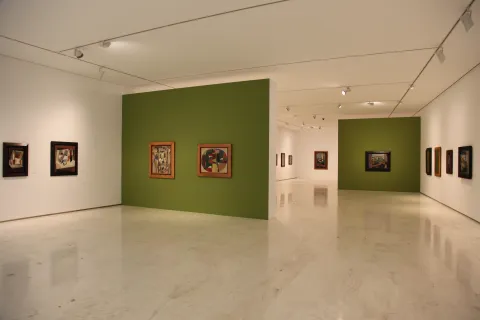
• 38 paintings by some of the great representatives of this movement centered around the work of Madrid-born Juan Gris, of whom twelve works will be displayed, including the oil painting Nature morte à la serviette (1924) owned by MACA.
• This is the first time the Telefónica Cubist Collection is shown in a Spanish contemporary art museum of public character, a milestone in its touring exhibitions.
• The exhibition is completed with the documentary Juan Gris. Cubism and Modernity, by José Luis López-Linares and several educational workshops and activities. Alicante, September 30, 2014.- Not one, but many cubisms are brought together in the exhibition "Telefónica Cubist Collection" with 37 beautiful pieces of exceptional quality that can be visited from today until January 11, 2015 at the Museum of Contemporary Art in Alicante (MACA). To this selection of 37 works organized around the work of Juan Gris, is added the oil on canvas Nature morte à la serviette (Still Life with a Napkin, 1924) owned by MACA and which collector Eusebi Sempere acquired with enormous economic effort in Madrid in 1977. This work is preserved in the MACA's 20th Century Art Collection and became the first Juan Gris exhibited in a Spanish public collection. The exhibition, which brings together part of the holdings of the Telefónica Cubist Collection, is structured in three areas: the work of Juan Gris –11 exceptional pieces by the Madrid artist–, the vision of other cubisms with the work of other contemporary artists who worked in Paris (Gleizes, Metzinger, Marcoussis, Lhote, Valmier, María Blanchard...) and, closing the exhibition, the international expansion of the movement reflected in the presence of Spanish and Latin American artists. This is the first time the Telefónica Cubist Collection is shown in a Spanish contemporary art museum of public character, a milestone in its touring exhibitions. The exhibition is completed with the documentary Juan Gris. Cubism and Modernity, by José Luis López-Linares and several educational workshops and activities. Many Cubisms The Telefónica Collection highlights the diversity of cubist proposals and techniques developed over time, as Cubism was more than an avant-garde: it was the artistic movement that inaugurated modernity. There was not just one cubism but many cubisms. Founded in Paris at the end of the first decade of the 20th century by Braque and Picasso, its temporal limits extend beyond the 1920s, when other artists join to redefine it. Through a revolutionary way of painting, cubism changed forever the way we look at painting: now the viewer must traverse planes, lines and colors, arranged according to their own rhythm that demands not only sensory contemplation, but also an intellectual exercise of reconstruction.
Above all, cubism is based on intense work of deconstructing reality, renouncing conventional perspective, absence of details and geometrization of forms. Its capacity for transformation made it an aesthetic legacy that has endured over time. Juan Gris, the Purest of the Cubists Juan Gris developed a notion of painting capable of structuring his entire aesthetic trajectory with great coherence and powerfully influencing that of other artists, from his time to today. He joined the cubist movement when it was already founded to refound it, creating a universal plastic language related to modern classicism and abstraction called second cubism or synthetic cubism. Juan Gris does not start from nature to go to the abstract but from the abstract of geometry and the plane of color to go to reality. A new definition of cubism carried out between 1916 and 1923 that gives unity to the painting, now converted into a true architecture of forms and colors. For Juan Gris, cubism was not a pictorial procedure but an aesthetic, a state of mind that permeated his vision of modernity. The artist is represented in the Telefónica Cubist Collection in the diversity and complexity of his trajectory. From the works of the first decade of the 20th century characterized by the fragmentation of the image, restrained chromaticism and rigorous geometrization of forms to his works of the 1920s, nuanced with color, more lyrical, more naturalistic that include the exterior, organic life and the curve. Juan Gris always seeks dialogue between painting and poetry. Inventor of plastic rhymes—a sort of aesthetic metaphors—, his canvases hide symbolic games, correlations of forms and figures that give plasticity and sensuality to his eternal works.
The Cubist Movement in Paris
Traditionally art history considers that cubism was born in 1907 and died in 1914. But in times of cubism, being a cubist was something more complex and diverse. To the first artistic avant-garde of the century were added, besides Picasso and Braque, the most important artists. Some initially adopted the cubist aesthetic, such as Picabia, Duchamp, Lipchitz, Leger, Gleizes or Metzinger, the latter authors of On Cubism – Du cubisme—, a highly influential text in which they expounded their theory of the flat plane and multidimensional perspectives. Others joined later such as Dufy, Derain, the Delaunays or María Blanchard who did so for a brief but intense period in which she created a series of still lifes of great geometric purity. And among them, Guillaume Apollinaire drafting the text that would serve as a false manifesto, The Cubist Painters. The study of the Parisian environment between 1914, the date of the beginning of the First World War and 1924, year of publication of the Surrealist Manifesto, has demonstrated the persistence and development of the cubist experience illuminating a second period as fertile and "heroic" as the first. New registers always around Juan Gris. Artists who worked beyond canonical cubism affirming the plastic possibilities of color, betting on the aesthetic and communicative qualities of form, giving spatial sensation and depth to compositions..., landscapes and still lifes, that capture our gaze.
International Expansion in Spain and Latin America
Several artists who participated in cubism played a leading role in the modernization of Latin American art, extending geographically the avant-garde movement: networks, crossings, personal relationships and travels that transport and transform cubism from one side of the Atlantic to the other. In the Uruguayan Rafael Barradas or in the Argentines Pettoruti and Xul Solar, the imprint of this movement is evident. The works of the Brazilian do Rego Monteiro or the Uruguayan Torres García start from cubism but point to other influences such as primitivism. Novel are the calligrams of the Chilean Vicente Huidobro, a union of painting and poetry by combining image and text. The Spanish artists Joaquín Peinado and Manuel Ángeles Ortiz transformed and reinterpreted the cubist language with the incorporation of landscape in the case of the latter.
The Museum inaugurates the exhibition that will remain during the months of July to September in the temporary exhibitions room of the MACA, composed of a selection of 18 works, belonging to the private collection Mariano Yera.
The YERA Collection:
The origin of the collection dates back to 1999, when Mariano Yera together with Javier Lacruz, began collecting Spanish painting from the second half of the 20th century under the name of De Pictura Collection, becoming known, from 2013 onwards, as the Mariano Yera Collection.
The Collection follows the evolution of art history in Spain as the main pictorial currents and their most outstanding authors are represented. It is composed of more than one hundred and forty works of great quality, all of them expressive of the particular perspective of each of the sixty-three artists that make up this singular testimony of Spanish pictorial creation from the 1950s of the last century until the end of the twentieth century, a period rich in artistic proposals of enormous relevance. As Valeriano Bozal rightly points out in History of Painting and Sculpture of the 20th Century in Spain II. 1940-2010 "...these were years in which some of the most important works of our modern art were created".
It brings together artists and movements such as the Pórtico groups (Lagunas, Aguayo and Laguardia) and Dau al Set (Tàpies, Cuixart or Ponç), pioneers of post-war plastic renewal; from the El Paso group (Saura, Millares, Feito, Rivera or Viola), from Equipo 57 or from the Chronicle of Reality (Equipo Crónica, Equipo Realidad or Genovés). Likewise, the Collection also includes works by members of the Trama group (Broto, Grau or Tena) and by artists of the caliber of Gordillo, Alcolea, Pérez Villalta, Cobo, Barceló, Sicilia or Campano among others, to which are added younger creators. Many of the works in the collection, some of which are now on display at the MACA, have been part of important collective exhibitions.
During the 32nd edition of the ARCO International Contemporary Art Fair in Madrid, Mariano Yera was awarded the Prize A for Private Collecting. The family's intention is for the Collection to contribute to the knowledge of the work and thought of these artists, a reflection and testimony of a time when Spain barely had a presence in the international artistic panorama.
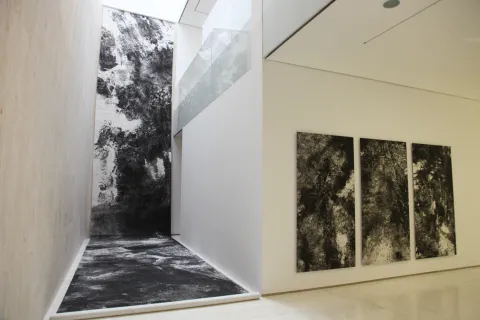
The exhibition titled Metamorphosis by artist Bingyi has been jointly organized by Miguel Hernández University, the Museum of Contemporary Art in Alicante (MACA), and the Charpa gallery in Valencia. The exhibition can be visited until June 29th. The exhibition consists of three plates and an endless roll of paper that are part of her most recent creation, evoking her travels through the sacred Chinese mountains; rolls of paper and Chinese ink of large proportions that unfold lengthening like springs in the spaces where she intervened. In the "Metamorphosis" exhibition, Bingyi resorts to plays of light and shadow, soft and delicate stains, characteristic of haiku poetics, where the artist likes to express herself, manifesting her amazement and rapture produced by the contemplation of nature. More information in the complete note.
From April 15 to June 8, 2014, the MACA presents an exhibition that brings together a selection of works that are part of the Caja Mediterráneo Collection, deposited at the MACA thanks to the agreement signed between the Alicante City Council and the Caja Mediterráneo Social Work. Works created using very diverse techniques and media: painting, sculpture, analog and digital photography, prints, projections, collage or installations, etc., populated with men and women. Of Human Nature brings together a series of pieces by different artists that share in common the representation of the human dimension. Narratives around the human body as a figure, as an individual, as a fragment but also as a sum or multitude. More information in the complete note.
The museum participates in the Festival Miradas de Mujer 2014, with this exhibition by Capella del Ministrers on the cycle of life. This has been made possible thanks to the sponsorship of La Fundació BancSabadell, organized by Capella de Ministrers and the Municipality of Alicante, in collaboration with the Universitat de València. Since its creation in 1987, the Capella de Ministrers group, under the direction of Carles Magraner, has developed important research and musicological work in favor of Spanish musical heritage, from the Middle Ages to the 19th century. The result, transformed into musical testimony, perfectly combines three key factors: historical rigor, musical sensitivity and, most especially, an irrepressible desire to communicate with us and make us participants in these experiences. More information in the complete note.