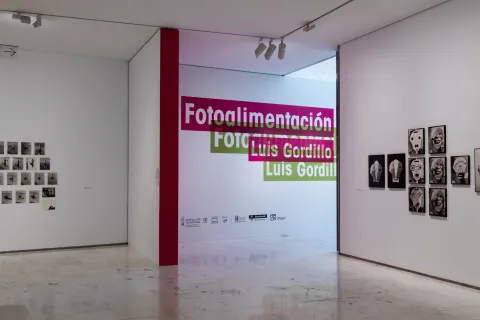
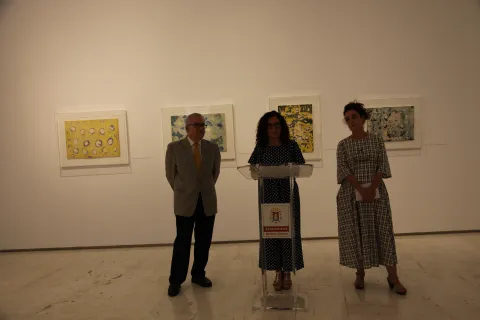
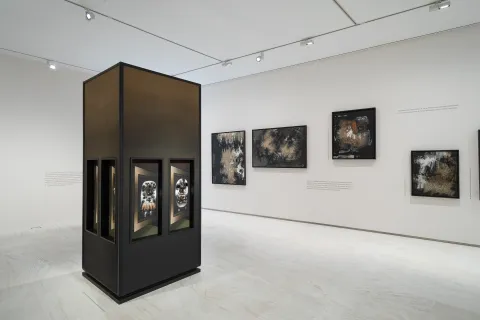
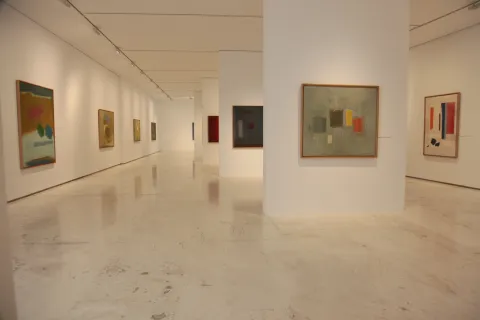
Gordillo returns to the Valencian Community with an exhibition of his photographic experimentation at the MACA

Submitted by brandcode_deweloper on
Organizes: Consortium of Museums and Museum of Contemporary Art of Alicante

Collaborates: City Council of Alicante

Curator: Luis Gordillo and Rosa María Castells

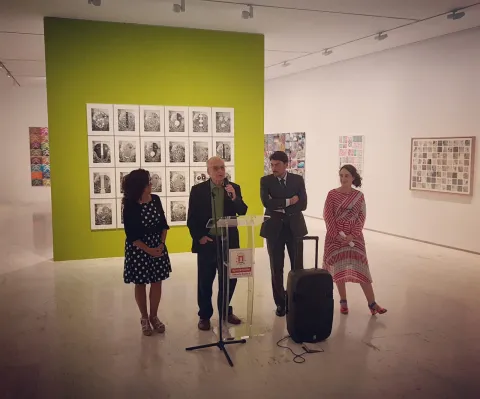
"In the seventies I used black and white photography for numerous purposes, but perhaps the most important one and the one I have maintained over time, is to analyze the organic elements of painting, neutralizing and reifying the gesture.

Currently I try to create spaces in which painting and photography dialogue and interact with each other; I attempt to articulate ways for the expansion of photography in my work.

I continue to be primarily interested in painting as a bodily interrogation; nevertheless, the technical intervention of photography creates a dialectical tension, a growing mental space".

Luis Gordillo More information in the complete note.
NP-0034
Imagen
IMG-20181026-WA0113.jpg
maca.comunicacion@alicante.es
Juana Francés. Up to the Sky, from the Bottom of the Sea

Submitted by brandcode_deweloper on
Organizes: Museum of Contemporary Art of Alicante and Department of Culture

Collaborates: Provincial Council of Alicante

Juana Francés

(Alicante, 1923 - Madrid, 1990) is one of the most forceful artists in the trajectory of Spanish visual art of the twentieth century; founding member and the only woman of the El Paso group, she was always a creator of strong character and extreme sensitivity not always recognized.

We present works from the "Juana Francés Collection", a legacy of the artist to this Museum. It is composed of more than one hundred works including drawings, paintings, boxes, towers, silkscreens and lithographs that span all her creative stages: from the first figurative works to the dazzling informalist pieces that gave way to her most radical works: the "boxes", where she reflects on the dehumanization of man. The search for harmony and balance, through the use of color, is materialized in the subtle papers of underwater backgrounds, to take up again, at the end of her life, gesture and matter.
NP-0033
Imagen
IMG_1404.jpg
maca.comunicacion@alicante.es
Esteban Vicente. Painting has to be poor

Submitted by brandcode_deweloper on
Esteban Vicente Museum of Segovia Collections.

Organized by: Museum of Contemporary Art of Alicante and Esteban Vicente Museum of Segovia.

The Esteban Vicente Museum of Contemporary Art, inaugurated in April 1998, houses a collection of 153 works by artist Esteban Vicente (Turégano, Segovia 1903 – Long Island, New York, 2001), a member of one of the most important movements of the second half of the 20th century, American Abstract Expressionism.

This collection, generously donated by the artist, encompasses his entire artistic and vital trajectory and is a fundamental point of reference for researchers and scholars interested in the era.

The title of the exhibition Esteban Vicente. Painting Must Be Poor alludes to a text written by the artist, originally in English "Painting should be poor" that speaks to us about the creative process of a work of art and the meaning of his painting. The exhibition comprises a selection of 27 works from the Permanent Collection of the Esteban Vicente Museum of Contemporary Art that allows for a journey through the artist's evolution in his different creative stages. More information in full note
NP-0032
Imagen
IMG_0027.jpg
maca.comunicacion@alicante.es
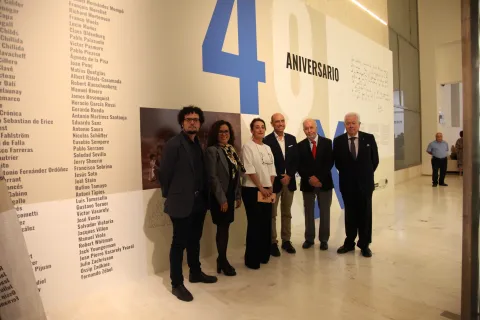
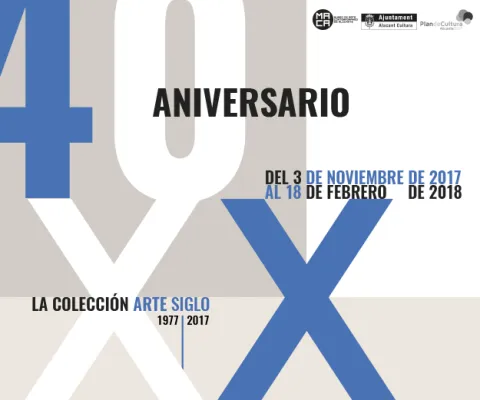
40th Anniversary of the 20th Century Art Collection

Submitted by brandcode_deweloper on
The 20th Century Art Collection was donated by Alicante-born artist Eusebio Sempere to the city of Alicante to inaugurate the Museum of La Asegurada on November 5, 1977, one of the first contemporary art museums in Spain. That was 40 years ago now. Founding a museum in the midst of democratic transition was a political act in itself: Sempere's was an attitude and a conviction. Donating his private collection was a consequence of a deep commitment to contemporary art. An act of extremely generous faith that on that day brought together the most important artistic personalities alongside a Sempere brimming with conviction about the transcendence of his gesture.
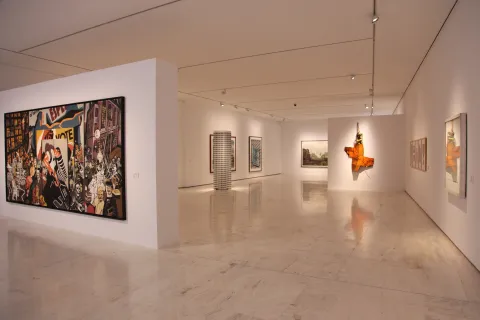
Today, the 20th Century Art Collection constitutes the basic pillar of MACA, the Museum of Contemporary Art of Alicante. An excellent collection, with international scope, coherent and effective, which holds the best works by the protagonists of almost all artistic trends of 20th century art. It is composed of 177 works by 117 artists including paintings, sculptures, drawings and graphic works that have been shown, throughout history and for various reasons, in a fragmentary manner.
Never before had it been shown complete at the same time. And this 40th anniversary is a good reason for it. Occupying the Ground Floor and the First Floor we can discover the great importance of this 20th Century Art Collection. The 177 pieces, the 117 artists with the same objective as its founder: to facilitate public access to contemporary art. More information in the complete note.
NP-0031
Imagen
MACA - Museo de Arte Contemporáneo de Alicante
maca.comunicacion@alicante.es

Lost in the City shows urban life in the IVAM collections at MACA

Submitted by brandcode_deweloper on
The city is one of the most characteristic symbols of modern society. Cities are the spearhead of the most outstanding experiences and the boldest behaviors, the place of maximum development of the arts. For this reason, many artists have the life in cities as a central element of their works, cities understood (often) as a collage of a multitude of discontinuous and fragmented memories and experiences, as a confusing labyrinth in which inhabitants cross paths immersed each in their own thoughts.

The central idea of this exhibition is to show works that allow us to know the multiple visions, the different spaces and the great quantity of human existences that have shaped life in cities over the last century, through works from the IVAM collection. The institution holds among its collections the most comprehensive and complete vision on this subject that can be found in a Spanish museum. The interest is to show it beyond its halls, as a temporary exhibition at the MACA, Museum of Contemporary Art of Alicante, thus contributing to the dissemination of the collections and redefining the collaboration agreements between institutions, IVAM and MACA and between administrations, Generalitat Valenciana through the Conselleria d' Educació, Investigació, Cultura i Esport and the City Council of Alicante. More information in the complete note.
NP-0030
maca.comunicacion@alicante.es

Ángeles Marco is the protagonist of the third exhibition of Every Landscape is Fiction

Submitted by brandcode_deweloper on
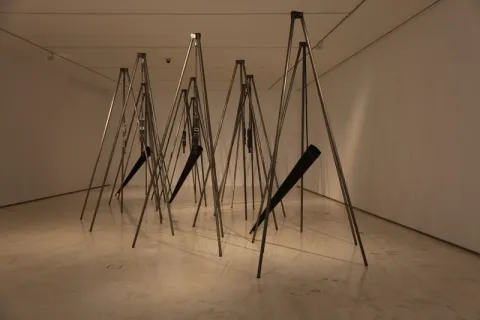
The installation, of variable dimensions, is composed of 14 iron tripods, six of which
have safety belts suspended from them, covered with graphite powder; three have rubber
cones attached by metal bars, and four are arranged empty.
This is one of the most hermetic works and of greatest constructive rigor by the Valencian artist in
which an underlying narrative background subsists. I seek, she explains, "to provoke sensations of instability, so that
each object created does not die with its representation. Nothing is static, not even we
ourselves. I am interested in that having a projection in sculpture; that is why the sensations I wish to
provoke are not so much sculptural as human".
Tripods, safety belts and bottomless wells resemble a forest, a landscape flooded with
thick and dark fog in which it is impossible to walk. An invisible and unfathomable reality. And in the
forest, a series of bottomless wells where the soul resides in a deep abyss of dark and
black water. An example of conceptual landscape, with no intention whatsoever of creating beauty, in the wake of
minimalism, a sculpture far from the academic: from a cold metal tripod, hangs a black rubber
cone tilted. The opaque black and the cold metallic gleams and bright contrasts that
geometric rigidity with a less strict geometry, that of the cone-shaped form with a more manual appearance. One must
lean in to see the bottom. And not be frightened. More information in the complete note.
NP-0029
maca.comunicacion@alicante.es
Every Landscape is Fiction 2 opens at MACA with works from the Mediterranean Foundation Collection

Submitted by brandcode_deweloper on
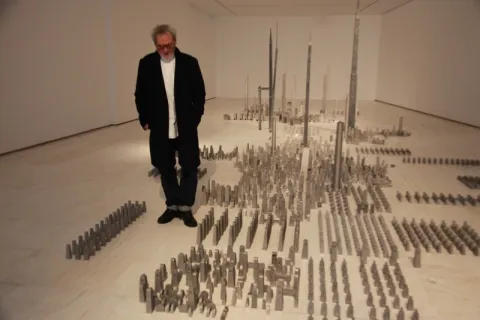
Miquel Navarro's first Ciutat was exhibited in 1974 at the College of Architects in
Valencia. Since then, the sculptor specialized in these installations, sculptural landscapes
composed of assemblies of small variable elements in series, thus constructing urban landscapes. In apparent contradiction, Navarro builds cities as a way of creating landscape.
And this obsession with the city as plastic material is explained through his biography. Miquel Navarro
was born in Mislata, a city near Valencia with a large area of farmland.
The artist witnessed the disappearance of the rural landscape gradually conquered by the metropolis,
by the urban expansion of the capital while disappearing at the frenzied pace of
industrialization. The city was invading the rural landscape.
Since the 1970s, Miquel Navarro has built cities, small or large installations that
extend, across the surface and from a bird's eye view, dozens, hundreds or thousands of pieces in wood, terracotta,
lead, zinc or glass of different sizes that configure a metaphysical landscape. Landscape as
a reflection of the world around us but also about our own gaze or way of looking at that
world around us. Miquel Navarro has managed to develop a way of approaching the
artistic phenomenon that is extraordinarily singular in the context of contemporary
western sculpture. More information in the full note.
NP-0028
maca.comunicacion@alicante.es

The MACA inaugurates the exhibition Every Landscape is Fiction. Mediterranean Foundation Collection

Submitted by brandcode_deweloper on
The Fundación Caja Mediterráneo Collection is composed of 213 works of art. Painting, drawing, sculpture, photography, video, installations, digital techniques… that span the work of 126 essential artists in the contemporary Spanish art scene, from the democratic transition to the present day. The Collection is deposited in the MACA, thanks to the agreement signed by the City Council of Alicante and the Fundación Caja Mediterráneo.
The representation of landscape in painting constitutes a classical genre that originated in bourgeois Holland in the seventeenth century, immediately enjoying success. Landscapes educated or dominated by man, seascapes, panoramic vedute of the eighteenth century, sublime landscapes of romanticism, tormented, dreamed, existing or real…. Landscape has been a way of expressing man's position in the world. It is a genre so embedded in classical tradition that it reveals itself as one of the most fertile and productive fields of investigation in contemporary art. A genre laden with new meanings.
Landscape is not nature or the place that is observed but a cultural construction that requires interpretation. Landscape is constructed at the very moment it is observed. It only exists through sight and thought. And one must observe both the visible and the invisible.
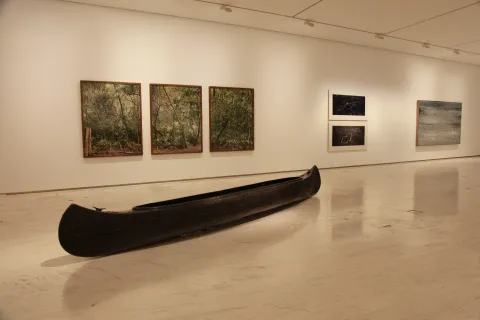
Every Landscape is Fiction brings together a series of works that share the common thread of reflecting on landscape and its contemporary representation. A broad selection of artists who, from different perspectives and through various techniques, have given landscape a leading role in their works. Paintings, sculptures, drawings, photographs, installations and videos make up this exhibition as we interpret landscape subjectively, while generating social awareness, concern about human intervention, discovering the past, speaking of lived time, of the people who inhabited, of the memory of the place… all of this while we long for the lost paradise. More information in the full note
NP-0027
maca.comunicacion@alicante.es

The Heterotopias exhibition with works from the CIRCA XX Collection becomes the new proposal of the MACA

Submitted by brandcode_deweloper on
This selection of works from the CIRCA XX Collection is titled HETEROTOPIAS, a neologism coined in 1967 by French philosopher Michel Foucault, which he constructed from the Greek words "heteros" (different) and "topos" (place), as a critique of history's exclusive interest in time. The concept of HETEROTOPIA reclaims the contemporary world par excellence, an era where space is heterogeneous, simultaneous, juxtaposed where the near and the far coexist, one beside the other and the dispersed; where we find those "other places" in which elements distributed through time form a set of relationships, a map of networks and synergies, a fatal interweaving of time with space.
For Foucault a museum or a library is a heterotopic place, a counter-space that brings together opposing spaces that organize themselves without any logic, generating "a place without place" where time ceases not to accumulate and pile up upon itself. A collection of artworks such as CIRCA XX responds to that same concept: the idea of accumulating everything, of constituting a kind of general archive, the will to enclose in one place all stages, all forms, all times that are in turn outside of time… a sort of perpetual and indefinite accumulation of time in an immovable place…
To review that place where diverse contradictory utopias coexist is the interest of this exhibition. Apparently discordant concepts that coexist becoming permeable: space/time, optical/chromatic, perceptive/non-visible; finite/non-finite… Through transgenerational connections we propose a reading without chronology. Only to look.
Early artists linked with artistic avant-gardes that seek the essence of forms by banishing the superfluous and retracing steps back to the origin, to the foundation of forms to be witnesses to the conjugations of black and the dissipations of transparency. More information in the full note
Other artists experiment with color and geometry: formal logic and constructive tradition are combined with computation and new technologies proposing visual games, concrete optical effects, dynamic, as virtual as they are perceptible subjected to a frenetic rhythm established by the repetition and interaction of colors.
And transforming perception, placing emphasis both on what is seen and what is suggested, later artists announce cold and distant environments subjected to the very fact of seeing or not seeing, dazzled by color or by its absence, traversed by a blinding light close to invisibility that constructs a mental state in permanent blur, an artificial atmosphere that embodies the abstraction of reality.
The HETEROTOPIAS constructed in real time and space are the places where utopias are fulfilled. More information in the full note.
NP-0026
maca.comunicacion@alicante.es

Spaces of resistance, the new exhibition that opens at the MACA, with the objective of making the viewer think

Submitted by brandcode_deweloper on
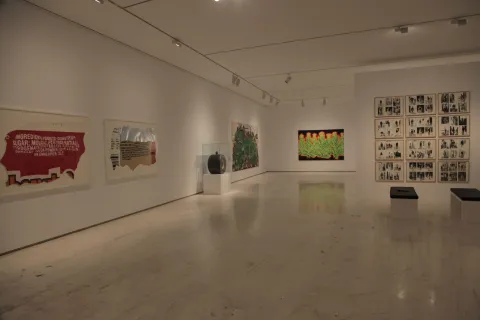
Spaces of Resistance brings together a series of works that seek critical spectators. Questioning social and political reality, consumer society, the media, advertising, the city, public space and the presence of power and its mechanisms of social inclusion and exclusion, these artists present uncomfortable, acerbic, provocative works… A cross-cutting proposal where the artistic creation process becomes the work itself or that constructs and deconstructs a fragmentary reality.
Through new formats, languages, media and contemporary techniques, video, photography, installation, computer programs or even through painting and sculpture, the works displayed always demand an active and committed spectator. Heirs to the conceptual practices developed in Spain, especially in Catalonia and Andalusia in the 1960s and 1970s and with a strong linguistic charge, these works draw a landscape of transgression of artistic behaviors that manages to dematerialize art or to construct it with archives, documents, image fragments, everyday objects, poor materials such as dust or cigarette butts and strange odds and ends that acquire other meanings. More information in the full note
NP-0025
Imagen
IMG_7544-scaled.jpg
maca.comunicacion@alicante.es