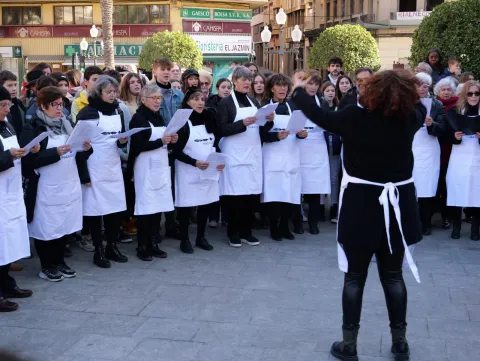
Harmonic Procession (sound route) The first harmonic procession took place in 2012 in New York, where I lived thanks to the Fulbright Scholarship. There I realized that people lived outside themselves and that capitalist society forced them to survive and forget who they really are. So I looked for a way to raise their awareness and help them think through a series of questions, and through a sound interval sung or played by all the people who are part of this walk.
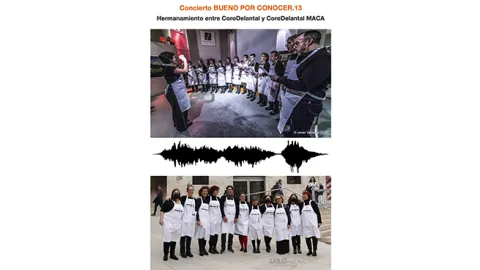
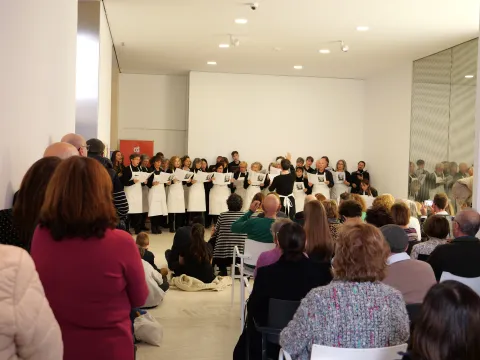
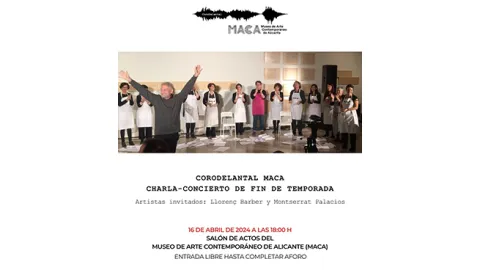
On this day we will have the CoroDelantal of the MACA together with the CoroDelantal de Madrid.
Join us with your voice or your instrument! At 6:00 PM at the museum entrance.
Contemporary saxophone at the MACA by the Lumina Ensemble group. With composer Eneko Vadillo
Born in Málaga where he completes his first music studies in Composition, Orchestra Direction, Piano and Analysis. He finishes his studies in composition, electroacoustic composition and Orchestration at the Royal Superior Conservatory of Music in Madrid with Antón García Abril and Zulema de la Cruz, obtaining the End of Studies Award and the Flora Prieto Award. His works have been performed by various festivals and ensembles: Aleph of Paris, Taim Granada, Philharmonic Orchestra of Málaga, BBC Philharmonic Orchestra, Nouvel Ensemble Moderne of Montreal, ASKO Ensemble Amsterdam and the Seville Symphony Orchestra, among others.
During the year 2004 - 2005 he was a visiting professor of analysis and composition at the Superior Conservatory of Music in Tenerife. He is Professor of Composition, Analysis and Orchestration at the Royal Superior Conservatory of Music "Victoria Eugenia" in Granada.
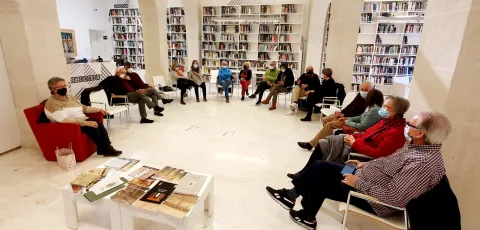
MACA, Museum of Contemporary Art of Alicante is carrying out The Afternoon Snack. A mediation project coordinated by educator Alba Cacheda, in collaboration with the Consortium of Museums of the Valencian Community, aimed at elderly people.
During the months of October to December 2021, every Wednesday and around an afternoon snack, a space for exchange and learning has been created, where the knowledge of the Group has intersected with the contents of the Museum's Collections.
As a result of these encounters, the Group proposes the creation of a platform to give visibility to artists who live in Alicante. This pilot project at MACA, titled The Corner of Local Creators, aims to showcase different Alicante creators, deepen and expand knowledge about contemporary art and learn to view the collections housed in MACA from another perspective.
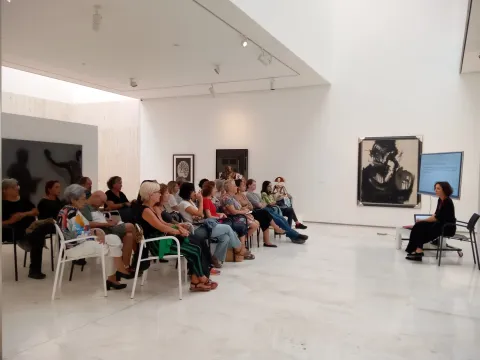
The Corner of Local Creators will materialize with a series of sessions in which an artist will be invited to present their artistic trajectory, sharing their artistic concerns and reflections, the development of their creative process, their techniques, etc.
Beneath the frescoes of the Royal Monastery of Santa Clara de Toro (Zamora), the signature of Teresa Díez appears inscribed: «TERESA DIEÇ ME FECIT». Author or possible patron of one of the scarce murals from the Spanish Gothic period (14th century) signed by a woman, and dedicated, in this case, to the effigy of Saint Catherine of Alexandria. The blessed woman whose «golden legend» recounts how in her martyrdom she dismantled a toothed wheel with her own faith, before being beheaded by the emperor Maxentius (306-312).
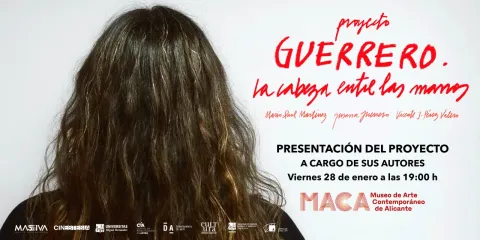
The artist Susana Guerrero, in collaboration with filmmakers Mario-Paul Martínez and Vicente J. Pérez, recovers the work of this enigmatic figure of sacred art, as well as her interpretation of the martyrdom of Saint Catherine, in a project that combines audiovisual media and sculptural installation. On one hand, featuring a documentary short film that addresses Guerrero's trajectory and the mythological and cultural imaginaries that link her to these important figures in Art History. And, on the other hand, featuring a series of sculptural installations created by Susana Guerrero herself, as a result of these investigations into Saint Catherine and Díez (and that connection between centuries and women artists that is being researched).
The documentary Guerrero. The Head in Her Hands, follows the creative processes of these and other works by the artist. Accompanying her in her own work studio (Elche), in the foundry and welding workshops of the Faculty of Fine Arts (Altea), or in the terrains where she collects materials, while also reflecting on her own work: how her stays in Greece and Mexico opened her eyes to the importance of myths and popular traditions; how rituals play an essential part in her artistic processes; or how working with the everyday constitutes an «anthropology of experience», key to approaching her work. Accompanying her in these reflections will be art critic and member of the North American Academy of the Spanish Language, Joaquín Badajoz (Cuba/New York), the director of 532 Gallery, Thomas Jaeckel (New York), and the director of the Museum of Contemporary Art of Alicante (Alicante), Rosa María Castells.
The sculptural pieces that accompany and are exhibited alongside this video speak to us of the severed body of Saint Catherine, rewriting it as a beheaded woman who survives her decapitation. A reconstruction of her body through her legend, her attributes and her martyrdoms, translated poetically and symbolically into metal structures embroidered with agave leaves, in enameled ceramics and flesh made of braided cables: an «object of faith» with which to invoke the power of this sacred figure.
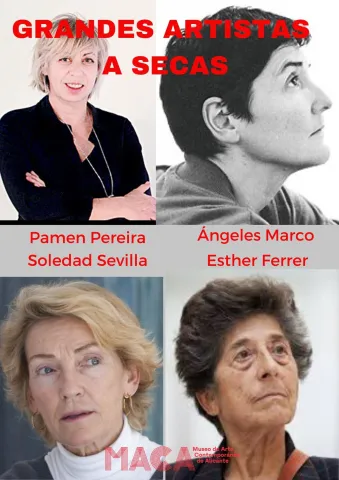
Guided tour with vermouth for the general public touring the rooms and works of women artists.
Traditionally, women have been considered second-class citizens in the world of culture. This position was based on a statistic supported by a very limited number of women who had stood out in the field of literature, thought, and the plastic arts. This idea crumbles when faced with a simple consideration: the reduced opportunities they had to develop their personal talents.
We will focus on Pamen Pereira, Esther Ferrer, Soledad Sevilla, and Ángeles Marco, attentive to the plastic concerns of their generation and shaped by their sociocultural context.
We will get to know not only their work but also their lives, with the intention of awakening a new perspective that recognizes women's work in overcoming the roles and models imposed throughout the history of art dominated by the male sex.
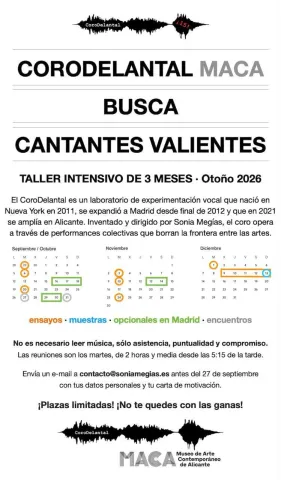
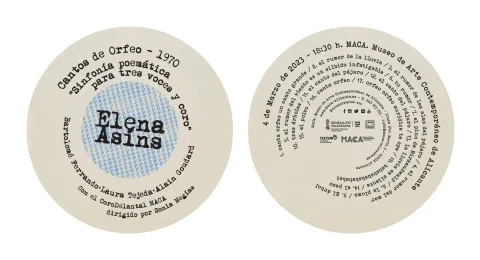
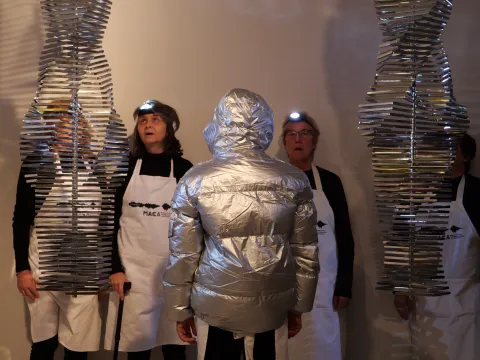
A vocal experimentation group that was born in New York in 2011 and continued in Madrid from the end of 2012. In 2025 it celebrates its 5th edition at the MACA.
Round table discussion on vulnerability on the occasion of the Henri Cartier-Bresson Exhibition.
Participants:
Juan Antonio Roche, professor at the University of Alicante, Department of Sociology I
Cristina Guirao, professor at the University of Murcia, Department of Sociology
Juan Manuel Zaragoza, University of Murcia, Department of Philosophy
Lecture by Jorge Pulla, professor at the University of Alicante, Department of Communication and Social Psychology on the occasion of the Henri Cartier-Bresson Exhibition.
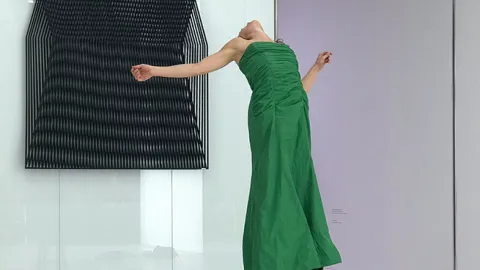
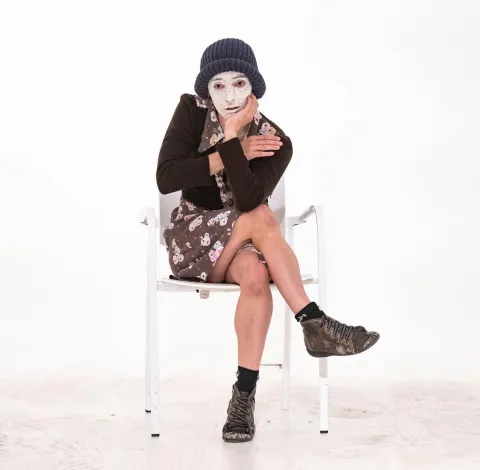
She draws inspiration from the everyday aspects of living. Physical theater becomes a central axis. Absurdity, poetry, and physicality combine narratively. Humor and transformation are essential parts of her pieces. Nadine has developed her work with companies and choreographers in Canada, Germany, and also from her platform based in Barcelona.
"My work is based on the exploration of the abstraction of dance or movement, placing it in a concrete situation that transforms it into something more conceptual. This allows me to emphasize the feelings and emotions of the performers on stage. Movement can seem very abstract, but as humans, we use something very tangible which is our body. The link between the real and the imagination is something fundamental in my research.
As performers, we have the opportunity to play with this fine line where nothing is completely one thing or the other, so I create this concept in bodies, and also in space. Our bodies end up being small in space, but our imagination gives us the opportunity to go beyond our physical boundaries and overcome limits. Our mind has an underestimated power and is a wonderful tool that makes everything you connect with your body become another path to seek and achieve virtuosity. But it requires time to achieve it; in fact, the concept of time is also something I like to play with. I feel a lot of adrenaline when I see speed because as a performer, I can feel the effort and complexity of the path that leads to it. But it has to be managed well so as not to disappear into it: to emphasize it, you need to have silences and moments of slowness in the body, which is even more powerful and also difficult to accept and achieve. As a creator and artist, when you find a concept to play with, it is always important to also play with its opposite. It gives you a greater range of opportunities and allows your body and mind to show the beauty of movement through a simple gesture".