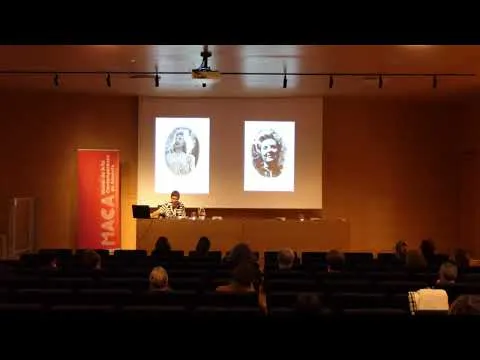
Juana Francés: context, experience and role. Lecture by María Rosón, Professor of Contemporary Art History at the Complutense University of Madrid.
After earning her doctorate from the Autonomous University of Madrid, she has worked as a researcher in the Collections Department of the Reina Sofía Museum and in the Department of Theory of Languages and Communication Sciences, University of Valencia. She has conducted research stays at Southampton University; New York University; University of Oxford and University of Leeds. In the field of museums, she stands out for curating the exhibition José Ortiz Echagüe: representing women, types and stereotypes (2010, CAM, Red Itiner) and co-curating the exhibition Women under suspicion: memory and sexuality (2013, UNED). Her research focuses on visual and material culture, mainly from twentieth-century Spain, at the intersection with feminist/gender studies. In addition to articles and book chapters, she has published, with Cátedra publishing house, Gender, memory and visual culture in early Francoism (everyday materials, beyond art). As co-editor, her work stands out in the following monographs: Poetry, cinema and humor. Tales of exception in the years of autarky (Reina Sofía Museum, 2017) and Queer barbarisms and other proparoxytone words (Bellaterra, 2017).
Her research connects the visual and material culture of twentieth-century Spain with perspectives of intersectional feminisms, dissident memories and archives.
With the support of the Ministry of Education, Culture, Universities and Employment of the Generalitat Valenciana.
Juana Francés. The Construction of a Modern Artist, 1945-1956
08.10.2025
-
25.01.2026
Juana Concepción Francés de la Campa (Alicante, 1924 - Madrid, 1990) is one of the most forceful artists in the Spanish artistic panorama of the second half of the twentieth century, a pioneer of abstract informalism and the only woman in the emblematic El Paso Group. She exhibited in important international artistic events such as three Hispano-American Biennials, the Venice Biennale, in as many as five editions, and the São Paulo Biennale. She exhibited in group shows alongside her generation's peers at the Guggenheim Museum in New York and at the Tate Gallery in London, and in notable solo exhibitions at institutions in Spain, France, and Portugal, among other places. She was recognized by critics from her early figurative period through the end of her career, but has been forgotten by art historiography. In recent years, her figure has been strongly reclaimed, affirming her quality and relevance, and at the MACA we have delved deeper into separate exhibitions on her abstract paintings. Now we propose to review the origins of her painting: the years of training, her more symbolist figurative period, and her personal transition before embarking on the generational adventure of abstract art. It is the least known period: paintings where figurative work of Italianate influence moves between restrained symbolism and surrealism with metaphysical roots, featuring rounded and voluminous figures of geometric character. Among the themes presented are maternities, portraits of children and women, families, and enigmatic still lifes as well as allegorical scenes that present an air of intriguing mysticism and that contain a spirituality that we will see emerge in later periods. On a technical level, Francés works innovatively to achieve certain textures and impastos using the encaustic technique, where she mixes wax, resin, and solvent on a rigid support, superimposing different layers of paint to "wound" them afterward with a nail. An experimental will that remains intact throughout her entire career, marking her strong plastic personality. Juana Francés is the most prominent of a group of women artists who began exhibiting in the 1950s and whose professional determination defied the society of her time: an exclusionary system that relegated women to the domestic sphere or to decorative roles in culture. Facing a hostile, normative, and rigid environment created by the social ideology of Francoism, Juana Francés managed to remain attentive to plastic concerns and to be an active part of a generation of artists who revolutionized the art of their time. Her trajectory allows us today to rethink the role of women in art history, as well as the complex relationship between aesthetic modernity and social commitment.
Lecture by María Rosón, Professor of Contemporary Art History at the Complutense University of Madrid.With the support of the Ministry of Education, Culture, Universities and Employment of the Valencian Regional Government. November 7, 2025