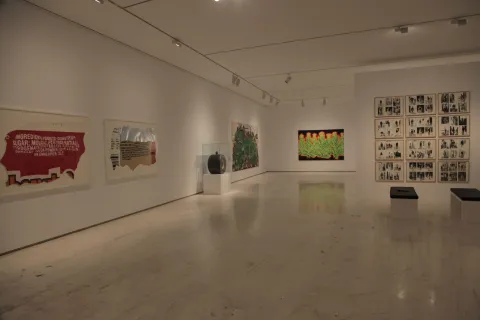
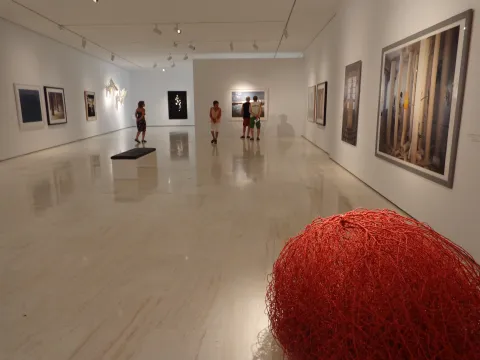
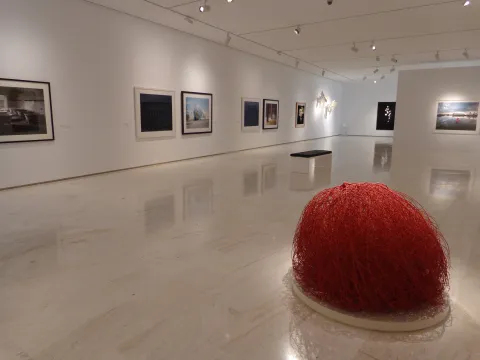
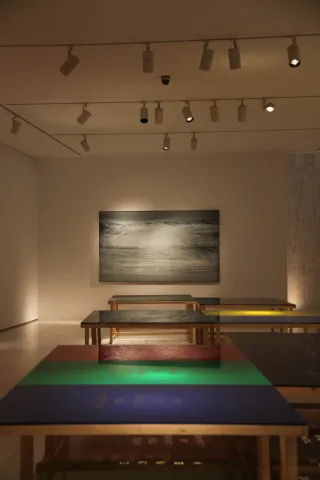
The exhibition brings together a series of works that seek critical viewers. Questioning social and political reality, consumer society, the media, advertising, the city, public space, and the presence of power and its mechanisms of social inclusion and exclusion, these artists present uncomfortable, acerbic, provocative works… A transversal proposal where the artistic creation process becomes the work itself or constructs and deconstructs a fragmentary reality.
The visit addresses issues of consumerism, the denunciation of the remnants of unbridled consumption that characterizes and obsesses human beings, and social commitment through linguistic games and the ironic juxtaposition of images...
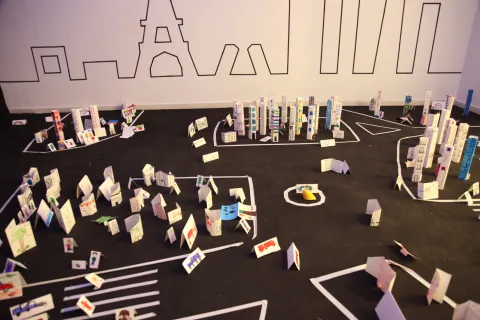
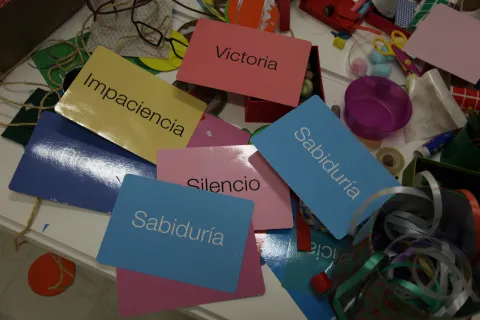
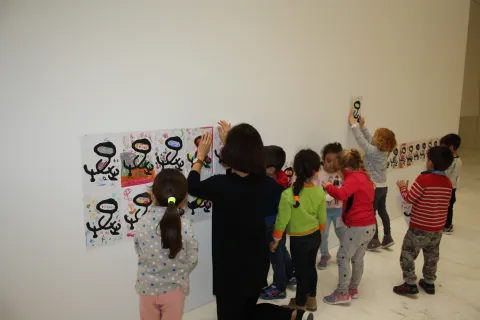
Antoni Muntada's work On Translation: Miedo/Jauf seeks to explore "how fear –a cultural/sociological construction that always refers to the political and economic sphere– is an emotion translated on both sides of the border from very different perspectives". Based on the concept of fear, we gave the public the opportunity to express their idea of fear graphically or literally. This, in turn, became a collective work that was exhibited in a museum space. All school visits represented their idea of fear, and on International Museum Day the best ones were selected and awarded.
In collaboration with the Explicarte Association.
EDUC-0052
Imagen
From Tuesday to Friday. School period
From 10:00 to 14:00 hours
90 minutes
Ground Floor
Gratuito previa reserva
Minimum groups of 8 students and maximum of 25 or class group. Up to two groups are allowed at the same time and day
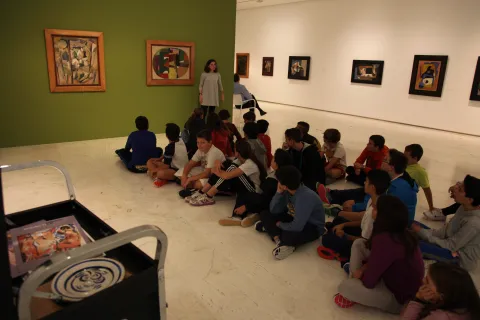
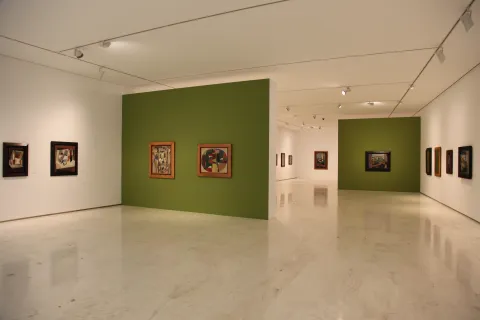
The exhibition that emerged around the contextualization of Juan Gris's work proposes a vision of Cubism alternative to that of traditional historiography.
Although the importance of this movement is vital for contemporary art, it is usually identified exclusively with Braque and Picasso, as well as limited to the artistic environment of Paris and World War I. However, there were other cubisms that gathered the different proposals of French, Latin American, and Spanish artists.
Juan Gris is one of the best representatives of these other cubisms. His work is not only important for the continuity it represents in the cubist movement after 1918, but it is also fundamental for connecting the development of modernity in Europe with Latin America.
On this occasion, visits can be organized around two fundamental themes of this movement:
The portrait, where the aim is to understand the different types of portraits: close-up or bust, medium shot or torso, full shot or full-length figure, etc. The importance of clothing for the portrait. The physical and psychological representation of a character. The title of the work—what can be known about the subject through the title of the painting?
The relationship of cubism with the different artistic expressions of the era (music, literature, performing arts) and describing somewhat the panorama in which cubist painters moved.
The still life where light and objects are the protagonists; glasses, bottles, furniture, newspapers... The windows that can be interpreted as the serene and metaphorical counterposition between the two worlds that make up the artist's vision: interior and exterior—art and life—in the borderland of the open window.
In collaboration with the Explicarte Association.
EDUC-0051
Imagen
From Tuesday to Friday. School period
From 10:00 to 14:00 hours
90 minutes
Ground Floor
Gratuito previa reserva
Minimum groups of 8 students and maximum of 25 or class group. Up to two groups are allowed at the same time and day
Treatise on Human Nature brings together a series of works by different artists that share in common the representation of the human dimension. Narratives around the human body as figure, as individual, as fragment. Between attraction and repulsion, works by artists such as Daniel Canogar, Enrique Marty, Javier Pérez, Santiago Ydáñez, Jana Sterbak or Javier Vallhonrat confront the historical vision of established artists such as Juan Hidalgo, Esther Ferrer, Albert Porta or Pepe Espaliú to position themselves in the territory of discomfort, urging us to reflect on ourselves.
Through the different works we see that the human body is the usual protagonist on which reflection occurs: the passage of time, forms, gender, gesture, emotions….
In collaboration with the Explicarte Association.
EDUC-0050
Imagen
From Tuesday to Friday. School period
From 10:00 to 14:00 hours
90 minutes
Ground Floor
Gratuito previa reserva
Minimum groups of 8 students and maximum of 25 or class group. Up to two groups are allowed at the same time and day
Inadvertent Architecture emerges from the interaction of works and artists around a discovery: the poetics of an inadvertent but present architecture formally responsible for creating literary spaces as isolated scenes from a dream. Unveiled mysteries where a column, a tree, a door, a spotlight, a hallway, a staircase… help discover the stage of a very personal aesthetic reality. Investigating what we habitually do not look at, atmospheres voluntarily blurred, symbolic and monumental spaces but also lived spaces that sometimes evoke a forgotten past, a memory that brings the trace that remains alive. Dignified Architecture that constructs a narrative landscape between representation and illusion. Universes of fiction of extraordinary beauty and evocative capacity. Self-absorbed figures in a moment prior to chaos resolved in unstable equilibrium, where the vulnerable or the fragile by its lightness, breaks.
The visit aims to show how the built environment reveals the traces of the past and the insinuations of a future. Equally, it seeks to emphasize the different ways of inhabiting that each society has in different places on the planet and to make visible the perversity of the power structures that promote the alienation and exploitation of workers, the injustice of labor relations, the unequal distribution of wealth, the perverse nature of work and money, and discrimination based on racial grounds.
In collaboration with the Explicarte Association.
EDUC-0049
Imagen
From Tuesday to Friday. School period
From 10:00 to 14:00 hours
90 minutes
Ground Floor
Gratuito previa reserva
Minimum groups of 8 students and maximum of 25 or class group. Up to two groups are allowed at the same time and day
This is a selection of works that invite the viewer to reflect on the very concept of reflection. Questions are addressed related to reflection, contemplation, space, idea, and time.
Reflection, if derived from the Latin word reflectio, alludes to the highest functions of the spirit and designates the very process of thinking carefully about something with the purpose of drawing conclusions. However, if derived from Latin reflexus, it alludes to reflection, to the image of something that can be formed on a bright and smooth surface. But the reflection of a thing also means allowing itself to be seen in another, and projecting beyond appearance or even manifesting and making evident something that perhaps until now was hidden.
The purpose of the guided visit is to immerse the viewer in the work, making them a participant in it and inviting them to reflect with each artist through their particular way of questioning reality.
In collaboration with the Explicarte Association.
EDUC-0048
Imagen
From Tuesday to Friday. School period
From 10:00 to 14:00 hours
90 minutes
Ground Floor
Gratuito previa reserva
Minimum groups of 8 students and maximum of 25 or class group. Up to two groups are allowed at the same time and day
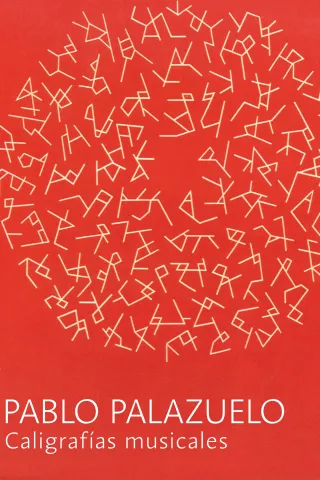
This exhibition titled Palazuelo. Musical Calligraphies aims to approach the artist's work from his relationship with music, exploring the intimate connection that exists between his work, sound, and silence. A relationship that is discovered from the earliest works created in Paris, some as evident as those written On the Staff or the sets of signs arranged in moving drawings as Forgotten Things. Also in his later compositions, rhythm, tempo, fugue, intensity, chords, timbre, and tone are essential questions… The point and the line become signs of a form of musical notation, a calligraphy that can be understood as a code and language of a primordial sound, of that music that is at the origin, that is vibration, energy that flows filling and coagulating all the spaces of the world.
With this visit we aim to contemplate how musical language underlies the entire trajectory of the Madrid-born creator as a common denominator element. We address the spatial question and the role of color as a reinforcement of the materiality of space and how colors have a musical quality and a beauty that borders on emotion.
In collaboration with the Explicarte Association.
EDUC-0047
Imagen
From Tuesday to Friday. School period
From 10:00 to 14:00 hours
90 minutes
Ground Floor
Gratuito previa reserva
Minimum groups of 8 students and maximum of 25 or class group. Up to two groups are allowed at the same time and day
The exhibition brings together a selection of works that are part of the CAM Collection of Contemporary Art deposited in this museum, thanks to the agreement signed by the City Council of Alicante and Caja Mediterráneo, for a period of five years.
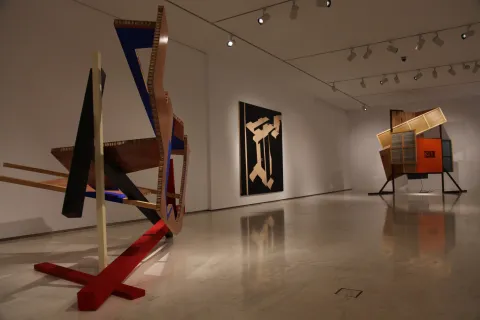
Silent Genealogies brings together a series of works by artists such as: Isidro Blasco, Toño Barreriro, Txomín Badiola, Pello Iraza, José Ramón Amondarain, Daniel Gutiérrez Verbis, Miquel Mont and Manu Muniategiandikoetxea, strongly linked and influenced by constructivism and minimalism, which share in common the elaboration process in which the architectural concept of construction and deconstruction stands out.
In these visits, questions are raised related to three-dimensionality, surface, space, idea or constructive process. To do this, three strategies are implemented: observation, dialogue and manipulation of materials, images and very diverse objects that complemented the explanation of some of the works, such as a deconstructed image of the museum and its surroundings, works by constructivist and minimalist artists such as Malevich and Mondrian, the Tatlin Tower or the Basque flag alluding to the colors most represented in the exhibition.
In collaboration with Ester G. Guixot
EDUC-0046
Imagen
From Tuesday to Friday. School period
From 10:00 to 14:00 hours
90 minutes
Ground Floor
Gratuito previa reserva
Minimum groups of 8 students and maximum of 25 or class group. Up to two groups are allowed at the same time and day
The dynamic tour of the exhibition presents a journey through Spanish art from the last third of the 20th century based on the works of the most renowned artists present in the exhibition.
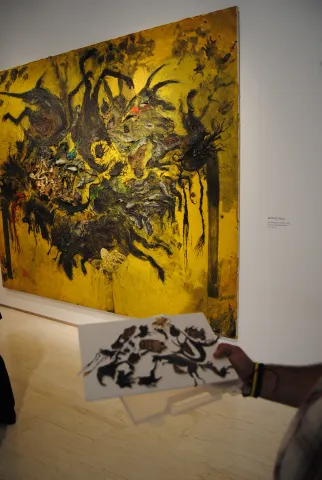
Already classic names of a contemporary aesthetic such as: Eduardo Arroyo, Miquel Barceló, José Manuel Broto, Luis Gordillo, Cristina Iglesias, Miquel Navarro, Pablo Palazuelo, Soledad Sevilla, José María Sicilia, Daría Urzay, Juan Uslé, Xesús Vázquez and Dario Villalba.
In this tour, the rhythm of brushstrokes, still lifes, the organic and the passage of time, the chromatic value of the works and other issues will be addressed.
In collaboration with Ester G. Guixot
EDUC-0045
Imagen
From Tuesday to Friday. School period
From 10:00 to 14:00 hours
90 minutes
Ground Floor
Gratuito previa reserva
Minimum groups of 8 students and maximum of 25 or class group. Up to two groups are allowed at the same time and day
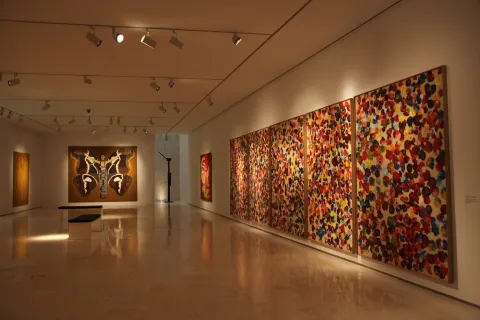
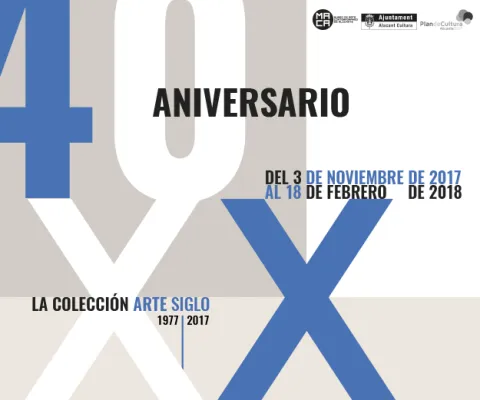
To commemorate the 40th anniversary of the inauguration of the La Asegurada Museum, the complete 20th Century Art Collection is on display at the MACA. These are 177 works by 117 artists that Eusebio Sempere gathered throughout his life and donated to the city of Alicante.
For this occasion, we have prepared a series of visits and workshops that will explore the works of the collection, a legacy of Eusebio Sempere, and therefore a heritage of the city with the objective of bringing students closer to the knowledge of the different artistic manifestations of the 20th century.
This project aims to respond to the interests and needs of students and help them analyze and understand images, educate them in aesthetic taste and critical perspective, and introduce them to the enjoyment of works of art by discovering different
approaches to the plastic arts:
AVANT-GARDES
At the beginning of the 20th century, the avant-gardes represent a revolution in the plastic arts, as they break with the way of seeing and representing reality, and there is a clear hegemony of the unconscious.
This tour aims to reflect on the concepts and ideas related to this period, to make known the general characteristics and defining features of the
most significant movements through the different pieces that bring us closer to this moment and thus understand their language.
KINETIC ART
In 1950s Paris, geometric forms become the protagonists. Kinetic art breaks with the static function of the work, and space and movement are the main characters.
The objective of this tour is to learn about the works and artists who experiment with movement, light, and the reflections produced by geometric forms with the different materials that involve the viewer in a novel way. Students will be able to interact with some of the works and achieve different optical effects.
ABSTRACTION
An artistic expression that dispenses with all figuration and proposes a new reality different from the natural one, using the language of line, color, and form to create compositions independent of visual references from the real world.
With this tour, we propose a new perspective on reality based on forms and free relationships between them. And thus understand how artists working with abstraction incorporate all kinds of objects and materials foreign to the work of art and how
they approach gesturality as a way to convey emotions.
REALITY
In 1960s Spain, a series of artists take pop art as a reference and create works full of irony that produce a confrontation between the language they use and reality, with the appearance of images from the history of art, comic books,
and advertising.
This tour aims to analyze the images represented in the works and thus understand the social function of art and its different manifestations. Through a language accessible to all, using icons from everyday life, producing in the viewer a reflection that is social or political and full of meaning.
EDUC-0044
Imagen
From Tuesday to Friday. School period
From 10:00 to 14:00 hours
90 minutes
1st floor | Ground floor
Gratuito previa reserva
Minimum groups of 8 students and maximum of 25 or class group. Up to two groups are allowed at the same time and day
Eusebio Sempere, artist from Alicante, born in Onil. His artistic trajectory is based on the search for light, movement and geometry. He is the host artist of the museum since thanks to his legacy the museum of La Asegurada was created, today MACA.
We turn Eusebio Sempere into a paradigm of the traveling artist. Throughout his trajectory he moves to cities that have become art centers while he trains as an artist. With his suitcase we travel with him through his life and the main characteristics of his works.
Stamping the oval. (Workshop)
In this workshop a stamping work is carried out using geometric shapes smaller than those that will allow creating a larger composition from different stages.
The objective is to work on the notion of space and movement through the creation of a geometric composition.
Screen printing*. (Workshop)
Sempere learned this technique in Wifredo Arcay's workshop in Paris and was the introducer of artistic screen printing in Spain. It is a workshop specialized in this stamping technique where they will learn the different possibilities of carrying it out.
*Tuesdays from 10 to 12 a.m. A group of 25 students. Exclusively for 2nd cycle ESO and High School.
EDUC-0043
Imagen
From Tuesday to Friday. School period
From 10:00 to 14:00 hours
90 minutes
1st floor
Gratuito previa reserva
Minimum groups of 8 students and maximum of 25 or class group. Up to two groups are allowed at the same time and day