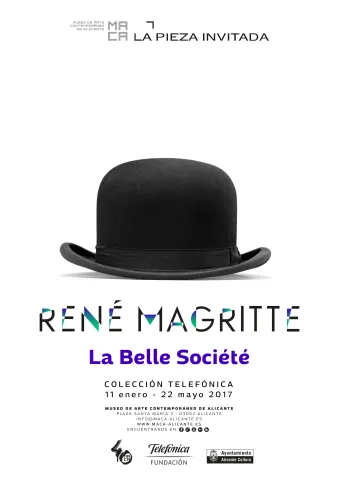
The Invited Piece. René Magritte: The Beautiful Society
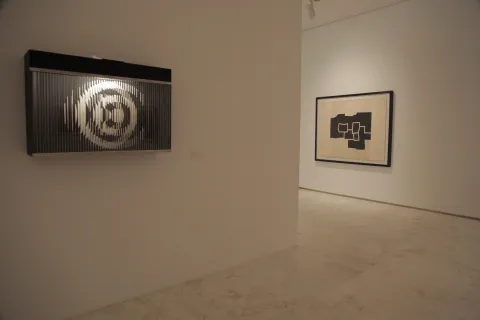
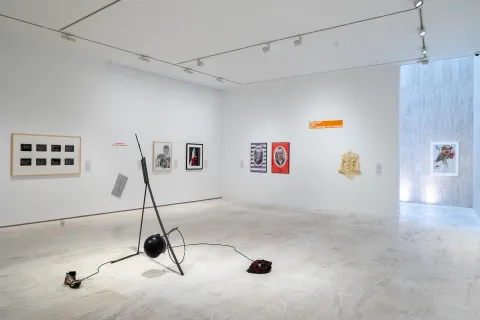
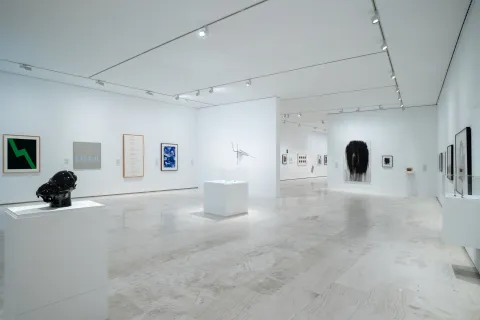
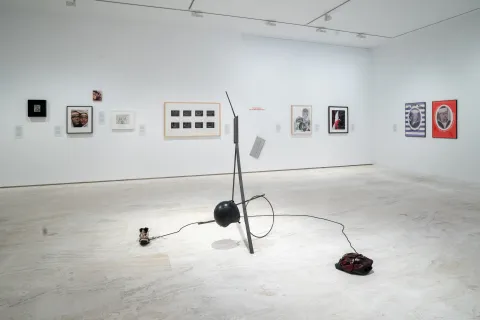
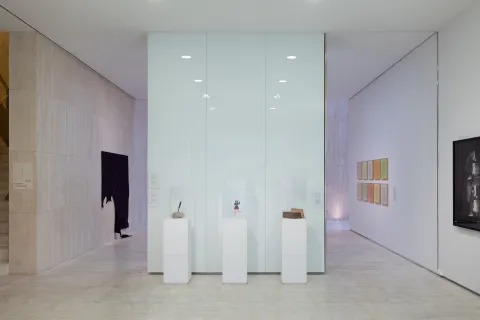
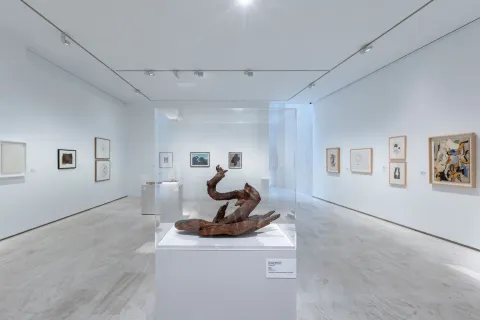
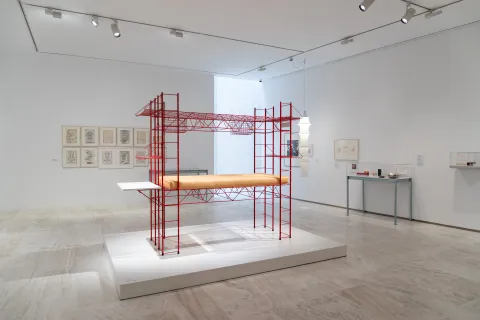
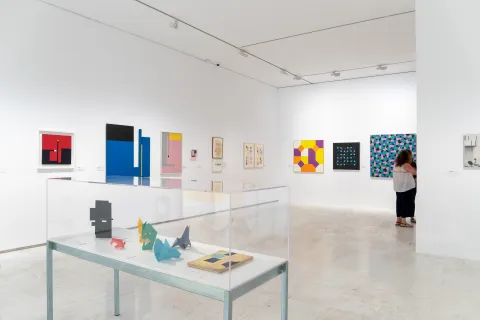
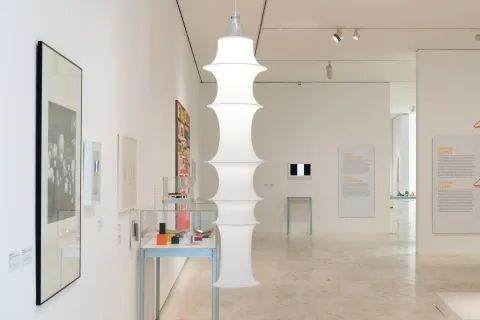
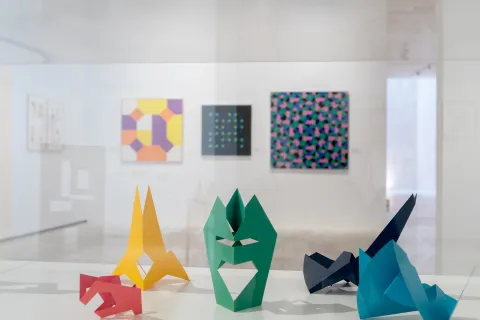
This original and avant-garde work accompanies the exhibition of works from the Twentieth Century Art Collection; it is displayed alongside very relevant pieces from the MACA, such as Kiki of Montparnasse by Pablo Gargallo, canvases and sculptures by Julio González or sharing the avant-garde space among Miró, Juan Gris, Alexander Calder or Ángel Ferrant.
In 1927 René Magritte [Lessines, Hainaut, (Belgium), 1898–Brussels, (Belgium), 1967] moved to Paris, where he befriended André Breton and became one of the most prominent members of the surrealist group. His compositions are characterized by the juxtaposition of everyday objects in unusual contexts, represented with refined painting in clear colors and flat backgrounds. This work captures one of his most celebrated motifs, the man wearing a bowler hat and faceless, which has often been interpreted as Magritte's own alter ego. Here, the figure appears duplicated and silhouetted to contain, respectively, dense foliage and a landscape with sky and clouds as protagonists. This peculiar mixture between reality and fiction produces a disconcerting image, characteristic of the Belgian master's style.
In La Belle Société, painted by the artist shortly before his death, he superimposes two silhouettes of the same character, but replaces the image of a man with contours that contain natural and landscape motifs; dense vegetation, and in front, an identical profile of beach and horizon. The silhouettes act as if they were two windows onto external reality; perhaps they observe each other, perhaps there is a perpetual conversation between two different types of nature that fail to intertwine. Far from succumbing to the automatism of the freest current of surrealism and yet without abandoning the taste for the dreamlike or psychoanalytic, Magritte draws with a sure, clean, almost simple line, with simple forms in pursuit of freedom and expressiveness of thought.
Magritte explained his conception of painting thus: "The painted image is, on one hand, the description of the visible world modified by a way of thinking, or on the other hand, the painted image is the description of the visible world understood in a spontaneous way".