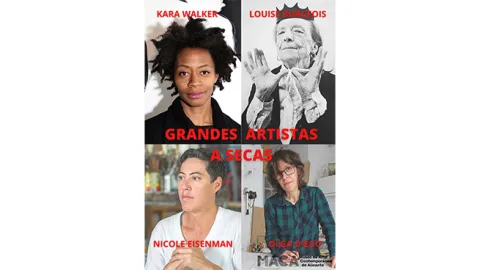
About the work of...Kara Walker, Louise Bourgeois, Nicole Eisenman and Olga Diego

Submitted by brandcode_deweloper on
Great artists, plain and simple. May 2022

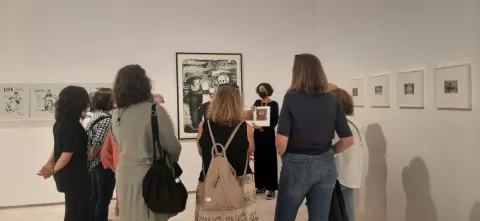
Guided tour with vermouth for the general public touring the rooms and works of women artists.

Traditionally, women have been considered second-class citizens in the world of culture. This position was based on a statistic supported by a very limited number of women who had stood out in the field of literature, thought, and the plastic arts. This idea crumbles when faced with a simple consideration: the reduced opportunities they had to develop their personal talents.

We will focus on Kara Walker, Louise Bourgeois, Nicole Eisenman, and Olga Diego, attentive to the plastic concerns of their generation and dominated by their sociocultural context.

We will get to know not only their work but also their lives, with the intention of awakening a new perspective that recognizes women's work in overcoming the roles and models imposed throughout the history of art dominated by the male sex.

Free admission until capacity is reached.

ACTI-0168
Imagen
58.jpg
Desactivado
12:00 hours
90 minutes
Library

About the work of... Ana Teres Ortega, Corita Kent, Anni Albers and Katharina Fritsch

Submitted by brandcode_deweloper on
Great artists, plain and simple. April 2022

Guided tour with vermouth for the general public touring the rooms and works of women artists.

Traditionally, women have been considered second-class citizens in the world of culture. This position was based on a statistic supported by a very limited number of women who had excelled in the field of literature, thought, and the plastic arts. This idea crumbles when faced with a simple consideration: the reduced opportunities they had to develop their personal talents.

We will focus on Ana Teres Ortega, Corita Kent, Anni Albers, and Katharina Fritsch, attentive to the plastic concerns of their generation and shaped by their sociocultural context.

We will learn not only about their work but also their lives, with the intention of awakening a new perspective that recognizes women's work in overcoming the roles and models imposed throughout the history of art dominated by the male sex.

Free admission until capacity is reached.

ACTI-0167
Imagen
15.jpg
Desactivado
12:00 hours
90 minutes
Library

Catalina. Female Sexual Initiative

Submitted by brandcode_deweloper on
MACA Live

Catalina doesn't go to a party: she is a party in herself. Before going out she tries on her four torn stockings to see which looks best on her and tomorrow she discovers the purple cheekbone, the jagged stitches, sore muscles in her calves, the hoarseness. Catalina bursts and manages, through kisses given well and badly, to make the others burst. Against the "Madame Bovary am I", which she doesn't even want to hear about, Catalina declares "The rumba am I", like Andrés Caicedo with his novel "¡Que viva la música!", who taught us to suck our hair just as "Lectura fácil", by our colleague Cristina Morales (Herralde Prize 2018 and National Narrative Prize 2019) taught us to drive the edge of the table into ourselves. Catalina sins through dance and literature, but atones for her culture with little shame.

ACTI-0163
Imagen
WhatsApp-Image-2021-11-29-at-09.04.43-1.jpeg
12:30 hours
Ground floor

The Eye of the Hurricane. Lucía Marote

Submitted by brandcode_deweloper on
MACA Live

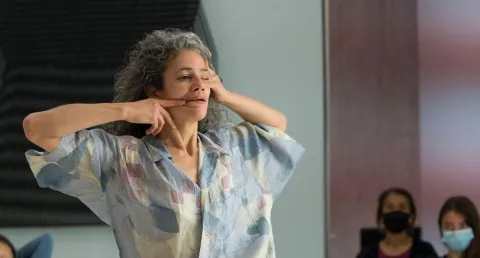
The eye of the hurricane: one is part of the eye of the hurricane, a project of bodily research and choreographic creation that stems from the action of spinning, and from how remaining in this action can transform us and allow the personal and the subtle to emerge and become perceptible. It is a leap into the void, a serene challenge to limits through continuity and persistence. If I could approach something similar to meditation, it would be through action, through an action that would involve my entire body and attention so that the mind would also have to surrender and give itself over. This is how I imagine myself in the midst of perpetual movement, seeking some kind of stillness, some kind of silence, in the eye of the hurricane, there where new possibilities open up and other faces are revealed, and in the body and space different geometries are composed and decomposed. When the unknown becomes the normal, movement becomes stillness and stillness becomes dance, I would like what begins as a surrender of a body to become contagious and for the space to gradually fill with traces of actions and forms and gestures and compositions where the enduring and the ephemeral coexist.

Dance: Lucía Marote

Sound: Peter Memmer

ACTI-0162
Imagen
WhatsApp-Image-2021-05-25-at-09.20.27-2.jpeg
12:00 hours
Ground floor

Primordial Broth. Doctor Alonso Society

Submitted by brandcode_deweloper on
MACA Live

Directed by Tomas Aragay (theater director and playwright) and Sofia

Asencio (dancer and choreographer) was created in 2001; it has built a

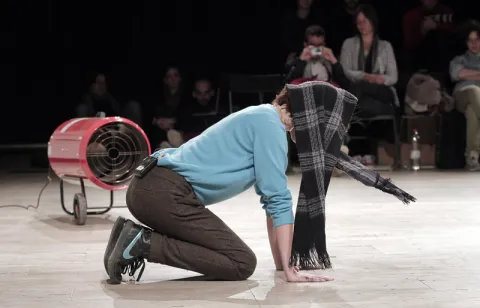
language that finds one of its fundamental keys in the concept of displacement. Of placing something outside its place, scope or own space to investigate how this displacement modifies the language, both in terms of its constitutive grammar and in terms of the reading that an observer can make. Displace to unveil something. This displacement maneuver has proven to be an effective instrument for generating spaces of poetic discourse that question the status quo of our understanding of reality. Primordial broth is an artistic action in a determined space. Abstract. Non-narrative. Primordial broth is an investigation in search of: anti-narrativity as a form of narration. The profanation of the stylistic features of the scenic.

ACTI-0161
Imagen
5527378143_1c02b7e465_c.jpg

Technical Innovation and Moral Decision. José María Lapuerta

Submitted by brandcode_deweloper on
The architect's desk 7

The architect's table is a cycle of encounters about art and architecture around a table where many projects have been drawn. A board, a paper, the tension: strokes and lines that belong to its memory and that are now revealed to bring us closer to the creators of spaces. The architect's table continues drawing....and we continue learning.

Since 2015, MACA has proposed a series of encounters in conversation format, around art and architecture. To reflect again on the relationships between architecture and art, to understand the process of construction and reconstruction of architecture from a more artistic or philosophical point of view, leads us to delve deeper into this proposal. In the MACA Library, the last Thursdays of each month, from September 2020 to May 2021.

The Museum of Contemporary Art of Alicante, whose collections are formed by works created fundamentally in the twentieth century, encompasses from the so-called avant-gardes to all the approaches and plastic manifestations that took place in the decades of the second half of the past century. Works expressed on different supports and materials, with diverse dimensions and techniques. Similarly, temporary exhibitions always related to these collections, allow us to expand or deepen some aspects of contemporary chronology. However, from the permanent collections and those temporary manifestations, contemporary architecture is absent.

The architecture of MACA itself, a project created and directed by Estudio Sancho Madridejos, is a beautiful building of great functional efficiency. The syncopated projection of horizontal and vertical spaces establishes a formal order based on the geometry and texture of the materials used in construction, while revealing a kind of tension resolved by the zenith path of light, a kind of "felt" spirituality more emotional than real.

The architect's table, a table from 1912, real and present (deposited by its owner Alfonso Navarro Guzmán at MACA), serves as an ideological foundation to link the conversations and serves as material support for drawings, sketches, plans and models so that we can travel, while dreaming, through the imagined space. The coordination of these encounters is in charge of Santiago Varela Botella, architect.

ACTI-0147
Imagen
401c08c6-e749-4bc6-9d2e-b0bb33354626.jpg
7:00 PM
90 minutes
Library

Without Limits. The Architecture of the Pioneers of the 21st Century. Carmen Espegel

Submitted by brandcode_deweloper on
The architect's desk 7

"Architecture is the transformation of a worthless brick into a golden brick," appears in Castilian texts as a phrase attributed to Alvar Aalto. Hanni Sippo, in Finland, gave us another version: "When used properly, the brick transforms into gold."

The palette of my architecture, of my craft, does not now have the color of the symbolic, nor of my personal desires. I find, instead, construction on all sides. Construction, of the physical and the sensible; abstract construction, ethical, moral…..We do not want our buildings to represent anything other than their own presence.

Construction that penetrates to the core of the project and that disappears as something separate from it. Construction as aspiration and not as necessity.

If materiality is not something external to the project, it can even participate in the relevant matters that society demands: creation of well-being, saving resources, building with less,… It will be then when materiality can transmit immaterial thoughts.

And to seek a formal identity, and a constructive identity and coherence. And that causes the minimum possible materials to question the origin of the project. Details should not entertain, distract, but help in the understanding of the totality of the project.

One must then tell the projects with plain language, without specialized jargon, without the usual neologisms taken from other disciplines. If it is so important from where we make constructive decisions, we will say that one builds by desire and by illusion. We will have memories and nostalgia of architectures and also anticipation. I am interested in employing material in a specific and sensitive way, without its cultural meanings. And, then, the material can acquire poetic qualities, because materials are not in themselves poetic.

Architecture as THE REPRESENTATION OF CONSTRUCTION". Because material is the concrete substrate and geometry is the abstract.

The nucleus of my architectural activity resides in the act of building. Building appropriate places for human activities and happiness. Because there can exist an ethical approach to constructive problems.

ACTI-0146
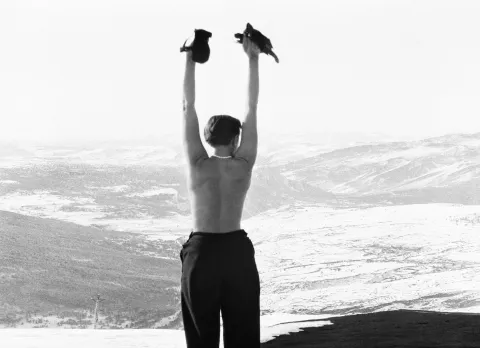
Charlotte Perriand in the mountains, 1930
Imagen
21CF07-WEB-scaled.jpg
7:00 PM
90 minutes
Library

The Tangible. Alfredo Payá

Submitted by brandcode_deweloper on
The architect's desk 7

"The Tangible" is part of a series of lectures that began with "the Invisible". If "the Invisible" was that which lies behind the works, "the Tangible" would be the concrete, the material,

the perceptible, the physical,… reality. A reality that is mass and space but also living matter. An approach to understanding architecture as an interaction of all sensory modalities.

ACTI-0145
Imagen
LAL5821-scaled.jpg
7:00 PM
90 minutes
Library

10 years have passed. Where are we today? Ginés Garrido

Submitted by brandcode_deweloper on
The architect's desk 7

Architect [1989] ETS Arquitectura, UPM. Doctor of Architecture [2005] ETS Arquitectura, UPM. Extraordinary Doctoral Award (2005) and V Thesis Competition Award Fundación Caja de Arquitectos (2006). Professor at the Department of Architectural Projects ETS Arquitectura UPM since 1991 and Associate Professor since 2007. Visiting Professor at Washington University St. Louis (2017, 2019), GSD Harvard University (2012, 2013), Pontifical Catholic University Peru (2011, 2017), Central University Santiago de Chile (2008), University of Arizona (2005).

He has published the following books: Landscapes in the City. Madrid Río: Geography, Infrastructure, and Public Space (2014), Melnikov in Paris 1925 (2011), The House of Melnikov. The Utopia of Moscow (2009), Alexander Ródchenko. Letters from Paris (2008), Moisei Ginzburg. Writings 1923-1930 (2007), El Lissitzky. Wolkenbügel 1924-1925 (2005), Critique of Spanish Architecture of the Twentieth Century (2003); and K.S. Melnikov (2001).

In 2002 he founded Burgos & Garrido Arquitectos [BGA] with Francisco Burgos. BGA has developed public space and urban design projects and pedestrian bridges, among them, the Madrid Río project which won the XII Veronica Rudge Green Prize in Urban Design (2016), GSD Harvard.

BGA has also carried out housing and public facilities projects and has won more than 40 first prizes in international architecture competitions; recently, the competition for the expansion of the Lima Art Museum.

BGA has obtained, among others, the following awards: American Architecture Award (2017); XII Veronica Rudge Green Prize in Urban Design, Harvard University (2016); Hispania Nostra Award (2016); FAD Award (2009, 2012); XIII Spanish Biennial of Architecture and Urbanism Award (2016); COAM Award (2000, 2001, 2003, 2011, 2012, 2014), Ibero-American Biennial of Architecture and Urbanism Award (2012); Green Good

Design (2012); International Architecture Award (2012); Mies van der Rohe Award [Finalist] (2012); A Plus Award (2012); VII European Landscape Award (2012); European Public Space Award CCCB (2011); CICA Award (2011); COICCP Award (2011); JEC Composites Award (2011); Excellent Work Award (2000); XVI Urbanism, Architecture and Public Works Award. Madrid City Council (2000, 2001).

ACTI-0144
Imagen
gines-garrido-landscape-mch2018-rec.jpg
7:00 PM
90 minutes
Library

Only this time

Submitted by brandcode_deweloper on
Museum Day 2021

It is the photography contest that MACA launched in 2012 in order to allow photographing any aspect of the museum: artworks, spaces, people, activities, etc. during a short period of time. Over these 10 years we have collected more than 900 photographs that best illustrate how the museum is felt by those who inhabit it and enjoy it, our most loyal public. We have selected a series of 120 images available on the museum's website and social networks so that you can choose your preferred images.

ACTI-0137
Imagen
75.jpg
All rooms