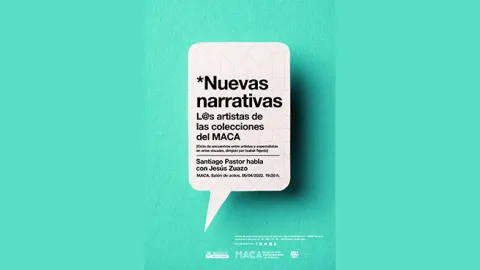
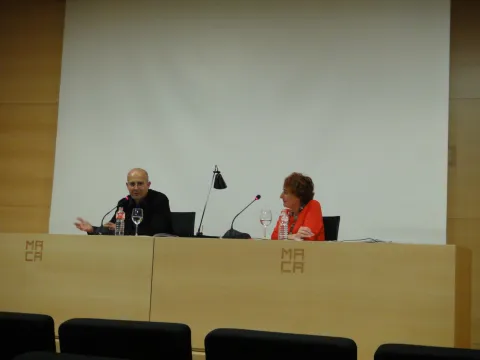
Santiago Pastor talks with Jesús Zuazo

Submitted by brandcode_deweloper on
New narratives 3

Encounters where artists whose work is represented in the museum's collections, together with critics, curators and experts in visual arts, will analyze their creative trajectory in a conversation format. Different professionals will participate in various days of analysis and reflection, always starting from different works in the museum's collections, which will also serve for the citizens of Alicante to learn firsthand about the MACA's heritage.

ACTI-0124
Imagen
117.jpg
Desactivado
7:00 PM
90 minutes
Assembly Hall

Patricia Molins talks with Eva Lootz

Submitted by brandcode_deweloper on
New narratives 3

Encounters where artists whose work is represented in the museum's collections, together with critics, curators and experts in visual arts, will analyze their creative trajectory in a conversation format. Different professionals will participate in various days of analysis and reflection, always starting from different works in the museum's collections, which will also serve for the people of Alicante to learn firsthand about the MACA's heritage.

ACTI-0123
Imagen
119.jpg
Desactivado
7:00 PM
90 minutes
Assembly Hall

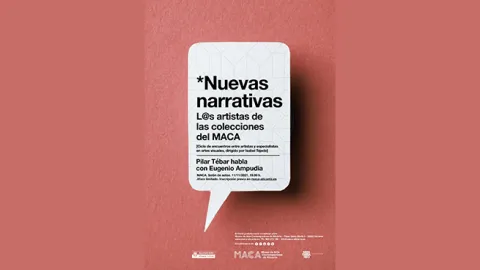
Pilar Tébar talks with Eugenio Ampudia

Submitted by brandcode_deweloper on
New narratives 3

Encounters where artists whose work is represented in the museum's collections, together with critics, curators and experts in visual arts, will analyze their creative trajectory in a conversation format. Different professionals will participate in various days of analysis and reflection, always starting from different works in the museum's collections, which will also serve for the people of Alicante to learn firsthand about the MACA's heritage.

ACTI-0122
Imagen
115.jpg
Desactivado
7:00 PM
90 minutes
Assembly Hall

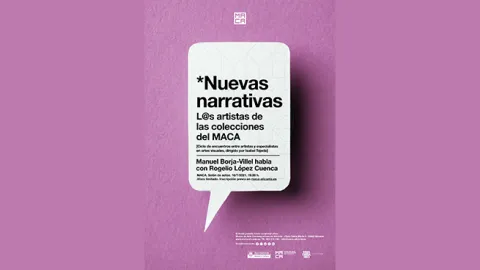
Manuel Borja Villel talks with Rogelio López Cuenca

Submitted by brandcode_deweloper on
New narratives 2

The MACA will bring together in this cycle of encounters, called New Narratives, artists whose work is represented in the museum's collections. Together with critics, curators and experts in visual arts, the artists will analyze, in a conversation format, their creative trajectory. Manuel Borja Villel

Academic Background

He graduated in Art History from the Faculty of Geography and History at the University of Valencia in 1980. In 1981-1982 he was a Special Student at Yale University. In 1981-1983 he received a Fulbright scholarship. In 1987 he received a Master of Philosophy from the Department of Art History at the City University of New York. In 1988-1989 he obtained the Kress Foundation Fellowship for Art History and, in 1989, a Doctor of Philosophy from the Department of Art History at the Graduate School of the City University of New York. He is the author of texts on modern and contemporary art.

Professional Experience

He was director of the Fundació Antoni Tàpies in Barcelona from its opening, in June 1990, until July 1998. At this Foundation he organized exhibitions such as The Limits of the Museum and The City of People, as well as exhibitions of artists Louise Bourgeois, Brassaï, Marcel Broodthaers, Lygia Clark, Hans Haacke and Krzysztof Wodiczko, among others.

From July 1998 to January 2008, he was director of the Museum of Contemporary Art in Barcelona (MACBA). Among the exhibitions he presented at the MACBA, those dedicated to Vito Acconci, El Lissitzky, Öyvind Fahlström, Peter Fischli & David Weiss, Robert Frank, David Goldblatt, Luís Gordillo, Raymond Hains, Richard Hamilton, William Kentridge, Perejaume, Michelangelo Pistoletto, Gerhard Richter, Martha Rosler, Antoni Tàpies, among others, stand out. Some thesis exhibitions he organized at that Museum are: Antagonisms. Case Studies; Fields of Force; Art and Utopia. Restricted Action; A Theater Without Theater and Under the Bomb. The Jazz of the Transatlantic Image War. 1946-1956. Under his direction, the Museum's Collection was expanded and consolidated, and the MACBA Library and Documentation Center was created in the building of the Convent dels Àngels.

Since January 2008 he has been director of the National Museum Reina Sofía Art Center (MNCARS), where he has programmed exhibitions such as Nancy Spero. Dissidances; Deimantas Narkevičius. Unanimous Life; Manhattan, Mixed Use; Georges Vantongerloo. A Longing for Infinity; Deviations of Drift; Paul Thek; New Realisms: 1957-1962; Miralda. De Gustibus Non Disputandum; Martín Ramírez. Frames of Confinement; Leon Ferrari and Mira Schendel: The Enraged Alphabet; Atlas. How to Carry the World on Your Shoulders?; Juan Muñoz; Thomas Schütte. Retrospection; : Overflow of VAL DEL OMAR; alighiero boetti. game strategy; Rosemarie Trockel: a cosmos; Elena Asins. Fragments of Memory; Specters of Artaud; Nacho Criado. Collaborating Agents; Encounters with the 1930s; Concrete Invention. Patricia Phelps de Cisneros Collection; Cristina Iglesias: Metonymy; Cildo Meireles, Richard Hamilton or Dalí. All Poetic Suggestions and All Plastic Possibilities, among many others. The axes of his program at the Museum are the development and reorganization of the Collection; the systematic approach to a series of thesis exhibitions and the creation of a Public Activities area, and, in general, the implementation of an international structure of networked museums. Under his direction, the Museum's own Law has been approved.

Rogelio López Cuenca

Doctor in Fine Arts. University of Castilla-La Mancha, 2016. Graduate in Philosophy and Letters. University of Málaga, 1983.

Poet and visual artist, through publications, courses, workshops, exhibitions, interventions in urban public spaces, on television or on the Internet (www.malagana.com), his work addresses, from visual arts, literary creation and social sciences, key issues of contemporary societies, among which stand out the construction of identity, migration and racism, the analysis of media and cultural criticism.

Since he began his career in the eighties, Rogelio López Cuenca (Nerja, 1959) has worked at the intersection of poetry with visual arts and mass media. Displacing writing outside the page, he has practiced his own visual poetry that moves within the tradition of institutional critique and pop drifts, through multiple media such as painting, installation, urban intervention and publishing.

In his early work, López Cuenca investigates around music and collaborative work, particularly with the musical group Peña Wagneriana and the collectives Agustín Parejo School and UHP (Unite, Proletarian Brothers). In these first forays, certain concerns that the artist also addresses individually become evident, such as the space of the city, popular language and the language of the avant-gardes.

Around 1992, in the framework of the V Centenary of the Discovery of America, the Universal Exposition of Seville, the Cultural Capital of Madrid and the Barcelona Olympics, a turning point occurs in his work. From then on, he carries out different critical interventions with the contemporary system, in which questions that run through his work are reflected, such as migratory and historical memory policies, or new forms of urban speculation and the spectacularization of culture, symptoms of incipient cognitive capitalism.

López Cuenca takes images and texts from different media of high and low culture, which in many cases he places in advertising or commercial devices in public space, to denounce situations of violence and discrimination that function both in historical and current terms. It is worth highlighting the capacity of his work to be inscribed outside the museum sphere, generating short circuits in different systems of social circulation of images, thereby questioning both the uniqueness of the work of art and its conventional space of contemplation.

Different professionals will participate in several days of analysis and reflection, always starting from different works from the museum's collections, which, furthermore, will serve for the citizens of Alicante to know firsthand the heritage of the MACA.

ACTI-0121
Imagen
91.jpg
Desactivado
7:00 PM
90 minutes
Assembly Hall

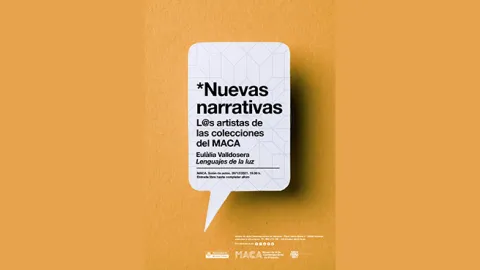
Eulàlia Valldosera's Talk

Submitted by brandcode_deweloper on
New narratives 2

«We are producers of images, we project or awaken inner images constantly in the face of any situation or perception. Imagination serves us not only to filter and organize what life proposes to us, but it is the engine of creation and manifestation of the realities we experience. Artistic practice is the ideal medium to bring to consciousness that torrent of collective images, of living entities, for their transformation.

Perception is the root of my artistic research, and through the language of light and shadow I generate psychological spaces to unveil the burdens of hidden memory in our imaginary. I do this by relocating our everyday objects before beams of light to review concepts that Western socio-cultural power has misunderstood or distorted such as the body, illness and death, or the role of the feminine and its aspects of motherhood, care and cleanliness.

I understand all creation as a co-creation, and the crucial moment we are going through as a civilization leads me to open a new expressive cycle with the actions of reading cultural objects in the public domain or natural entities such as plants and animals, or with collective sessions of 'drawing and energy'».

ACTI-0120
Imagen
116.jpg
Desactivado
7:00 PM
90 minutes
Assembly Hall

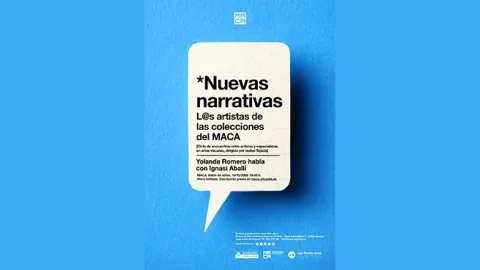
Yolanda Romero talks with Ignasi Aballí

Submitted by brandcode_deweloper on
New narratives 1

In 2020, the MACA brought together in this first cycle of meetings called New Narratives, artists whose work is represented in the museum's collections. Together with critics, curators, and experts in visual arts, the artists analyzed, in a conversation format, their creative trajectory. Different professionals participated in sessions of analysis and reflection, always starting from different works in the museum's collections, which also served for the citizens of Alicante to learn firsthand about the MACA's heritage.

ACTI-0119
Imagen
114.jpg
Desactivado
7:00 PM
90 minutes
Assembly Hall

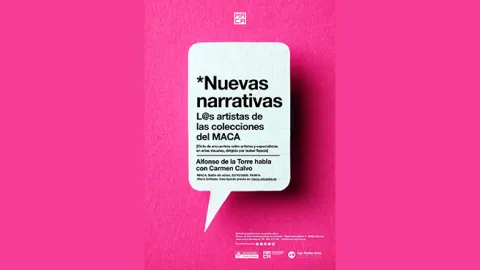
Alfonso de la Torre talks with Carmen Calvo

Submitted by brandcode_deweloper on
New narratives 1

In 2020, the MACA brought together in this first cycle of meetings called New Narratives, artists whose work is represented in the museum's collections. Together with critics, curators, and experts in visual arts, the artists analyzed, in a conversation format, their creative trajectory. Different professionals participated in sessions of analysis and reflection, always starting from different works in the museum's collections, which also served for the citizens of Alicante to learn firsthand about the MACA's heritage.

ACTI-0118
Imagen
113.jpg
Desactivado
7:00 PM
90 minutes
Assembly Hall

Santiago Pastor talks with Soledad Sevilla

Submitted by brandcode_deweloper on
New narratives 1

In 2020, the MACA brought together in this first cycle of meetings called New Narratives, artists whose work is represented in the museum's collections. Together with critics, curators, and experts in visual arts, the artists analyzed, in a conversation format, their creative trajectory. Different professionals participated in sessions of analysis and reflection, always starting from different works in the museum's collections, which also served for the citizens of Alicante to learn firsthand about the MACA's heritage.

ACTI-0117
Imagen
117.jpg
Desactivado
7:00 PM
90 minutes
Assembly Hall

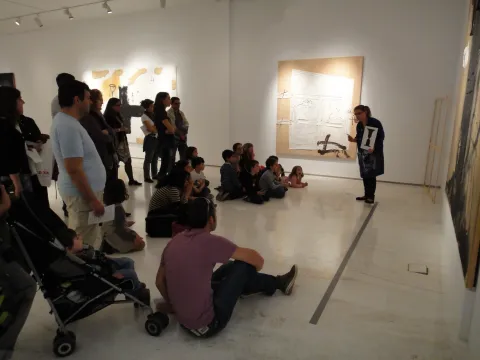
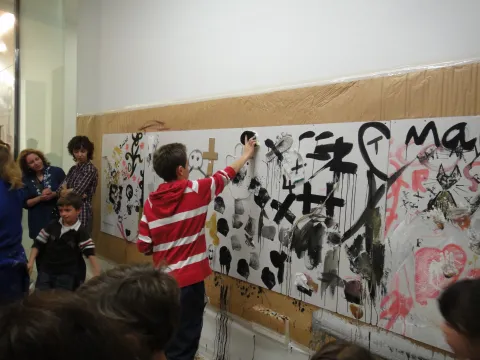
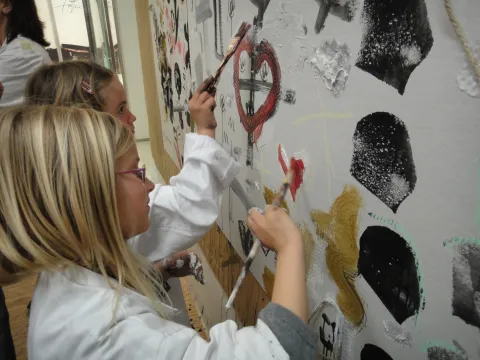
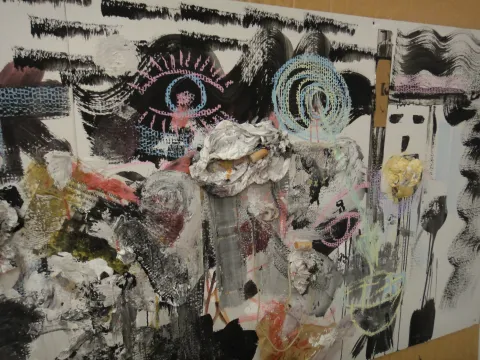
Tàpies. Conversation on the Wall

Submitted by brandcode_deweloper on

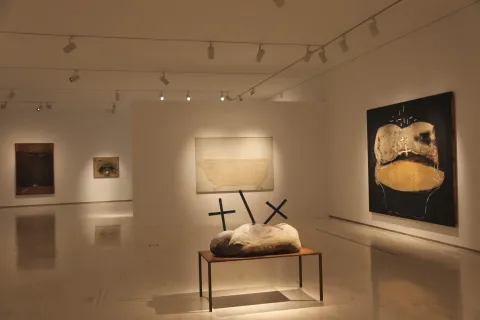
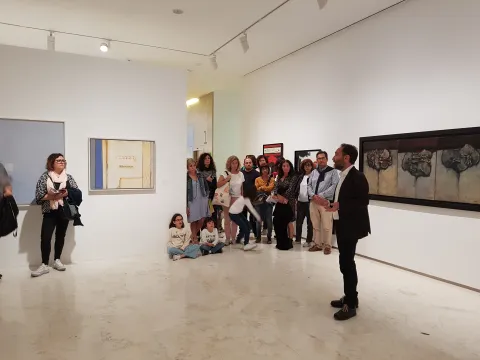
Dynamic visits around the Tàpies exhibition and workshop in which children and adults put themselves in Tàpies' shoes and created a collective work on the blank canvas on the wall using various materials and textures. The workshop will remain open so that all visitors who wish to enjoy the result can do so.

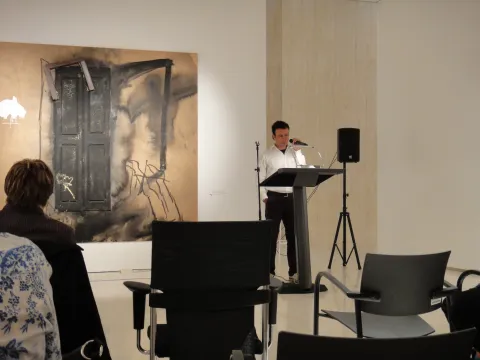
The MACA wishes to extend special thanks for the collaboration in the round table discussion on Tàpies by Juan Bautista Peiró, professor at the Universitat Politécnica de Valencia, and for the effort and sensitivity displayed by Agustín Manzanet and Candela Jiménez in the reading of dramatized texts.

ACTI-0106
Imagen
DSC01645.jpg
Floor 0 | Auditorium