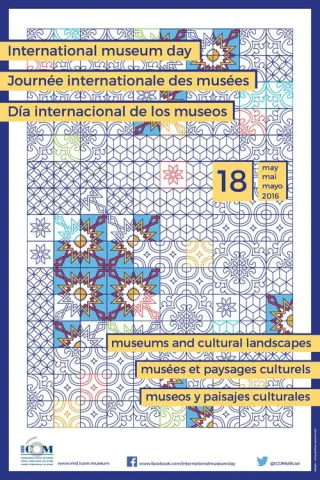
Since 1977, ICOM has organized the International Museum Day (IMD) every year, a unique occasion for the international museum community. On that day, museums participating in IMD plan events and creative activities related to the International Museum Day theme, connect with their audiences, and emphasize the importance of the role of museums as institutions serving society and its development. The objective of International Museum Day is to raise public awareness of the fact that "Museums are an important means for cultural exchanges, the enrichment of cultures, the advancement of mutual understanding, cooperation and peace among peoples". It is celebrated every year on May 18 or around that date, and the events and activities organized for the celebration can last a day, a weekend, or an entire week. International Museum Day brings together an increasing number of museums around the world. In 2014, more than 35,000 museums from 145 countries participated in the event. In 2016, the event will revolve around the theme: Museums and Cultural Landscapes.
The theme "Museums and Cultural Landscapes" presupposes a form of responsibility of museums with respect to the landscape of which they are a part, to which they can contribute their own knowledge and expertise, being active protagonists in its management and proper maintenance. The primary mission of museums is to safeguard heritage, whether within or outside their walls. Their natural vocation is to expand their mission and deploy their own activities in the open field of cultural heritage and the landscape that surrounds them, and for which they can assume responsibility in varying degrees.
To the vision of a museum primarily committed to the conservation, exhibition, and communication of its own collections, another vision is substituted that is more respectful of nature—an institution that also conducts research and produces, acquires, and disseminates knowledge about the territory that surrounds it, and raises awareness among the communities living there to have a different perception of their landscape.
Responsible for the landscape that surrounds it, the museum equally has the mission to protect and conserve environmental heritage, in order to promote development that respects its identity characteristics, by mutual agreement and in collaboration with all entities—public and private—that have an interest in it in various aspects. A museum responsible for the landscape assumes, at the same time, its role as a center for the interpretation of heritage and territory, promoting its knowledge and raising awareness among its inhabitants and visitors about its constitutive values, requesting their intervention for its conservation, promotion, and enrichment. The landscape, by nature, is in constant evolution and could not be fixed or converted into a museum. Protecting and conserving it amounts to preventing its transformations from resulting in the annihilation, disfigurement, or degradation of its identity characteristics.
Museums can thus contribute significantly to the administration of a territory that respects the values of the landscape, by providing knowledge about the territory, heritage, and landscape; through activities of protection, conservation, and interpretation of cultural heritage carried out both inside and outside their walls; via active participation in public and urban policies and in the definition and implementation of landscape policies.