Mother of Srebrenica

Submitted by maca on
Almin Zrno

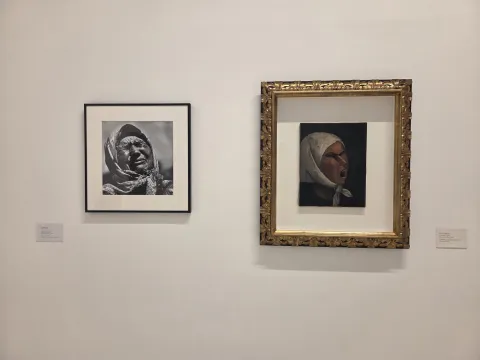
The United Nations General Assembly, through Resolution 78/282, adopted on 23 May 2024, declared 11 July as the International Day of Remembrance of the Srebrenica Genocide, emphasising the importance of remembrance and education as tools for raising awareness, combating the denial of this tragedy and preventing crimes of this nature from ever happening again. Around this date, the Museum of Contemporary Art Ars Aevi in Sarajevo is inviting museums around the world to take part in this commemoration by exhibiting the photograph “Mother of Srebrenica”, taken in 2001 by the artist Almin Zrno. It is an image of
great symbolic power, encapsulating silence, grief and dignity; a work that invites introspection and compassion, and bears witness to horrors that defy description, becoming a symbol of pain.
 

The display of this photograph alongside the oil painting “Montserrat criant n.º 2” by the artist Julio González, painted between 1936 and 1940, reveals a striking affinity between the two compositions. Through the figure of a Catalan peasant woman, whom he named Montserrat, Julio González depicts the suffering of the civilian population during the Spanish Civil War.
 

The two images share the same expressive power: almost the same woman, a universal mother, with a scarf tied beneath her chin; her mouth open or closed in a muffled cry; her eyes closed; her face furrowed by deep wrinkles that bear witness to extreme pain. The cry cannot be heard, but it is clearly sensed. Both works were conceived within the same context of war, several decades apart, granting art not only the potential for aesthetic enjoyment, but also the capacity to serve as a testimony and an act of resistance against oblivion.
 

Imagen
foto

The Invited Piece. Equipo Crónica: Meninas in the Chalet

Submitted by brandcode_deweloper on
Chirivella Soriano Foundation

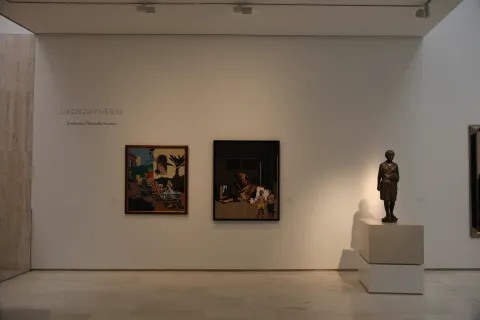
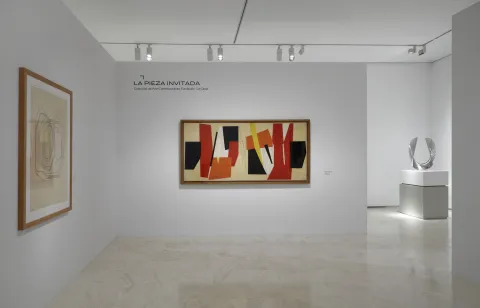
The MACA - Museum of Contemporary Art of Alicante has invited on this occasion the work of Equipo Crónica titled Las Meninas in the Chalet from 1969 belonging to the Chirivella Soriano Foundation of Valencia, which can be enjoyed from February 1st to April 28th, 2013. This splendid work from the Chirivella Soriano Foundation Las Meninas in the Chalet from 1969 fits perfectly alongside the work of Equipo Crónica belonging to the 20th Century Art Collection titled Self-portrait in Palace painted just one year later, in 1970.

A reflection on the theme of classical painting that serves to place Velázquez's characters—in the case of Las Meninas in the Chalet—the Infanta Margarita of Austria, the lady-in-waiting of the Infanta Isabel de Velasco, the dwarf Mari Bárbola, the royal chamberlain José Nieto and the dog, in a chalet from the 50s-60s, a time when the tourist phenomenon emerged and the chalet became fashionable for summer vacations. The exterior space of this representation corresponds to an advertisement from the Valencian store "Hogar completo"—specialized in armchairs, rocking chairs and folding summer loungers.

Self-portrait in Palace places the scene in the original space of the Las Meninas painting, preserving the characters of the royal chamberlain José Nieto and the Dog decorated with the Cross of Santiago, but in this case distorted, to occupy a gigantic volume. The two artists Manolo Valdés and Rafael Solbes, portray themselves in the foreground as in the original work the main characters of Las Meninas are placed. The painting is not finished, as there appears a blank area, empty and thousands of paint drips, and they appear characterized as two house painters who, during a break from their work, stop to look at us because we have placed ourselves in the scene and they invite us to reflect on the work they are carrying out.

The collaboration between institutions such as the MACA and the Chirivella Soriano Foundation, in this case coordinated through the Consortium of Museums of the Valencian Regional Government and the Culture Department of the Alicante City Council, has made possible the arrival of this work by Equipo Crónica. An exhibition program that will continue throughout the year.

Equipo Crónica. (1964-1981)

Formed by the artists Manolo Valdés, Rafael Solbes and Juan Antonio Toledo (although the latter soon distanced himself from the group), the group reacted against the dominant informalist current in the Spanish artistic panorama of the time. Their collective work developed during the last ten years of Francoism and the democratic transition, until 1981.

Equipo Crónica creates decidedly figurative work very close to the pop art aesthetic. Taking advantage of resources from journalistic chronicles, the language of mass media, comics, advertising or art history itself, their painting critically analyzes the social and political situation of Spain and casts an ironic look at myths by placing well-known situations and characters in different contexts, thus contributing to the demystification of images and questioning the very function of art.

The MACA - Museum of Contemporary Art of Alicante has invited on this occasion the work of Equipo Crónica titled Las Meninas in the Chalet from 1969 belonging to the Chirivella Soriano Foundation of Valencia, which can be enjoyed from February 1st to April 28th, 2013.

The collaboration between institutions such as the MACA and the Chirivella Soriano Foundation, in this case coordinated through the Consortium of Museums of the Valencian Regional Government and the Culture Department of the Alicante City Council, has made possible the arrival of this work by Equipo Crónica. An exhibition program that will continue throughout the year.

EXPO-0062
Imagen
PIEZA-INVITADA-008.jpg
/sites/default/files/inline-images/resources/exposiciones/EXPO-0062/HOJA-MANO-EQUIP-CRONICA-ALTA-ilovepdf-compressed_5.pdf
Rosa María Castells
Fundación Chirivella Soriano

Avant-garde Context 4. Luis Fernández

Submitted by brandcode_deweloper on
IVAM Collection of Valencia

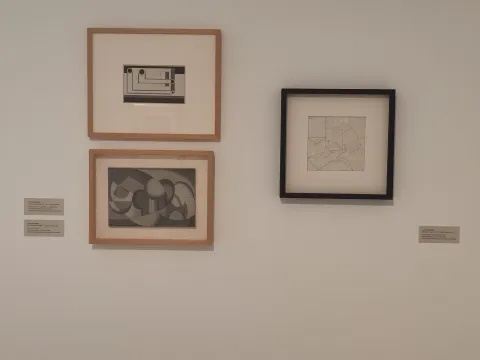
This is the fourth exhibition within "Contexto Vanguardia" that seeks to maintain a permanent dialogue between the works of the IVAM collection belonging to the avant-gardes of the first decades of the twentieth century and the works of the MACA's Twentieth Century Art Collection, so that complementary readings are established, support and context for some pieces that, in communication with others, strengthen their language, thus allowing the visitor to enjoy artists not represented in the MACA while completing the vision of the avant-gardes. The objective is to create content and share knowledge. «Abstraction or Still Life», «Abstraction» (1933) and «Abstraction in longitude» (1926-1928) are the three oil paintings on canvas by artist Luis Fernández that are shown alongside works by Julio González, Pablo Gargallo and Juan Gris, among others. Luis Fernández (Oviedo, Spain, 1900- Paris, France, 1973) was one of the Spanish artists of the so-called School of Paris. He arrived there in 1924 and struck up friendships with Picasso and Julio González, as well as with geometric abstraction that would lead him to join the Abstraction-Création movement. A painter concerned with craftsmanship and the artisanal concept of the work, he formulated his thinking in various texts written in the 1930s, his most analytical and experimental period. He reflected on color and its function in painting, on composition, format and the profound meaning of abstraction which for him possessed metaphysical and symbolic resonances. His painting—he said—was an "unconscious representation of the order that man observes in the universe".

EXPO-0061
Imagen
WhatsApp-Image-2024-10-16-at-11.35.00.jpeg
Luis Fernández
Rosa María Castells
Obras del Instituto Valenciano de Arte Moderno (IVAM)

Eusebio Sempere. Learning the Painter's Trade

Submitted by brandcode_deweloper on

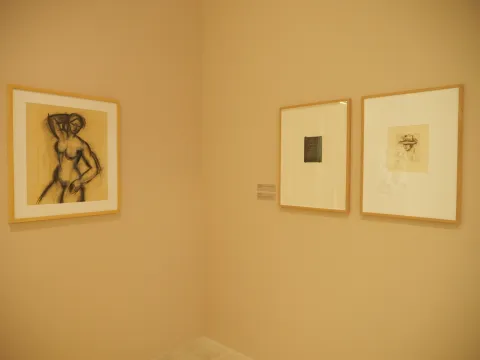
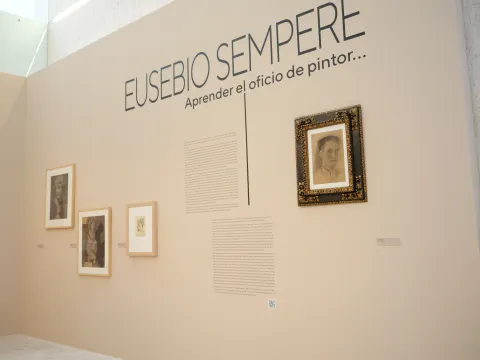
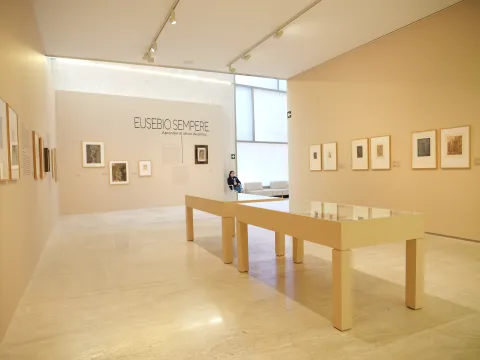
Thanks to an early vocation for painting, Sempere began in 1941 his training period at the School of Fine Arts of San Carlos in Valencia, the city where his family moved after the civil war, after having lost his toy factory in Onil. 
 

Sempere had finished his high school studies a few months earlier and attended evening classes at the School of Arts and Crafts, which had given him some knowledge and practice in drawing. His six years of academic training were tedious and frustrating. Artistic education in Spain during those postwar years was depressing; to the poor teachers, mediocre as artists, authoritarian and despotic in their classes, was added an extreme conservatism in the content and continuous "Sorolla-like" references as the only valid example to follow, just as the artist recalls time and again. 
 

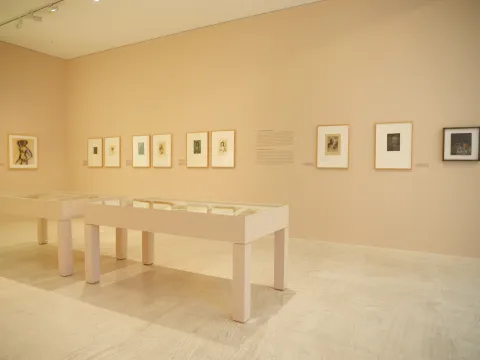
At the School he met Father Alfons Roig, professor of the subject Liturgy and Christian Culture, who spoke to the San Carlos students about Kandinsky and was perhaps the only person knowledgeable about and an enthusiastic defender of modernity and avant-garde movements. Eusebio finished his studies in 1946 but remained at San Carlos until 1948 in order to study the specialty of intaglio engraving with professor Ernesto Furió, one of the few teachers who managed to earn the respect of his students. Sempere learned the technique of etching and dry point, and his engravings show an exceptional mastery of graphic art, working texture and volume and skillfully balancing light and darkness. 
 

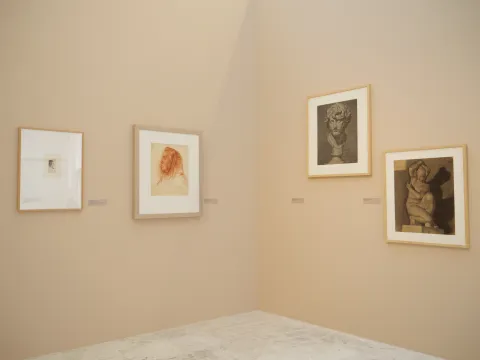
Sempere studied modeling, drawing, anatomy, perspective and painting procedures, acquiring solid training in the artistic craft that is demonstrated in the preserved works from those training years. At the end of 1948, the SEU (University Students' Union) grants him a scholarship to pursue further studies in Paris. There he will become an artist-

EXPO-0060
Imagen
P1060957
/sites/default/files/inline-images/resources/exposiciones/EXPO-0060/TEXTO-EXPO-SEMPERE-LECTURA-FACIL_5.pdf
Rosa María Castells

The Invited Piece. Pablo Palazuelo: Alborada

Submitted by brandcode_deweloper on
Contemporary Art Collection of the "La Caixa" Foundation

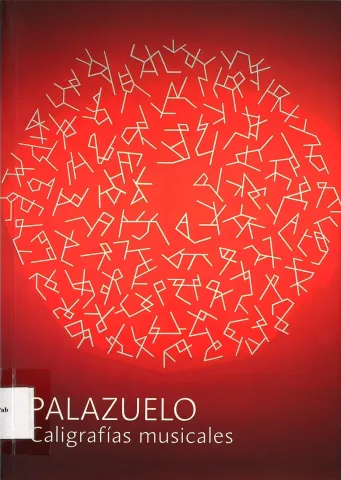
Alborada by Pablo Palazuelo came to share the space alongside the constructivists from the 20th Century Art Collection and established a dialogue with Palazuelo's work held in the Collection, Sub-rosa XII.

In Palazuelo's painting, one observes an attempt, sometimes unattainable, to represent the logic of chance. This—this structural, architectural, scientific will, falsely impersonal—makes his paintings appear as authentic manifestos about how abstract language materializes. Thus, the alborada to which the title refers, a musical composition that celebrates the dawn, unites two significant aspects in the artist's work: light, understood as a succession of chromatic planes, an optical variation, and the idea of serialization, represented through forms that configure a kind of rhythmic sequence, a movement that vibrates and shifts horizontally across the surface of the painting.

EXPO-0059
Imagen
303011.jpg
Rosa María Castells

Elena Asins. The murmur of the wind is an tireless whistle

Submitted by brandcode_deweloper on

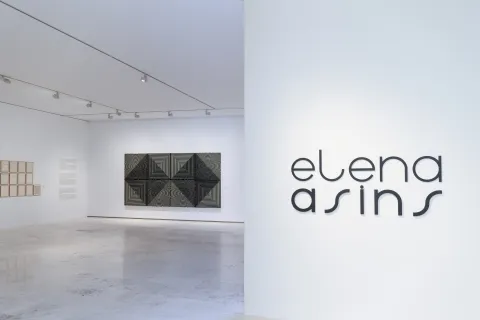
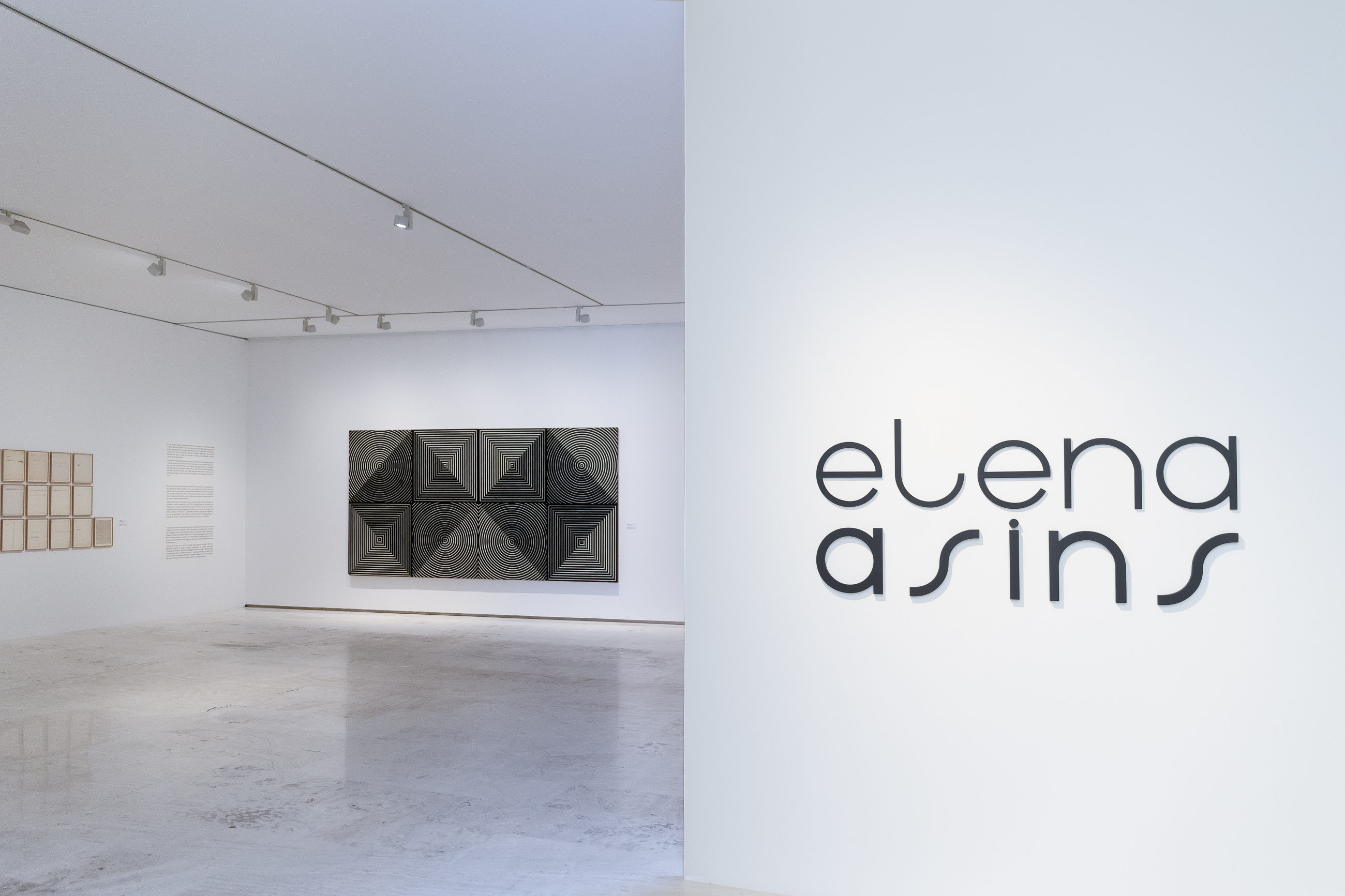
Elena Asins (Madrid, 1940 - Azpíroz, Navarra, 2015) is one of the most radical and rigorous artists in the Spanish art scene. A renovator of plastic language, Asins combines the constructive tradition of twentieth-century avant-garde with computation and information theory, being considered one of the pioneers of computer-assisted art in Spain. A brilliant artist, provocative in silence, who builds from structure, from mathematical norm and logic, a work that generates itself to become, at times, almost invisible.

Through, fundamentally, the works bequeathed by the artist to the Museo Nacional Centro de Arte Reina Sofía, this exhibition proposes a journey through the persistent investigations carried out by the artist and their plastic results: a final work of apparent simplicity in its calculations, but linguistically hermetic. True to herself and the result of her renunciation of color, Elena Asins's works are read first through the word and then through structure and line. Never forgetting the tempo: an internal music that runs through all her artistic production, sequencing it. Asins has resorted in her works to a wide range of formats and media from concrete poetry to video, passing through drawing, sculpture or installation, always characterized by compositional rigor and formal refinement.

Linked to some of the most innovative projects in the recent history of Spanish art, such as the Cooperative of Artistic and Craft Production or the Computing Center of the Complutense University of Madrid, we highlight the encounter there with Eusebio Sempere and Abel Martín, their friendship and the coincidence of their investigations. And we will show for the first time a fundamental work by Elena Asins: the Songs of Orpheus, a series of visual poems dated 1970 and preserved by Eusebio Sempere that have become one of the most important pieces in the history of Spanish experimental poetry.

EXPO-0057
Imagen
3F1A9604-Editar.jpg
/sites/default/files/inline-images/resources/exposiciones/EXPO-0057/poliptico-definitivo_7.pdf
Rosa María Castells
Obras han sido prestadas por el Museo Nacional Centro de Arte Reina Sofía, el MACVAC de Villafamés, el Museo de la Universidad de Alicante, la Fundación Mediterráneo y la Colección espíritu-materia. Obras a las que se unen las piezas de Elena Asins pertenecientes a las colecciones del MACA así como las que se encuentran depositadas en el museo como las de Robledo-Palop Collection de Nueva York o la Colección Ars Citerior.

Text [No Text]

Submitted by brandcode_deweloper on
Books and Artist Publications Collection Universitat Politècnica de València


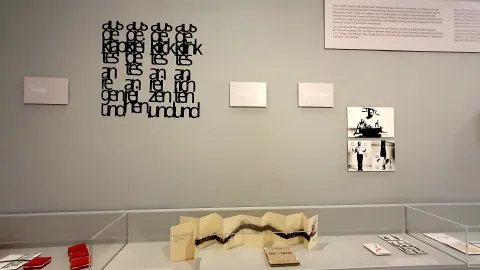
When reviewing history from the perspective of the present, specifically the contributions and importance of books produced by artists from the sixties and seventies onwards, when viewed from the current situation, a surprising updating occurs of the emergence and recognition of Fluxus, conceptual or minimalist artistic practices, but, above all, of the production of artist books and publications during that period.

It was in the early 1960s, the same decade in which conceptual art was formulated, when a truly different approach emerged regarding the conception of artist books, as well as their realization and the form of distribution. During that period, the book occupied a central place in the production of relevant contemporary artists, while also being the subject of critical theories about authorship (or, rather, the lack of authorship), the elimination of text or image in the book and, no less importantly, about the impact of new technologies on the mass production of works of art.

The artists who decided to work with the book as a plastic medium, assumed that their publications, in addition to functioning as an artistic product, would work as purely communicative instruments produced through more economical systems and would be easy to obtain. They set out to work with the techniques and printing processes that were most advanced at the time, the reproduction of black and white photography through offset or Xerox, which allowed them to produce numerous editions quickly and at low cost. And, according to these criteria, they radically distanced themselves from previous productions, the so-called livres d'artiste or illustrated books, as well as from any of the other commitments of artists who used the book in the first half of the twentieth century.


EXPO-0049
Imagen
20201008_115729.jpg
/sites/default/files/inline-images/resources/exposiciones/EXPO-0049/MACA_TEXTNOTEXT_HOJADESALA_DIGITAL_7.pdf
Dick Higgins, Edward Ruscha, Bruno Munari, Richard Hamilton
Antonio Alcaraz

Grayscale

Submitted by brandcode_deweloper on
Mediterranean Foundation Collection

Grayscale brings together a series of works from the Fundación Caja Mediterráneo Collection, deposited in this Museum of Contemporary Art in Alicante, which share a common reflection on matter and its physical presence while consciously abandoning color and sometimes, form. Color in art history is as important as its negation, and the conscious declaration of its absence has been equally revolutionary thought. Although the choice of color is always a chemical process, its meaning has varied according to the era. Black and white. The negation of color or the sum of all. Two chromatic values that give rise between them to an infinite scale of degrees of luminosity. From light to darkness: the Grayscale. An ordered and gradual system of percentage of black over white that leads to light, medium, and dark gray, and to an endless range of intermediate grays.

From different perspectives and through various techniques, the exhibited artists have given material a substantial role in the aesthetic and conceptual debate of their works. They have chosen highly varied textures: Steel, lead, titanium, glass, iron, aluminum, asbestos cement, mirror or ceramic and graphite, paper, linen or wood. Matter becomes conscious and its presence is reclaimed. In the same way as sound. The physical properties of each element turn sculptures, photographs, films, paintings and drawings into complex works that reflect the intense relationship that has been produced between the artist and matter. 

A display of subtle chromatic balances, of cracks of clarity through which time escapes while the echoes of our presence sound in the room, literally.

EXPO-0046
Imagen
042A9973.jpg
/sites/default/files/inline-images/resources/exposiciones/EXPO-0046/folleto-escala-de-grises-CAST_7.pdf
Sergi Aguilar, Jordi Alcaraz, Rosa Brun, Carmen Calvo, Joan Cardells, Hannah Collins, Jon Mikel Euba, Rafael Lozano-Hemmer, Íñigo Manglano-Ovalle, Enric Mestre, José Antonio Orts y Amparo Tormo.

Rosa María Castells

Only two voices. Isidro Blasco

Submitted by brandcode_deweloper on
Contemporary Art Collection of the Valencian Generalitat
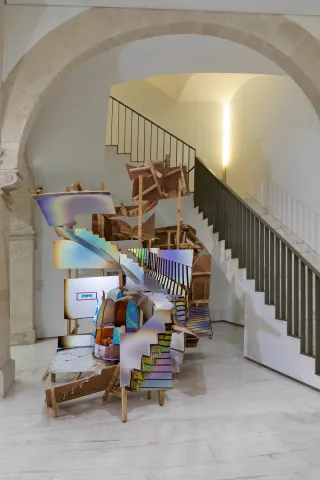
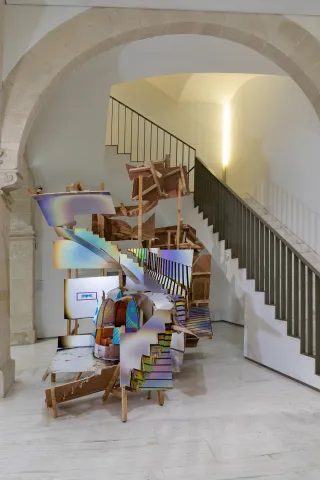
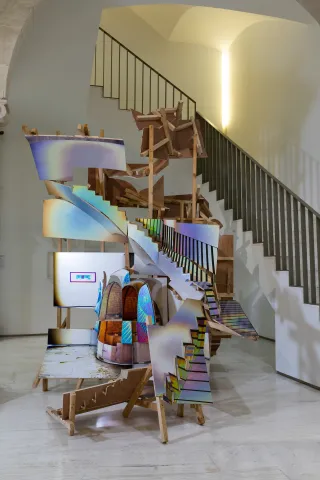
Isidro Blasco visits the MACA whenever he comes to Alicante and always finds his father's work at the foot of the staircase, framed between the arches of the old Casa de la Asegurada. The exceptional piece by Arcadio Blasco, Enclosure for a Legal Murder from 1971 is an emblematic work of the 20th Century Art Collection. It is a sculpture in iron and ceramic that envelops a space of ideological repression and political resonances.

Trapped by that space and by the dialogue that Arcadio's work establishes with the museum's architecture, Isidro needs to return to it and rethink it, in a kind of nostalgic but obsessive journey. During one of these visits the project takes shape: the artist analyzes and measures the void, draws and photographs, goes up and down the staircase, peers in and measures sections. Isidro Blasco has decided to destroy the place and construct a new space to prevent it from falling into oblivion. And thus this site-specific installation emerges.

Only Two Voices, it is a complex work between architecture, photography and sculpture. An installation in unstable equilibrium that deploys in three-dimensional form the same space it occupies in the museum. A space within the same space. The photography architecturally cohesifies the elements although the structure has been fragmented and the 90-degree angles have been destroyed. With great economy of means: some sheets of plywood, some screws and carpenter's jacks and some photographs, the artist has constructed an irrational artifice that reflects on the problem of representation and offers a legacy of fragments, a perfect analogy for attending to the affects on-over-inside the Blascos that functions in turn as a revealer of the image of the contemporary world.

EXPO-0045
Imagen
042A0161.jpg
Isidro Blasco

Over time

Submitted by brandcode_deweloper on
Mediterranean Foundation Collection

This exhibition showcases a selection of works from the Mediterranean Foundation Collection that is deposited in this Museum of Contemporary Art in Alicante thanks to the agreement signed between the City Council of Alicante and the Mediterranean Foundation.

The Mediterranean Foundation Collection consists of 212 pieces and covers the work of 125 artists, the most essential names in the contemporary Spanish art scene. It spans a chronological arc that runs from the democratic transition to the present day: an artistic period in Spain that corresponds to the last 40 years, so generous, filled with hope, energy, disenchantment, excess and naivety… but also with reflection, denunciation, commitment, adventure… A period in which several generations of artists coexist in a normalized way as had never happened before, enriching each other mutually, with the younger artists learning from the undisputed masters, and rediscovering in the younger generation the persistence of what is essential.

EXPO-0033
Imagen
IMG_3597.jpg
Rafael Luis Armengol, Eduardo Arroyo, Miquel Barceló, José Manuel Broto, Carmen Calvo, Ferrán García Sevilla, Curro González, Luis Gordillo, Xavier Grau, Joan Hernández Pijuán, Prudencio Irazábal, Ángeles Marco, Juan Muñoz, Juan Navarro, Jaume Plensa, Santiago Segura, Soledad Sevilla, José María Sicilia, Amparo Tormo, Juan Uslé y José María Yturralde.
Rosa María Castells