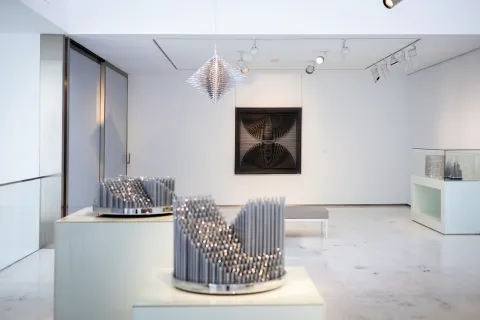
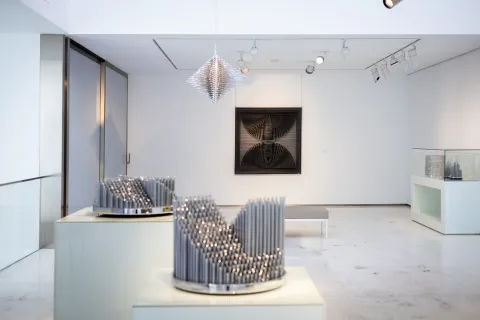
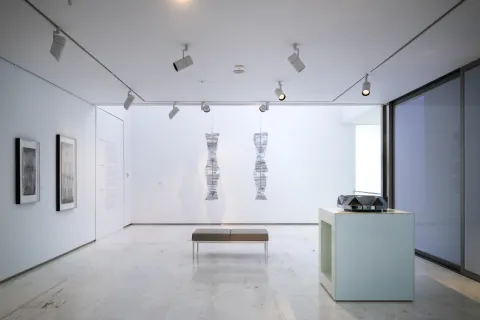
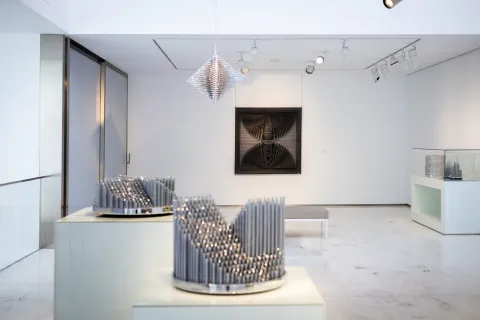
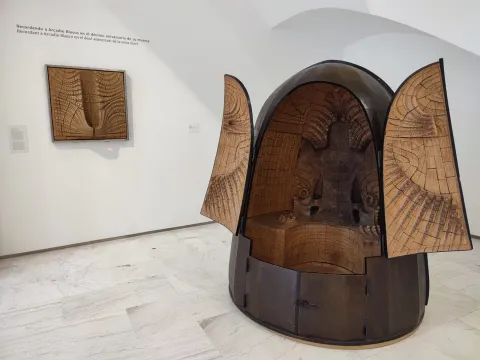
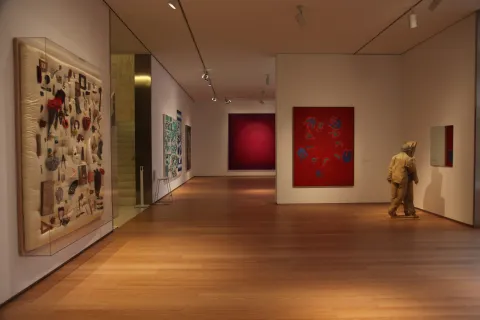
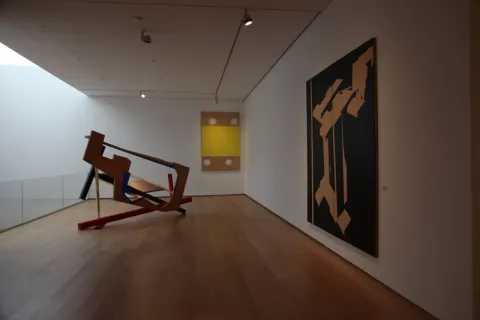
The MACA now has the piece "Objeto-idea" by Arcadio Blasco on the occasion of the tenth anniversary of his death. The work has been deposited for a period of five years by José Piqueras, and has been on display since today on the ground floor of the museum. The artist
Arcadi Blasco Pastor (Mutxamel, Alicante, 1928 – Majadahonda, Madrid, 2013) was a painter who in the second half of the 1950s found in ceramics the ideal material for plastic expression. His artistic training as a painter took place at the School of Fine Arts in Madrid, where he arrived at the age of 19, completing his teaching course at the School of Fine Arts of San Carlos in Valencia in 1953. That same year he moved to Italy, where he lived for two years at the Academy of Spain in Rome, where he had his first contact with ceramics through the work of Nino Caruso and Carlo Zauli.
Upon returning to Spain, he carried out his first ceramic experiments and became interested in artisanal ceramics, which led him to work with the potter from Cuenca, Pedro Mercedes—with whom he exchanged knowledge—and in other popular ceramic workshops in Agost and Triana (Cerámica Montalbán). In 1955 he set up his first workshop in a space—ceded by architect Luis Feduchi—the half-built building of the Museum of America located in the University City of Madrid, which he shared with José Luis Sánchez, Jacqueline Canivet and Carmen Perujo; there he would create, among other works, many stained glass windows, mosaics and ceramic murals intended, in large part, to decorate the churches that were built by commission of the Institute for the Colonization of the Towns of Spain, collaborating with architects José Luis Fernández del Amo, Ignacio Gárate, Luis Cubillo, García Benito, Luis Feduchi, Fernández Alba and Fisac, among others. The immense space of this place of work for creativity was also occasionally used by painters such as José Vento, Hernández Mompó, Rafael Canogar, Antonio Saura, etc., who needed to create large-format works and did not have sufficient space in their studios. This provisional workshop became a meeting place for artists of the young Madrid avant-garde.
Precisely, one of the most notable characteristics of Arcadio Blasco's trajectory as a ceramicist is his direct participation, between the years 1945 and 1974, in the new development of contemporary art, as he was—as Carmen González has rightly pointed out—"the only ceramic artist who, through a series of 'coincidences'"—as he himself defines them—participates in the field of plastic arts, and who has held a large number of national and international exhibitions in contemporary art forums, always bringing ceramic work.
After an initial direct approach to ceramic work, which consisted of using the surface of vessels as a support for his pictorial vocabulary—creating works with a certain decorative charge—Arcadio Blasco felt strongly attracted to the qualities and expressiveness of this material, and as a consequence his Ceramic Paintings (1956-64) were born.
In all his subsequent work cycles: Idea Objects (1969), Ornamental Proposals (1969-74), Architectures and Walls to Defend Oneself from Fear (1970-86), Archaeological Ruins (1984-86), Mill Wheels to Commune (1985), Tributes (1992-95), clays of different tones, slips, glazes—less frequent and very nuanced—and applications of coloring oxides in earthy tones will be—often subjected to reduction firing—the protagonist materials of his works.
In that whirlwind of searches that the 1950s became for the most nonconformist Spanish artists, Arcadio Blasco investigated the possibilities of ceramic material and found in fired clay the ideal medium with which to realize in volume his latest pictorial investigations, which would lead—in ceramics—at the end of the 1960s to reliefs and sculptures of social commitment and political criticism.
With his return in 1985 to his birthplace (Mutxamel) and the installation of his workshop in a country house in the Bonalba area, Alicante, an artist in full maturity returned who made an effort to activate Alicante's culture through various initiatives, some related to ceramics and its teaching.
Some of these "Idea-Objects" from the late sixties were shown in the Arcadio Blasco exhibition at the Spanish Pavilion of the XXXV Venice Biennale in June 1970, and were the prelude to his "Ornamental Proposals for Dialogue" and "Proposals for Torture," series to which fundamental works of his artistic production from the early seventies belong, such as "Enclosure for a Legal Murder" from the MACA collection.
Ceramics is the protagonist and the reliefs begin to wrap around themselves, to want to hide, acquiring a more sculptural and even architectural aspect with the insertion of usable openings. These works are crafted with artisanal meticulousness through a set of very personal resources: touches and impressions like cuneiform and repetitive writing; rows of balls or pearls of clay added and of different sizes; necklace beads or radiations as if they were pieces of goldwork from ancient cultures, refined and barbaric at once, with all kinds of roughness and reliefs where the matter still seems to boil.