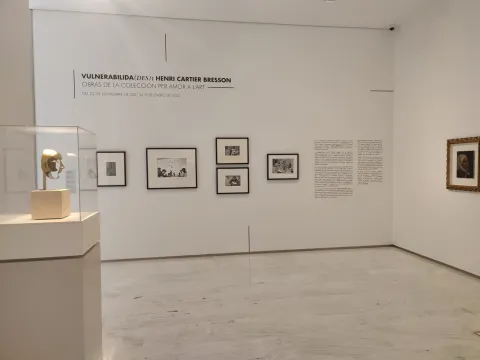
The Invited Piece. Vulnerability(ies). Henri Cartier Bresson
The five photographs by Henri Cartier Bresson shown here belong to the Per Amor a l'Art Collection – Per Amor a l'Art Foundation of Valencia. These works invited to the MACA are part of the exhibition project Vulnerability(ies), carried out in collaboration with Bombas Gens Centre d'Art and the Museum of the University of Alicante.
Vulnerability is a complex reality that has acquired notable prominence in recent times as a result of phenomena such as social inequality, the effects of climate change, gender-based violence, migratory movements, and the recent Covid pandemic. Theoretical reflection on human vulnerability is not recent; however, the urgency of responses to the moment we are living in, so compromised in many aspects, has validated its relevance.
We immediately associate the concept of vulnerability with that of fragility. To be vulnerable is to be a fragile subject. We often transfer this condition onto others based on their gender, their body, or their social position, but we avoid the thought that this state is constitutive of our own experience and, therefore, inherent to human nature. Feminist thinker Judith Butler has proposed rethinking vulnerability as a means to illuminate other models of living together, based on the recognition of interdependence between subjects and the need for care. Therefore, vulnerability is not a reason for inaction or submission but an opportunity for social emancipation and political resistance.
With this spirit, the exhibition Vulnerability(ies) emerges: as an approach to experiences of fragility from artistic practices that encourages us to understand ourselves as vulnerable beings – both in social and individual aspects – but capable of acting collectively to build new forms of relationship between us and between us and nature.
Henri Cartier Bresson (1908-2004) is one of the fundamental names in the history of photography of the last century. He was a pioneer of modern photojournalism, promoter of the Magnum Photos agency, and creator of the concept of the decisive moment: the sensation of making the eye, the head, and the heart coincide in a concentrated gesture that allows capturing reality by surprise.
Born in France, he wanted to dedicate himself to painting and began to frequent artists, especially surrealists, who decisively marked his almost pictorial gaze that he would express in images far from the anecdotal and as close as possible to the intimate truth of people. He always used black and white and was an enemy of color and the use of flash.
A man of strong political convictions, anticolonialist and republican, his commitment placed him in the most iconic revolutionary scenarios, making him an inveterate traveler. In the 1930s he traveled through several Spanish cities, including Alicante, where he captured with his lucid camera these famous images.
Works:
Henri Cartier Bresson
Alicante, Spain, 1933
Silver gelatin print
Per Amor a l'Art Collection, Valencia.
Henri Cartier Bresson
Alicante, Spain, 1934
Silver gelatin print
Per Amor a l'Art Collection, Valencia.
Henri Cartier Bresson
Madrid, Spain, 1933
Silver gelatin print
Per Amor a l'Art Collection, Valencia.
Henri Cartier Bresson
Madrid, Spain, 1933
Silver gelatin print
Per Amor a l'Art Collection, Valencia.
Henri Cartier Bresson
Flooding, Spain, 1933
Silver gelatin print
Per Amor a l'Art Collection, Valencia.