Text [No Text]

Submitted by brandcode_deweloper on
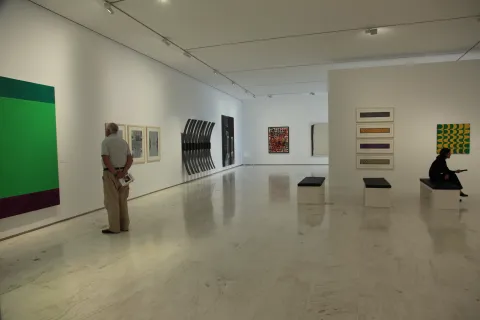
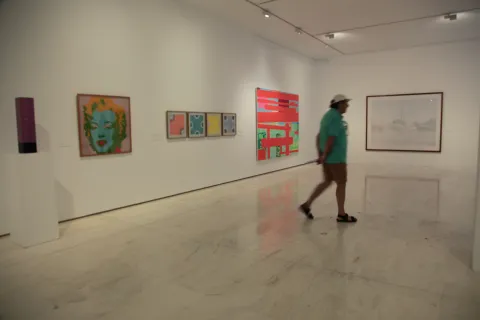
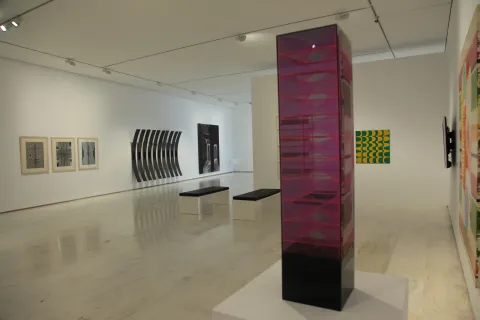
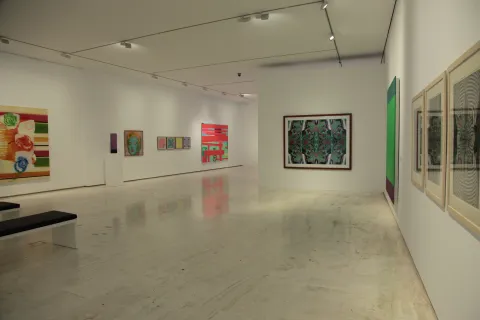
Books and Artist Publications Collection Universitat Politècnica de València


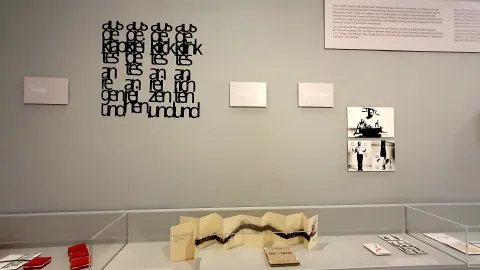
When reviewing history from the perspective of the present, specifically the contributions and importance of books produced by artists from the sixties and seventies onwards, when viewed from the current situation, a surprising updating occurs of the emergence and recognition of Fluxus, conceptual or minimalist artistic practices, but, above all, of the production of artist books and publications during that period.

It was in the early 1960s, the same decade in which conceptual art was formulated, when a truly different approach emerged regarding the conception of artist books, as well as their realization and the form of distribution. During that period, the book occupied a central place in the production of relevant contemporary artists, while also being the subject of critical theories about authorship (or, rather, the lack of authorship), the elimination of text or image in the book and, no less importantly, about the impact of new technologies on the mass production of works of art.

The artists who decided to work with the book as a plastic medium, assumed that their publications, in addition to functioning as an artistic product, would work as purely communicative instruments produced through more economical systems and would be easy to obtain. They set out to work with the techniques and printing processes that were most advanced at the time, the reproduction of black and white photography through offset or Xerox, which allowed them to produce numerous editions quickly and at low cost. And, according to these criteria, they radically distanced themselves from previous productions, the so-called livres d'artiste or illustrated books, as well as from any of the other commitments of artists who used the book in the first half of the twentieth century.
 

EXPO-0049
Imagen
20201008_115729.jpg
/sites/default/files/inline-images/resources/exposiciones/EXPO-0049/MACA_TEXTNOTEXT_HOJADESALA_DIGITAL_7.pdf
Dick Higgins, Edward Ruscha, Bruno Munari, Richard Hamilton
Antonio Alcaraz

Automatic Garden. Olga Diego

Submitted by brandcode_deweloper on

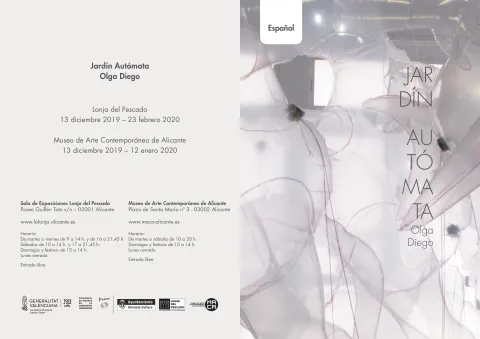
Automated Garden is a gigantic installation made up of almost a hundred inflatable and electronic sculptures inspired by the beautiful, extravagant and suggestive characters from Bosch's Garden of Earthly Delights, which is exhibited mostly in the Exhibition Hall of the Lonja, and which has a small representation in the MACA.

Attracted by the Procession of Desire painted on the central panel of the triptych, Olga Diego discovers naked human beings who enjoy, together with animals of all species, a world of unlimited pleasure. Lust represented in multiple and unimaginable forms. A suggestive world where we also find beautiful birds, fish and exotic fruits. Olga Diego builds that imaginary world in Automated Garden, a visual and creative orgy, a labyrinth of large translucent and transparent bodies that suggest a magical existence. The characters, in continuous movement and endowed with heart, mark with their rhythms an indecipherable electric symphony. Humanoids of all genders, simple and mixed quadrupeds, hybrid beings, women with large breast-antennas, globe-headed animals, the mutant giraffe, bird-boy with tortilla-wings, eggs and fish with legs, flying hermaphrodites, fruits with tentacles, two-headed dogs, strange birds with adapted wings, and a long etcetera.

Automated Garden has been a constructive challenge, but also an insinuating paradise in terms of the forms to be created. A lust converted into sin, religious in its time and profane now, due to the terrible consequences that continuous waste, unlimited consumerism and excessive use of plastic already have for humanity.

EXPO-0047
Imagen
Olga-Diego_Alicante-ESP_page-0001.jpg
/sites/default/files/inline-images/resources/exposiciones/EXPO-0047/Olga-Diego_Alicante-ESP_7.pdf

Grayscale

Submitted by brandcode_deweloper on
Mediterranean Foundation Collection

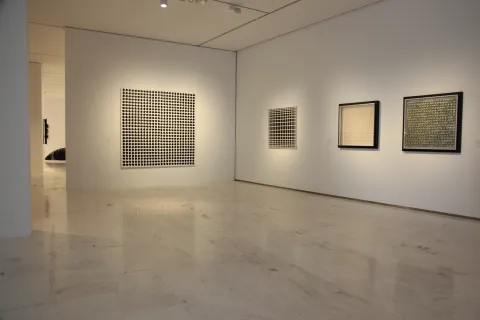
Grayscale brings together a series of works from the Fundación Caja Mediterráneo Collection, deposited in this Museum of Contemporary Art in Alicante, which share a common reflection on matter and its physical presence while consciously abandoning color and sometimes, form. Color in art history is as important as its negation, and the conscious declaration of its absence has been equally revolutionary thought. Although the choice of color is always a chemical process, its meaning has varied according to the era. Black and white. The negation of color or the sum of all. Two chromatic values that give rise between them to an infinite scale of degrees of luminosity. From light to darkness: the Grayscale. An ordered and gradual system of percentage of black over white that leads to light, medium, and dark gray, and to an endless range of intermediate grays.

From different perspectives and through various techniques, the exhibited artists have given material a substantial role in the aesthetic and conceptual debate of their works. They have chosen highly varied textures: Steel, lead, titanium, glass, iron, aluminum, asbestos cement, mirror or ceramic and graphite, paper, linen or wood. Matter becomes conscious and its presence is reclaimed. In the same way as sound. The physical properties of each element turn sculptures, photographs, films, paintings and drawings into complex works that reflect the intense relationship that has been produced between the artist and matter. 

A display of subtle chromatic balances, of cracks of clarity through which time escapes while the echoes of our presence sound in the room, literally.

EXPO-0046
Imagen
042A9973.jpg
/sites/default/files/inline-images/resources/exposiciones/EXPO-0046/folleto-escala-de-grises-CAST_7.pdf
Sergi Aguilar, Jordi Alcaraz, Rosa Brun, Carmen Calvo, Joan Cardells, Hannah Collins, Jon Mikel Euba, Rafael Lozano-Hemmer, Íñigo Manglano-Ovalle, Enric Mestre, José Antonio Orts y Amparo Tormo.

Rosa María Castells

Only two voices. Isidro Blasco

Submitted by brandcode_deweloper on
Contemporary Art Collection of the Valencian Generalitat

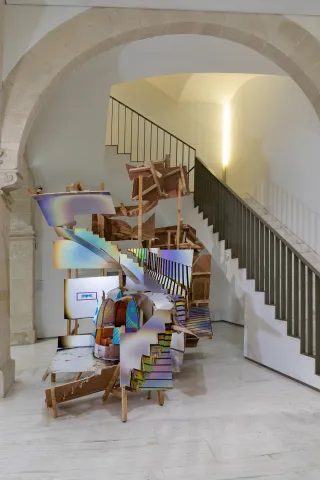
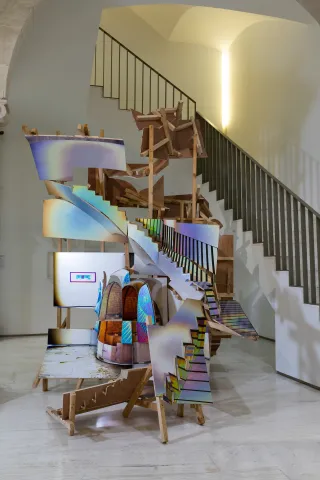
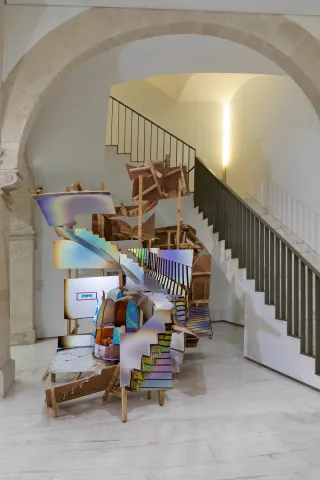
Isidro Blasco visits the MACA whenever he comes to Alicante and always finds his father's work at the foot of the staircase, framed between the arches of the old Casa de la Asegurada. The exceptional piece by Arcadio Blasco, Enclosure for a Legal Murder from 1971 is an emblematic work of the 20th Century Art Collection. It is a sculpture in iron and ceramic that envelops a space of ideological repression and political resonances.

Trapped by that space and by the dialogue that Arcadio's work establishes with the museum's architecture, Isidro needs to return to it and rethink it, in a kind of nostalgic but obsessive journey. During one of these visits the project takes shape: the artist analyzes and measures the void, draws and photographs, goes up and down the staircase, peers in and measures sections. Isidro Blasco has decided to destroy the place and construct a new space to prevent it from falling into oblivion. And thus this site-specific installation emerges.

Only Two Voices, it is a complex work between architecture, photography and sculpture. An installation in unstable equilibrium that deploys in three-dimensional form the same space it occupies in the museum. A space within the same space. The photography architecturally cohesifies the elements although the structure has been fragmented and the 90-degree angles have been destroyed. With great economy of means: some sheets of plywood, some screws and carpenter's jacks and some photographs, the artist has constructed an irrational artifice that reflects on the problem of representation and offers a legacy of fragments, a perfect analogy for attending to the affects on-over-inside the Blascos that functions in turn as a revealer of the image of the contemporary world.

EXPO-0045
Imagen
042A0161.jpg
Isidro Blasco

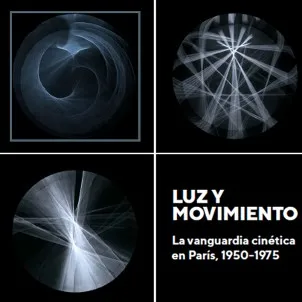
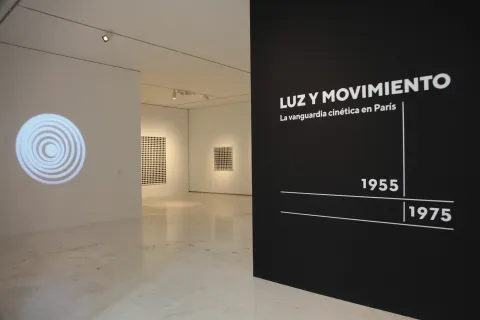
Light and Movement. The Kinetic Avant-Garde in Paris 1950-1975

Submitted by brandcode_deweloper on

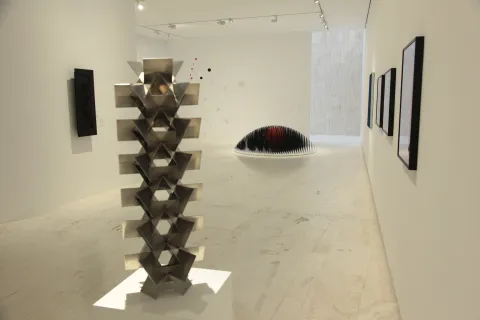
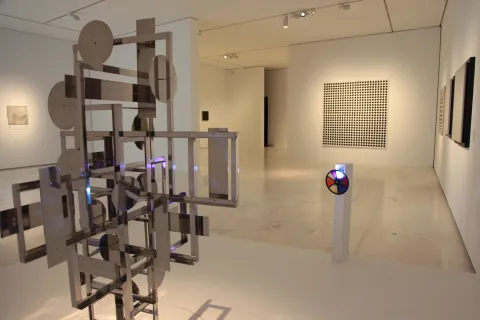
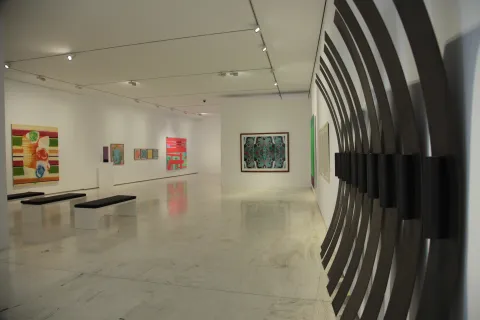
The question of movement, light and their representation runs through the history of art. From the 1950s onwards, following in the footsteps of pioneers such as Naum Gabo, Antoine Pevsner and László Moholy-Nagy, Marcel Duchamp and Alexander Calder, artists began to integrate these forces into their creations, shaping a new vision of reality in which nothing is fixed and definitive but rather unstable and indeterminate, in constant movement: the works live in the present, change, are never exhausted. Kinetic movement develops in Europe as an international constellation formed by a new generation of artists who want to radically transform art by opposing the myth of the work, a unique, defined and totemic object destined for an elite, personal expression of the artist, creative genius secluded in their ivory tower. These new breed of artists want to modernize the artistic object, open it to reality by integrating new materials and industrial techniques; from a social perspective, to produce art for a wider audience, participatory art, to propose an active role for both the artist and the spectator. 

Movement embodies the new mutual relationship, physical and emotional, that is established between spectator and work, it is a mouvement émouvant [moving movement], as Vasarely describes it in 1955: the works are living bodies that are reflected in the moving body of the spectator and enter into relationship with him, involving him in an exercise of conscious freedom. 

Light and Movement opens a perspective on the rich vitality of this international tendency in the active Parisian context, whose influence will also nourish Spanish artistic debate, focusing on the period of its fascinating creative development and maximum recognition between 1955, the year of the historic exhibition Le Mouvement at the Denise René gallery in Paris, and 1975. The works of the protagonists of this avant-garde, coming from private collections, galleries and Parisian institutions, will resonate and be enriched in dialogue with the exceptional collection of kinetic works at the MACA, a donation by Eusebio Sempere.
 

EXPO-0043
Imagen
Sin-título-6.jpg
/sites/default/files/inline-images/resources/exposiciones/EXPO-0043/MACA%E2%80%93VALN%E2%80%93CAST2_5.pdf
Takis (Panagiotis Vassilakis), Marina Apolonio, Pol Bury, Alexander Calder, Carlos Cruz-Diez, Ángel Duarte, Marcel Duchamp, Julio Le Parc, François Morellet, Jordi Pericot, Nicolas Schöffer, Francisco Sobrino, Jesús Rafael Soto, Víctor Vasarely, Eusebio Sempere, François Morellet, Horacio García, Joël Stein, Robert Breer y Brian de Palma.
Jordi Ballart, Marianna Gelussi
En colaboración con Fundación Catalunya La Pedrera

Lost in the city

Submitted by brandcode_deweloper on
IVAM Collection of Valencia

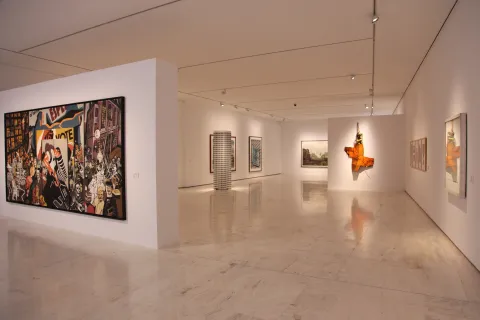
The city is one of the most characteristic symbols of modern society. Cities are at the forefront of the most outstanding experiences and the boldest behaviors, the place of maximum development of the arts. For this reason, many artists have the life in cities as a central element of their works, cities understood (often) as a collage of a multitude of discontinuous and fragmented memories and experiences, as a confusing labyrinth in which inhabitants cross paths immersed each in their own thoughts.

The central idea of this exhibition is to show works that allow us to know the multiple visions, the different spaces and the great quantity of human existences that have shaped life in cities in the last century, through works from the IVAM collection. The institution holds among its collections the most comprehensive and complete vision on this subject that can be found in a Spanish museum. 

EXPO-0037
Imagen
perdidos_en_la_ciudad
/sites/default/files/inline-images/resources/exposiciones/EXPO-0037/hoja-sala-perdidos-ivam_7.pdf
Valerio Adami, Eduardo Arroyo, Gabriele Basilico, Bernd y Hilla Becher, John Chamberlain, Horacio Coppola, Gregory Crewdson, Equipo Crónica, Candida Höffer, Gordon Matta- Clark, Julian Opie, Robert Rauschenberg y Thomas Ruff.
José Miguel García Cortés
La vida en las colecciones del IVAM

Over time

Submitted by brandcode_deweloper on
Mediterranean Foundation Collection

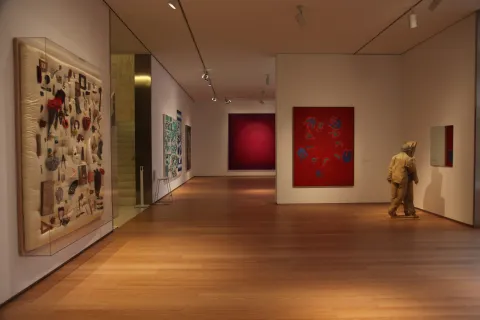
This exhibition showcases a selection of works from the Mediterranean Foundation Collection that is deposited in this Museum of Contemporary Art in Alicante thanks to the agreement signed between the City Council of Alicante and the Mediterranean Foundation.

The Mediterranean Foundation Collection consists of 212 pieces and covers the work of 125 artists, the most essential names in the contemporary Spanish art scene. It spans a chronological arc that runs from the democratic transition to the present day: an artistic period in Spain that corresponds to the last 40 years, so generous, filled with hope, energy, disenchantment, excess and naivety… but also with reflection, denunciation, commitment, adventure… A period in which several generations of artists coexist in a normalized way as had never happened before, enriching each other mutually, with the younger artists learning from the undisputed masters, and rediscovering in the younger generation the persistence of what is essential.

EXPO-0033
Imagen
IMG_3597.jpg
Rafael Luis Armengol, Eduardo Arroyo, Miquel Barceló, José Manuel Broto, Carmen Calvo, Ferrán García Sevilla, Curro González, Luis Gordillo, Xavier Grau, Joan Hernández Pijuán, Prudencio Irazábal, Ángeles Marco, Juan Muñoz, Juan Navarro, Jaume Plensa, Santiago Segura, Soledad Sevilla, José María Sicilia, Amparo Tormo, Juan Uslé y José María Yturralde.
Rosa María Castells

Heterotopias

Submitted by brandcode_deweloper on
CIRCA XX Collection of the IAACC Pablo Serrano Museum in Zaragoza

The set of works that make up the CIRCA XX Collection was acquired by the Government of Aragon from its owner Pilar Citoler at the end of 2013, through a mixed formula that included purchase and donation. Since then it has been assigned as part of the permanent collection fund of the IAACC Pablo Serrano in Zaragoza for its custody and exhibition. A set of 1200 works that includes paintings, drawings, graphic works, photography, sculpture, installations and video, which has become one of the reference collections in the national and international panorama. 

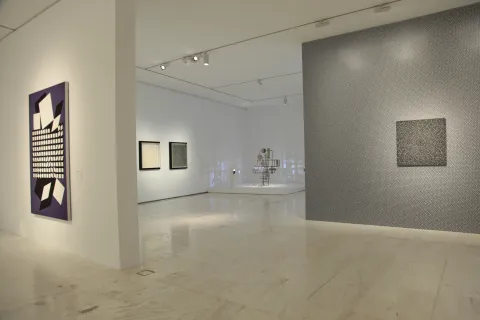
This selection of works is titled Heterotopias, a neologism coined in 1967 by French philosopher Michel Foucault, which he constructed from the Greek words "heteros" (different) and "topos" (place), as a denunciation of history's interest only in time. The concept of Heterotopia claims the contemporary world par excellence, an era where space is heterogeneous, simultaneous, juxtaposed where the near and the far coexist, one beside the other and the dispersed; where we find those "other places" in which elements distributed through time form a set of relationships, a map of networks and synergies, a fatal intertwining of time with space. 

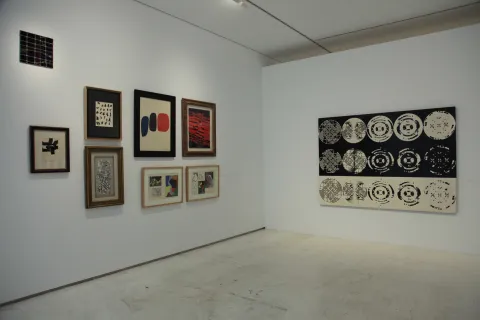
Through transgenerational connections we propose a reading without chronology. Only to look. Early artists linked with artistic avant-gardes that seek the essence of forms by banishing the superfluous and retracing the path until reaching the origin, the foundation of forms to be witnesses of the conjugations of black and the dissipations of transparency. Other artists experiment with color and geometry: formal logic and constructive tradition are combined with computation and new technologies proposing visual games, concrete optical effects, dynamic, as virtual as perceptible subjected to a frenetic rhythm established by the repetition and interaction of colors. And transforming perception, placing emphasis both on what is seen and what is suggested, later artists announce cold and distant environments subjected to the very fact of seeing or not seeing, dazzled by color or by its absence, crossed by a blinding light close to invisibility that constructs a mental state in permanent blur, an artificial atmosphere that captures the abstraction of reality. The Heterotopias constructed in real time and space are the places where utopias are fulfilled. 

EXPO-0031
Imagen
IMG_4080.jpg
/sites/default/files/inline-images/resources/exposiciones/EXPO-0031/folleto-cast_8.pdf
Henri Michaux, Alexander Calder, Jean Dubuffet, Equipo 57, Eusebio Sempere, Eduardo Chillida, Pablo Palazuelo, Erwin Bechtold, Ellsworth Kelly, Cristina Iglesias, Elena Asins, Pilar Urbano, Atsuko Tanaka, Luis Gordillo, Sol Lewitt, David Nash, Tomás García Asensio, Don Kunkel, Francisco Sobrino, Alex Haas, Rosa Brun, Andy Warhol, Mitsuo Miura, Felicidad Moreno, José Ramón Amondarain, José Manuel Ballester, Paul Graham, Mayte Vieta, Chema Alvargonzález y Edward Ruscha.
Rosa María Castells

Context avant-garde 2. Kurt Schwitters

Submitted by brandcode_deweloper on
IVAM Collection of Valencia

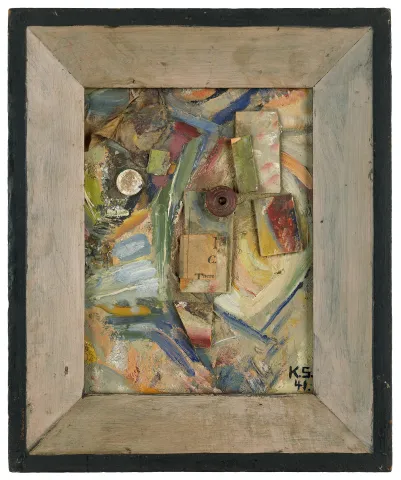
The MACA presents the second exhibition within the "Contexto vanguardias" program with two works by Kurt Schwitters. This program aims to maintain a permanent dialogue between the works in the IVAM collection belonging to the avant-gardes of the first decades of the twentieth century and the works of the Twentieth Century Art Collection, so that complementary readings are established, transversal perspectives, support and context for some pieces that, in communication with others, strengthen their language and message and complete the vision of a fundamental era of modernity that travels paths between tradition and the new. Doing it at the MACA, in Alicante, alongside the same works from the Twentieth Century Art Collection will allow visitors to enjoy works never before seen in the city and are references in art history that are part of the excellent collections of the institution you direct.

This second exhibition consists of a set of two works by Kurt Schwitters, one of the most radical artists in the twentieth-century artistic panorama, being the continuation of the previous "Contexto Vanguardias" and which will coexist in the first room of the museum alongside his contemporaries Julio González, Pablo Gargallo and Juan Gris.

The Artist

German artist Kurt Schwitters (Hanover, 1887 – Ambleside, United Kingdom, 1948) was one of the main and most influential protagonists of the Dada movement. In 1919 he constructed his first collages and assemblages with waste materials, which he would call Merz, turning them into a symbol of a world in ruins. He created multidisciplinary art, free from traditional artistic conventions, and Merz would give its name to his poems, his magazine, his theater and his collages or sculptural constructions.

He abandoned his architectural studies in his native city to move to Dresden, where he visited the Kunstakademie with the purpose of becoming a painter. After some beginnings linked to impressionism and somewhat later to expressionism, in 1918 he exhibited his first works in the cubist-futurist style at the Der Sturm gallery in Berlin. A year later he constructed his first collages and assemblages with waste materials, which he would call Merz, a name derived from the fortuitous mutilation of the word Kommerz, which he had used in one of his collages. Merz would become synonymous with the new multidisciplinary art he would create from then on, free from traditional artistic conventions and which would give its name to his poems, his magazine, his theater and his sculptural-architectural constructions (Merzbau). He himself would define this artistic process as a consequence of the historical moment in which he had lived: "The Great War has ended, in a way the world is in ruins, so I gather its fragments and build a new reality".

His work was banned by the Nazi authorities upon their rise to power in 1933 and included in the lists of "degenerate art". Upon learning that he was being sought by the Gestapo, he went into exile in Norway in January 1937, leaving his wife Helma in Germany. After the Nazi invasion of the Nordic country, he fled by ship to Edinburgh. In the United Kingdom he was considered a foreign enemy and went through several internment camps, finally ending up in the Hutchison Camp on the Isle of Man. Once released, he went through London and, after the war ended, moved to the Lake District in northern England. In October 1946 he broke a leg after a fall from which he would never recover. He died in Kendal on January 8, 1948; two days later he was informed by letter that he had been granted British citizenship.

EXPO-0030
Imagen
00785-1-1.jpg
Kurt Schwitters
Rosa María Castells

Eusebio Sempere/Abel Martín. The Music of Numbers That Do Not Exist

Submitted by brandcode_deweloper on
Sempere Collection of the MACA


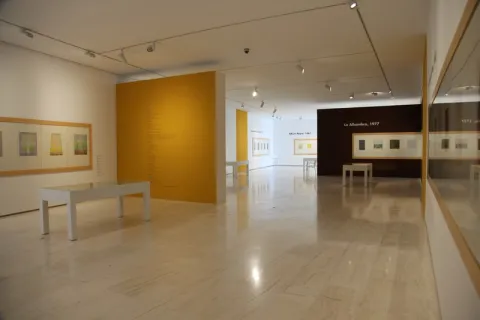
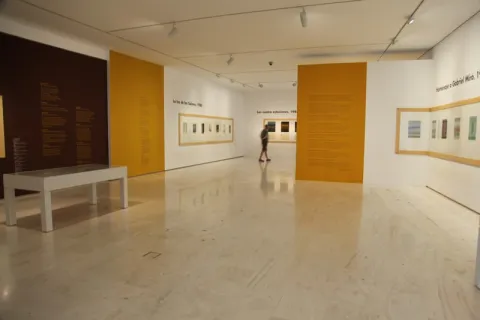
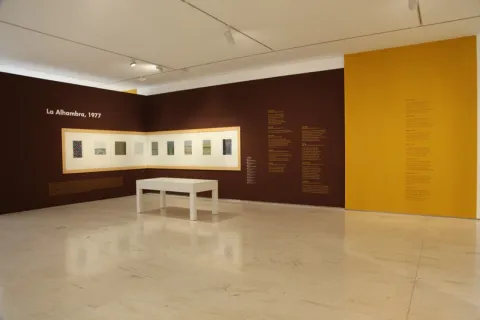
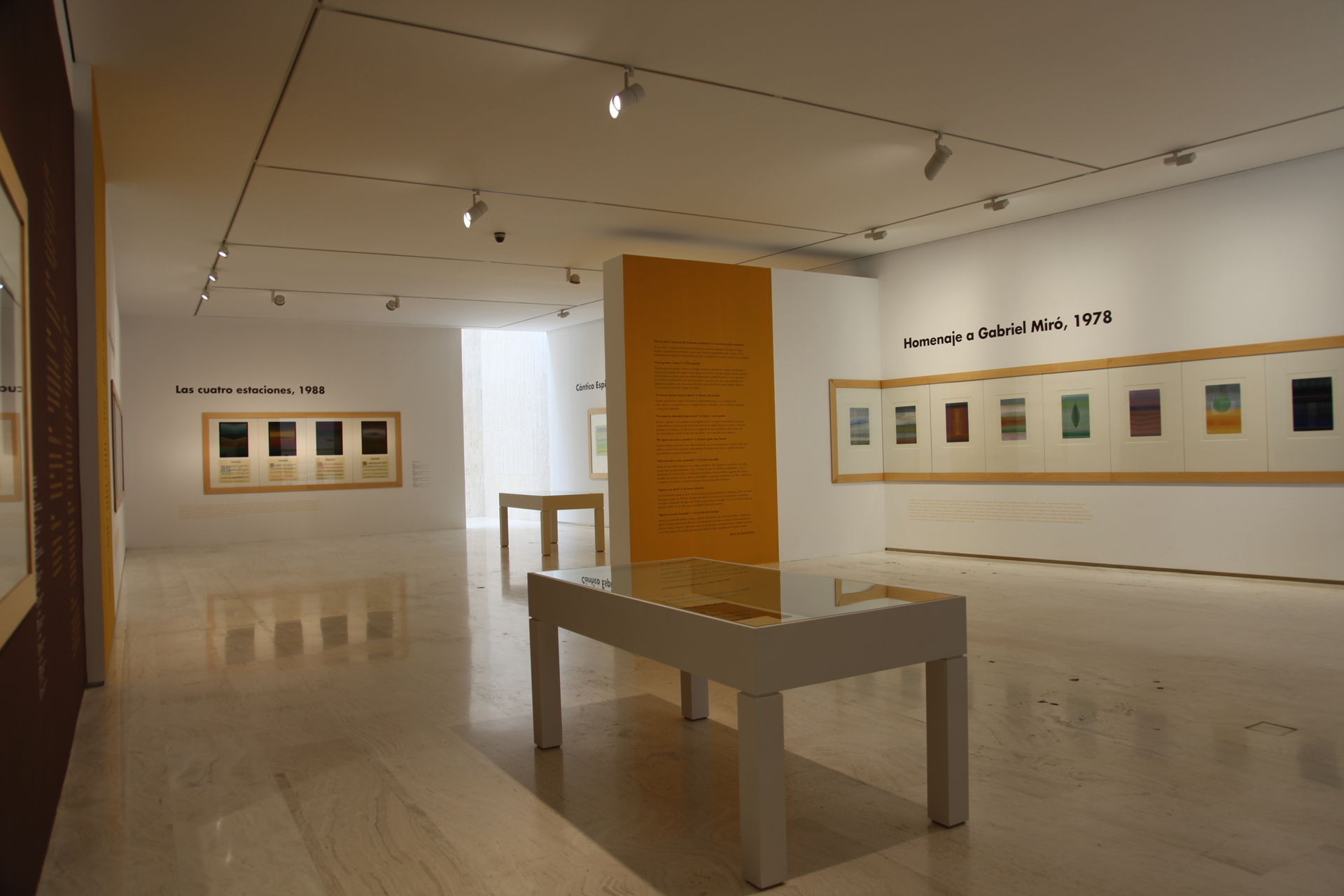
The Four Seasons of 1965 is the first portfolio of artistic silkscreens printed in Spain. It was 50 years ago and the presentation at the Juana Mordó Gallery became an unprecedented success with the public, critics, and sales. It was the beginning of one of the most important sets of graphic works created in twentieth-century Spain, that of artist Eusebio Sempere, exceptional both for its quality and its quantity. Approximately two hundred works among silkscreens, lithographs, and engravings, elaborated by hand in which the highest levels of meticulous perfection are achieved and sometimes, precious craftsmanship.

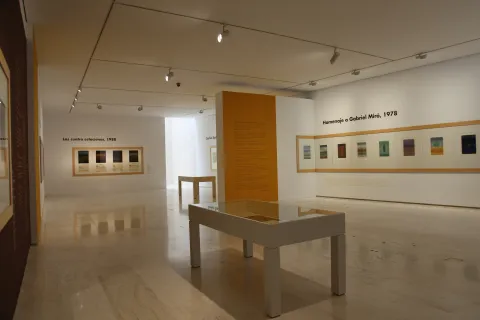
Nine portfolios of original silkscreens by Eusebio Sempere are presented, all printed by Abel Martín, as if it were a team effort, which trace the vital trajectory of both artists and demonstrate their joint artistic collaboration, the union and spiritual communication. Sempere would be the mind behind the forms and colors that Abel Martín, an excellent printer, then captured on paper through the superposition of silk screens, one for each of the colors used. Sometimes more than 40.

The Four Seasons of 1965, Nayar Album of 1967, Alarm Book, Transparency of Time or The Alhambra of 1977, Homage to Gabriel Miró of 1978, The Light of the Psalms of 1980, Spiritual Canticle of 1982 or the posthumous portfolio of The Four Seasons of 1988 that Abel Martín completed alone, combine the music of numbers that do not exist with the precise literature for each line.

All the portfolios are accompanied by literary texts, experimental, avant-garde, classical or mystical. Pedro Laín Entralgo, Julio Campal, José Miguel Ullán, Edmond Jabés, the Arab poets of Granada, Gabriel Miró, the biblical psalms or Saint John of the Cross presented in turn by Rafael Alberti, Gerardo Diego, Vicente Aleixandre, Juan Cantó or Vicente Aguilera Cerni, words kindled in the forms and colors that inspire souls with the desire to stay there and take a seat.


EXPO-0024
Imagen
Alt
Eusebio Sempere y Abel Martín.
Rosa María Castells
From February 2 to April 17, 2016. Valencia. Centro del Carmen. From April 5 to May 20, 2018 at the National Chalcography of the Royal Academy of Fine Arts of San Fernando. Madrid.