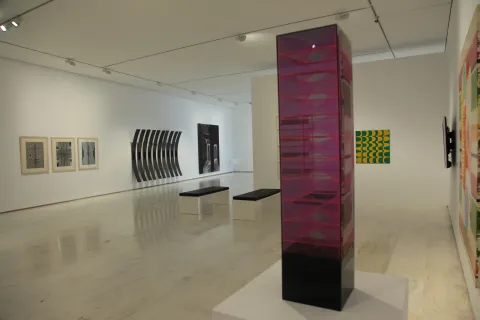
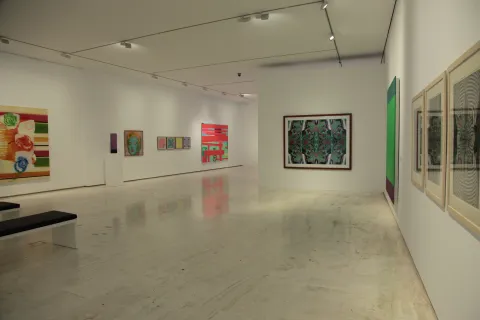
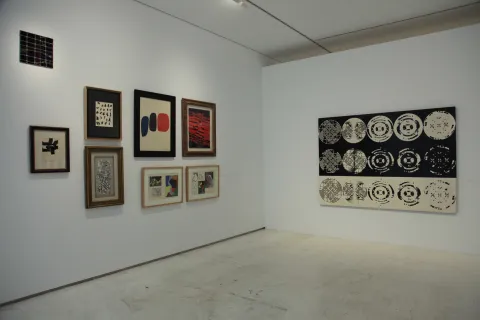
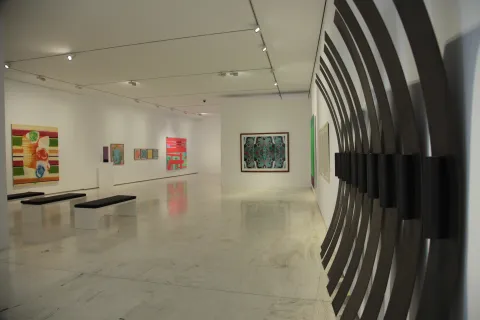
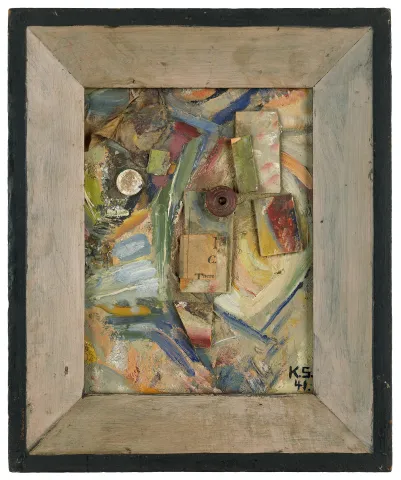
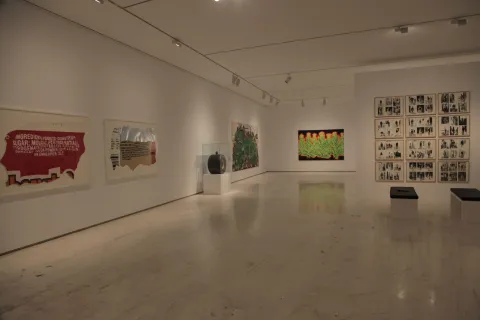
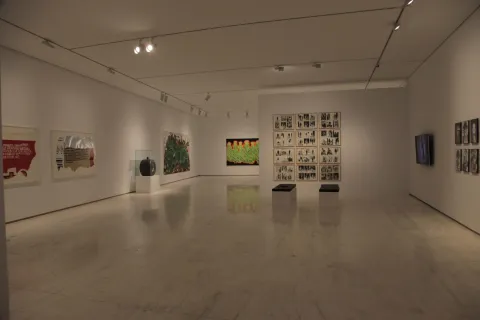
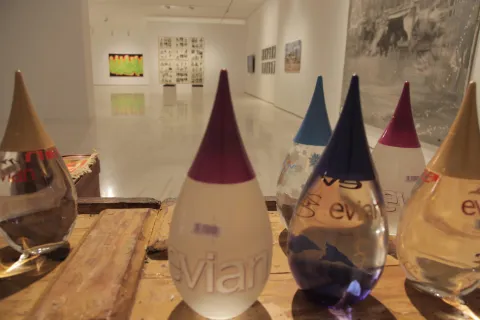
Over time 3

Submitted by brandcode_deweloper on
Mediterranean Foundation Collection

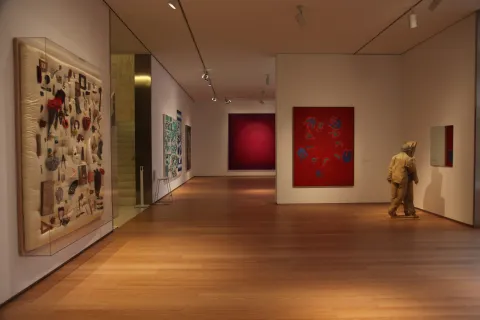
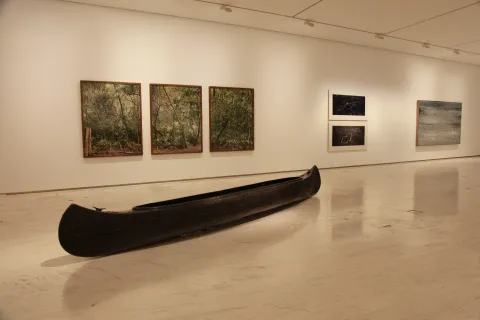
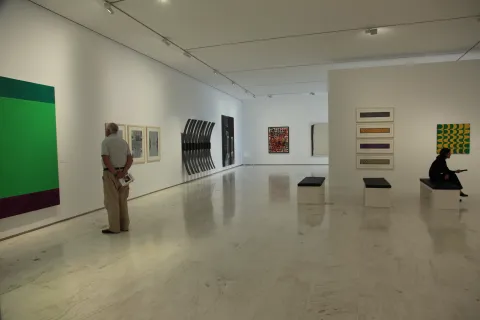
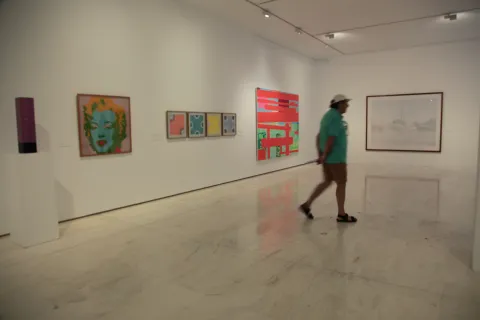
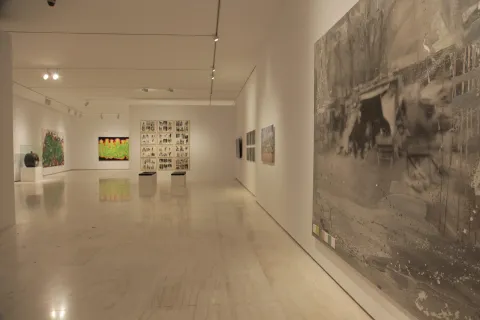
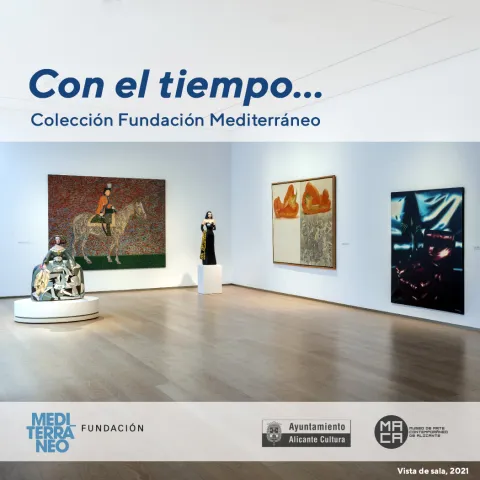
This exhibition showcases a selection of works from the Mediterranean Foundation Collection that is deposited in this Museum of Contemporary Art in Alicante thanks to the agreement signed between the City Council of Alicante and the Mediterranean Foundation.

The Mediterranean Foundation Collection consists of 212 pieces and covers the work of 125 artists, the most essential names in the contemporary Spanish art scene. It spans a chronological arc that runs from the democratic transition to the present day: an artistic period in Spain that corresponds to the last 40 years, so generous, filled with hope, energy, disenchantment, excess and naivety… but also with reflection, denunciation, commitment, adventure… A period in which several generations of artists coexist in a normalized way as had never happened before, enriching each other mutually, with the younger artists learning from the undisputed masters, and rediscovering in the younger generation the persistence of what is essential.

With time 3… wants to reflect on the contemporaneity of the works shown, beyond the historical references already known in the 20th Century Art Collection and what is to come. References that are linked to gesture and matter where the work is the process in a continuous search for the purest painting, the one that represents itself. But also with a generation of artists who will deeply review reality to address figuration from a thousand points of view. Or with the most essential ones, those who deal directly with the sublime in a stripping away of everything to find spirituality, the hidden breath of beauty.
EXPO-0035
Imagen
publicacion-instagram-02.jpg
Antoni Tàpies, Joan Brossa, Manuel Hérnández Mompó, Joan Hernández Pijoan, Equipo Crónica, Equipo Realidad, Eduardo Arroyo, Esther Ferrer, Jordi Teixidor, José María Yturralde, Soledad Sevilla, Carmen Calvo, Eva Lootz, Joan Cardells, Rafael Armengol, Juan Muñoz, Rogelio López Cuenca, José Manuel Broto, José María Sicilia, Miguel Ángel Campano, Miquel Barceló, Victoria Civera, Ángeles Marco, Juan Navarro, Antonio Murado, Prudencio Irazábal, Ferran García Sevilla y Pamen Pereira.
Rosa María Castells

Every Landscape is Fiction 2. Miquel Navarro

Submitted by brandcode_deweloper on
Mediterranean Foundation Collection

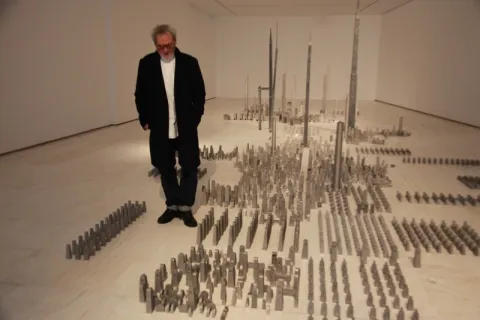
Every Landscape is Fiction 2 is a proposal for deepening the theme of landscape. If this first selection had the natural world as a reference for landscape, this second edition wants to show through a single piece and a single artist, Miquel Navarro, the world of the urban as a construction of contemporary landscape.

It is one of the most significant cities for the Valencian artist due to the dimension and presence that this Battle Space acquires. It was presented for the first time in 2002 at the Marlborough gallery in New York with great critical and public success. It was the artist's first individual exhibition in the New York capital and in it he wanted to pay homage to the city after the brutal attack on the Twin Towers on September 11. The center of the exhibition was this installation, Battle Space, composed of a series of aluminum and zinc sculptures of various forms and sizes that resemble a fantastic miniature city, half city, half cemetery. Navarro proposes that we perceive the city from above, like a tracking shot, on a scale that turns man into a giant.

The installation, fifteen meters long, seven meters wide, and two meters high, is composed of several series of geometric figures of small dimensions, organized in the form of blocks of houses, which could also be polished tombstones arranged in series in a cemetery. And it is completed with some large-scale elements that resemble New York skyscrapers. Approximately 2,500 pieces in total that, in rigorous arrangement, extend forming pure poetic creation between archaeology and modernity, a metaphor for destroyed civilization.

EXPO-0034
Imagen
IMG_9884.jpg
Miquel Navarro.
Rosa María Castells
Obras de la Colección Fundación Mediterráneo e IVAM.

Over time

Submitted by brandcode_deweloper on
Mediterranean Foundation Collection

This exhibition showcases a selection of works from the Mediterranean Foundation Collection that is deposited in this Museum of Contemporary Art in Alicante thanks to the agreement signed between the City Council of Alicante and the Mediterranean Foundation.

The Mediterranean Foundation Collection consists of 212 pieces and covers the work of 125 artists, the most essential names in the contemporary Spanish art scene. It spans a chronological arc that runs from the democratic transition to the present day: an artistic period in Spain that corresponds to the last 40 years, so generous, filled with hope, energy, disenchantment, excess and naivety… but also with reflection, denunciation, commitment, adventure… A period in which several generations of artists coexist in a normalized way as had never happened before, enriching each other mutually, with the younger artists learning from the undisputed masters, and rediscovering in the younger generation the persistence of what is essential.

EXPO-0033
Imagen
IMG_3597.jpg
Rafael Luis Armengol, Eduardo Arroyo, Miquel Barceló, José Manuel Broto, Carmen Calvo, Ferrán García Sevilla, Curro González, Luis Gordillo, Xavier Grau, Joan Hernández Pijuán, Prudencio Irazábal, Ángeles Marco, Juan Muñoz, Juan Navarro, Jaume Plensa, Santiago Segura, Soledad Sevilla, José María Sicilia, Amparo Tormo, Juan Uslé y José María Yturralde.
Rosa María Castells

Every landscape is fiction

Submitted by brandcode_deweloper on
Mediterranean Foundation Collection

The representation of landscape in painting constitutes a classical genre that originated in bourgeois Holland in the seventeenth century, immediately enjoying success. Cultivated or man-dominated natures, seascapes, panoramic vedute of the settecento, sublime landscapes of romanticism, tormented, dreamed, existing or real… Landscape has been a way of expressing man's position in the world. It is a genre so deeply rooted in classical tradition that it reveals itself as one of the most fertile and productive fields of investigation in contemporary art.
Landscape is not the nature or place that is observed but what is constructed from these, a cultural construction for which interpretation is necessary. Landscape is constructed at the very moment it is observed. It only exists through sight and thought. And one must observe both the visible and the invisible.

Furthermore, far from that ancient dichotomy between nature and city, today the territory is hybrid, discontinuously urbanized, transformed by man who thus adopts a position before nature. Intermediate spaces, wastelands, demolished, reconstructed, inert, in which it is difficult to hear silence. The theoretical debate has been charged with new meanings, it has been subverted. The semantic enrichment of the genre is perceived in the interest of all artists and all techniques.

Every Landscape is Fiction brings together a series of works that share the common goal of reflecting on landscape and its contemporary representation. A broad selection of artists who from different perspectives and through diverse techniques have given landscape a leading role in their works. Paintings, sculptures, drawings, photographs, installations and videos make up this exhibition as we interpret landscape subjectively, while generating social awareness, concern for man's intervention, discovering the past, speaking of lived time, of the people who inhabited, of the memory of the place… All of this while we long for the lost paradise,

EXPO-0032
Imagen
IMG_5094.jpg
/sites/default/files/inline-images/resources/exposiciones/EXPO-0032/IMG_7598-scaled_7.jpg
Carmen Calvo, Javier Codesal, Patricia Dauder, Susy Gómez, Lluis Hortalà, Mireya Masó, José María Mellado, Antonio Murado, Jesús Pastor, Perejaume, Xavier Ribas, Montserrat Soto y Javier Vallhonrat.
Rosa María Castells
Con la colaboración de la Fundación Caja Mediterráneo, la Diputación de Alicante y el Consorcio de Museos de la Generalitat.

Heterotopias

Submitted by brandcode_deweloper on
CIRCA XX Collection of the IAACC Pablo Serrano Museum in Zaragoza

The set of works that make up the CIRCA XX Collection was acquired by the Government of Aragon from its owner Pilar Citoler at the end of 2013, through a mixed formula that included purchase and donation. Since then it has been assigned as part of the permanent collection fund of the IAACC Pablo Serrano in Zaragoza for its custody and exhibition. A set of 1200 works that includes paintings, drawings, graphic works, photography, sculpture, installations and video, which has become one of the reference collections in the national and international panorama. 

This selection of works is titled Heterotopias, a neologism coined in 1967 by French philosopher Michel Foucault, which he constructed from the Greek words "heteros" (different) and "topos" (place), as a denunciation of history's interest only in time. The concept of Heterotopia claims the contemporary world par excellence, an era where space is heterogeneous, simultaneous, juxtaposed where the near and the far coexist, one beside the other and the dispersed; where we find those "other places" in which elements distributed through time form a set of relationships, a map of networks and synergies, a fatal intertwining of time with space. 

Through transgenerational connections we propose a reading without chronology. Only to look. Early artists linked with artistic avant-gardes that seek the essence of forms by banishing the superfluous and retracing the path until reaching the origin, the foundation of forms to be witnesses of the conjugations of black and the dissipations of transparency. Other artists experiment with color and geometry: formal logic and constructive tradition are combined with computation and new technologies proposing visual games, concrete optical effects, dynamic, as virtual as perceptible subjected to a frenetic rhythm established by the repetition and interaction of colors. And transforming perception, placing emphasis both on what is seen and what is suggested, later artists announce cold and distant environments subjected to the very fact of seeing or not seeing, dazzled by color or by its absence, crossed by a blinding light close to invisibility that constructs a mental state in permanent blur, an artificial atmosphere that captures the abstraction of reality. The Heterotopias constructed in real time and space are the places where utopias are fulfilled. 

EXPO-0031
Imagen
IMG_4080.jpg
/sites/default/files/inline-images/resources/exposiciones/EXPO-0031/folleto-cast_8.pdf
Henri Michaux, Alexander Calder, Jean Dubuffet, Equipo 57, Eusebio Sempere, Eduardo Chillida, Pablo Palazuelo, Erwin Bechtold, Ellsworth Kelly, Cristina Iglesias, Elena Asins, Pilar Urbano, Atsuko Tanaka, Luis Gordillo, Sol Lewitt, David Nash, Tomás García Asensio, Don Kunkel, Francisco Sobrino, Alex Haas, Rosa Brun, Andy Warhol, Mitsuo Miura, Felicidad Moreno, José Ramón Amondarain, José Manuel Ballester, Paul Graham, Mayte Vieta, Chema Alvargonzález y Edward Ruscha.
Rosa María Castells

Context avant-garde 2. Kurt Schwitters

Submitted by brandcode_deweloper on
IVAM Collection of Valencia

The MACA presents the second exhibition within the "Contexto vanguardias" program with two works by Kurt Schwitters. This program aims to maintain a permanent dialogue between the works in the IVAM collection belonging to the avant-gardes of the first decades of the twentieth century and the works of the Twentieth Century Art Collection, so that complementary readings are established, transversal perspectives, support and context for some pieces that, in communication with others, strengthen their language and message and complete the vision of a fundamental era of modernity that travels paths between tradition and the new. Doing it at the MACA, in Alicante, alongside the same works from the Twentieth Century Art Collection will allow visitors to enjoy works never before seen in the city and are references in art history that are part of the excellent collections of the institution you direct.

This second exhibition consists of a set of two works by Kurt Schwitters, one of the most radical artists in the twentieth-century artistic panorama, being the continuation of the previous "Contexto Vanguardias" and which will coexist in the first room of the museum alongside his contemporaries Julio González, Pablo Gargallo and Juan Gris.

The Artist

German artist Kurt Schwitters (Hanover, 1887 – Ambleside, United Kingdom, 1948) was one of the main and most influential protagonists of the Dada movement. In 1919 he constructed his first collages and assemblages with waste materials, which he would call Merz, turning them into a symbol of a world in ruins. He created multidisciplinary art, free from traditional artistic conventions, and Merz would give its name to his poems, his magazine, his theater and his collages or sculptural constructions.

He abandoned his architectural studies in his native city to move to Dresden, where he visited the Kunstakademie with the purpose of becoming a painter. After some beginnings linked to impressionism and somewhat later to expressionism, in 1918 he exhibited his first works in the cubist-futurist style at the Der Sturm gallery in Berlin. A year later he constructed his first collages and assemblages with waste materials, which he would call Merz, a name derived from the fortuitous mutilation of the word Kommerz, which he had used in one of his collages. Merz would become synonymous with the new multidisciplinary art he would create from then on, free from traditional artistic conventions and which would give its name to his poems, his magazine, his theater and his sculptural-architectural constructions (Merzbau). He himself would define this artistic process as a consequence of the historical moment in which he had lived: "The Great War has ended, in a way the world is in ruins, so I gather its fragments and build a new reality".

His work was banned by the Nazi authorities upon their rise to power in 1933 and included in the lists of "degenerate art". Upon learning that he was being sought by the Gestapo, he went into exile in Norway in January 1937, leaving his wife Helma in Germany. After the Nazi invasion of the Nordic country, he fled by ship to Edinburgh. In the United Kingdom he was considered a foreign enemy and went through several internment camps, finally ending up in the Hutchison Camp on the Isle of Man. Once released, he went through London and, after the war ended, moved to the Lake District in northern England. In October 1946 he broke a leg after a fall from which he would never recover. He died in Kendal on January 8, 1948; two days later he was informed by letter that he had been granted British citizenship.

EXPO-0030
Imagen
00785-1-1.jpg
Kurt Schwitters
Rosa María Castells

Spaces of Resistance

Submitted by brandcode_deweloper on
Mediterranean Foundation Collection

Spaces of Resistance brings together a series of works that share the common goal of seeking critical spectators. Questioning social and political reality, consumer society, the media, advertising, the city, public space, and the presence of power and its mechanisms of social inclusion and exclusion, these artists present uncomfortable, acerbic, provocative works… A cross-cutting proposal where the artistic creation process becomes the work itself or constructs and deconstructs a fragmentary reality. 

Through new formats, languages, media, and contemporary techniques—video, photography, installation, computer programs, or even traditional painting—the works displayed always demand an active and committed spectator. Heirs to the conceptual practices developed in Spain, especially in Catalonia and Andalusia in the 1960s and 1970s, and with a strong linguistic charge, these works draw a landscape of transgression of artistic behaviors that goes so far as to dematerialize art or construct it with archives, documents, image fragments, everyday objects, poor materials such as dust or cigarette butts, strange trinkets that acquire other meanings.

Art functions thus as resistance. Artists contemplate their creative process solely from the perspective of social transcendence, from confrontation with power, but also from paradox, humor, or irony. Art as denunciation but also as a way of changing the world. Artistic practice becomes the only weapon of survival. 

EXPO-0029
Imagen
IMG_7598-scaled.jpg
/sites/default/files/inline-images/resources/exposiciones/EXPO-0029/Triptico-castellano_8.pdf
Antoni Abad, Joan Brossa, Dionisio González, Federico Guzmán, Rogelio López Cuenca, Pedro Mora, Ester Partegás, Carlos Pazos, Antoni Muntadas, Pedro G. Romero, Francesc Torres, Juan Ugalde y Eulalia Valldosera.
Rosa María Castells

Paloma Navares: The Garden of Memory

Submitted by brandcode_deweloper on

Paloma Navares is a pioneer in art created by women. Her work, classified by stages and series, responds to various research processes in which she investigates social themes, delves into the world of women, their rituals, customs and traditions. Her plastic language is constructed from the idea of hybridity and sustained, from its inception, in interdisciplinary practice, the assembly of techniques and supports, and the use of industrial materials. Photography, video, sound and light are unified in her installations, sculptures, objects or collages.

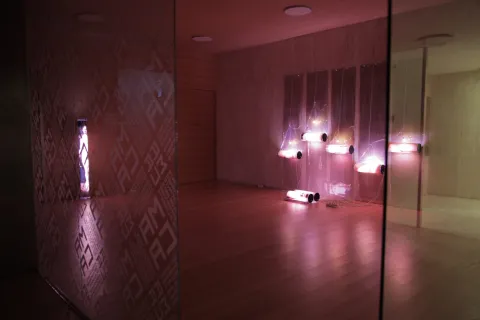
The works deposited and exhibited at the MACA are the installation On the Threshold of Dream, 1992-93 and Eva, a sculpture of photography and light.

These are works in which the artist works with photography, video, sound, electricity, industrial materials such as plastics, integrating the work with space and light. In the assembly, fractioned images are presented, adapted to cylindrical and transparent flat supports, all of them united to energy.

The two works belong to a series titled Fragments of the Garden of Memory where the artist integrates photography, electricity and industrial materials such as plastic, with video and sound recordings, creating and elaborating scenarios, stagings that provoke emotions full of strength by combining the effects of light and shadow with spatial interactions and iconographic resonances. Not in vain, Paloma Navares uses images from classical painting to deconstruct the stereotyped myth of woman.

EXPO-0028
Imagen
imagen-paloma-navares-web.jpg
/sites/default/files/inline-images/resources/exposiciones/EXPO-0028/hoja-sala-jardin_8.pdf
Paloma Navares
Rosa María Castells

Guest piece. Telekinetic sculpture by TAKIS

Submitted by brandcode_deweloper on
Deposit at the MACA

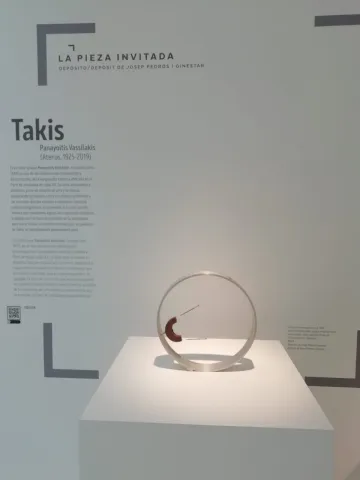
The MACA presents its fifteenth work within the program of The Invited Piece. It is "Electromagnetic Sculpture," from 1960 in chromated steel, magnet, needles and nylon thread by Greek sculptor Panayoitis Vassilakis, known as TAKIS and coming from the private collection of artist Josep Pedrós i Ginestar who was Takis' personal assistant in Paris.

Takis is one of the most interesting and unknown artists of the kinetic avant-garde established in mid-twentieth century Paris. His work, innovative and dynamic, relates art and science, exploring the relationship between ordinary objects and the energies that move and control them, such as magnetic fields, gravity, light and sound. Magnets that keep needles in suspension while working with the invisible forces of nature to make visible an invisible world that, in Takis' words, is simply pure thought.

The artist:

His works are found in the permanent collections of some of the most important museums in the world, such as the Centre Pompidou for Contemporary Art in Paris, the MOMA and the Guggenheim Museum in New York, the De Menil Collection in Houston, the Tate Modern in London and the Peggy Guggenheim Collection in Venice.

In 1986, the artist returned to Greece where he established the Research Center for the Arts and Sciences—known as the Takis Foundation on the hill of Gerovouno in Athens. The Foundation was officially inaugurated in 1993, with the objective of promoting knowledge and appreciation of the visual arts to the general public, as well as providing services and supporting art education programs.

The Invited Piece program:

With this exhibition program The Invited Piece, the MACA aims to bring to the public works temporarily loaned by other institutions and which in the Museum acquire a new meaning, by being presented as an exhibition of a single work in relation to the context of the permanent collection. The Twentieth Century Art Collection allows, through the extensive list of artists, the variety of historical works and the numerous aesthetic moments that are represented, an enriching program of invitations. Specific works that, in dialogue, discussion, contiguity or contradiction, are shown immersed within the museum's exhibition context.

Since its inception in 2011 to date, the MACA has exhibited 15 invited pieces.

EXPO-0027
Imagen
WhatsApp-Image-2022-12-02-at-13.31.49.jpeg
Takis (Panagiotis Vassilakis)
Rosa María Castells

María Aranguren: Station Stop

Submitted by brandcode_deweloper on
Tribute to Eusebio Sempere

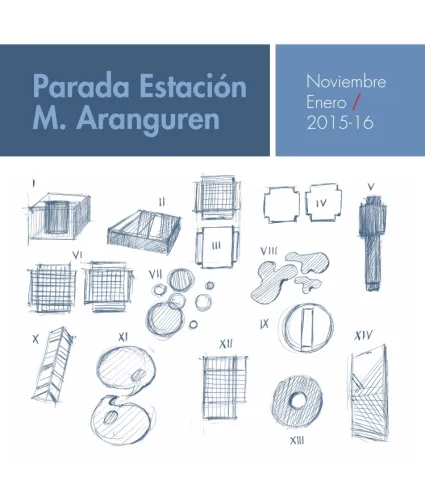
"Parada Estación" is an installation by María Aranguren that pays tribute to Eusebio Sempere and is part of the set of activities that the Alicante City Council and the MACA have programmed on the occasion of the 30th anniversary of the artist's death.

"Parada Estación" marks a route, through fourteen small polycarbonate pieces on the street, that leads the pedestrian from Plaza de la Santa Faz to the MACA. Fourteen "Stations" in places chosen by the artist between the first two stations of the Via Crucis of the Santa Faz: the fountain, the Palace, Portaferrisa, the Maldonado curve, the Heliodoro Guillén alley…

In the search for or discovery of these enclaves, aesthetic and conceptual relationships are established that encourage a different perspective on the walls and facades of this singular neighborhood and guide visitors toward the entrance of the MACA, where a large tribute piece, inspired by Sempere's work, closes the route.

EXPO-0026
Imagen
aranguren-es1.jpg
/sites/default/files/inline-images/resources/exposiciones/EXPO-0026/IpticoCastellano_8.pdf
María Aranguren
Rosa María Castells